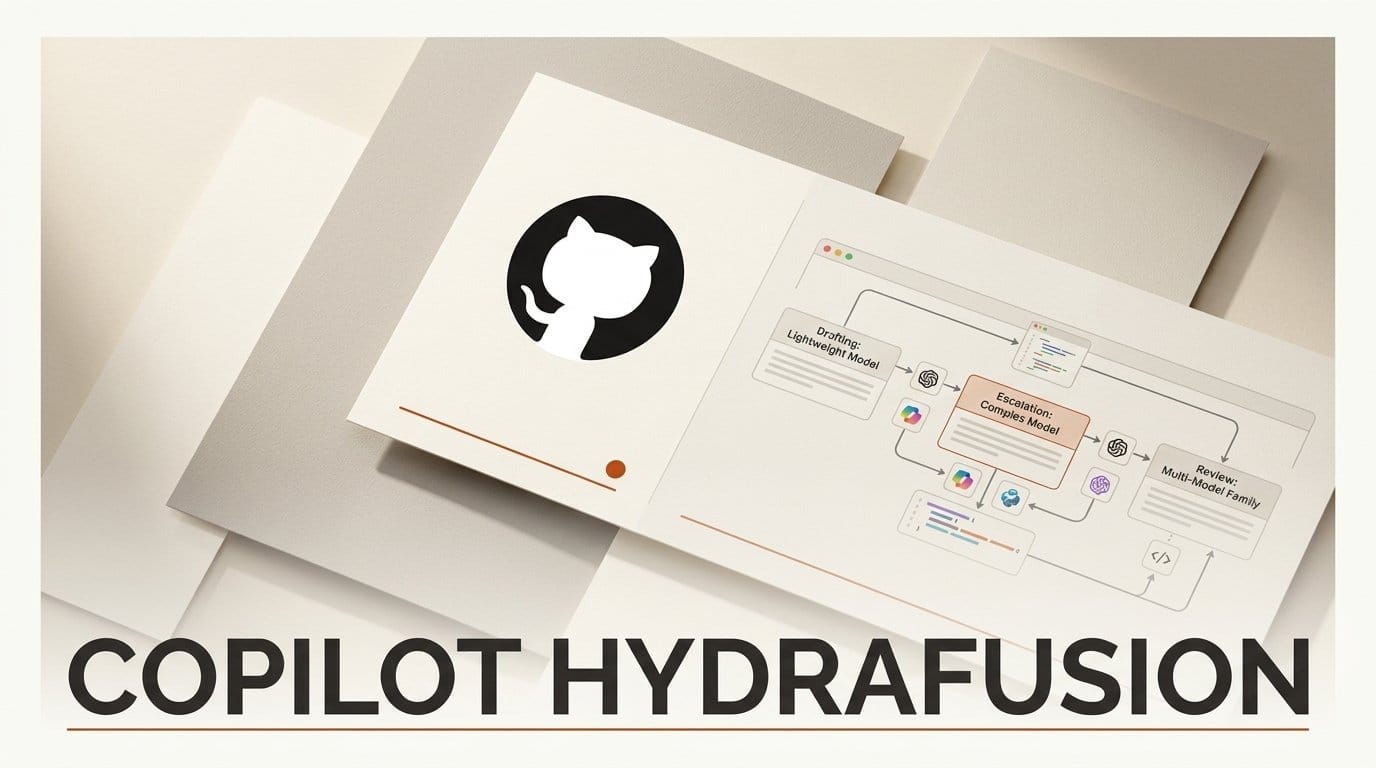
GitHub has put a new idea in front of every Copilot user: stop picking a model, and let a router pick several for you. Project HydraFusion, launched on September 4, 2026 as a research preview, is an orchestration layer that chooses and combines multiple AI models at runtime to solve a coding task. Instead of committing your whole workflow to one model, HydraFusion drafts with an efficient model, escalates to a stronger one when the work is hard, and brings in a second model family to review the result. GitHub's headline claim is that this beats single-model setups on both quality and cost, cutting spend up to 67 percent on one benchmark while matching or exceeding Claude Opus 5.
Background
For two years the standard advice for coding with AI was to pick the strongest model you could afford and route everything through it. That works, but it is wasteful. Most coding turns are simple edits, renames, or small refactors that a fast, cheap model handles perfectly. A minority are genuinely hard: multi-file changes, tricky concurrency bugs, tests that keep failing. Paying frontier prices for every turn means overspending on the easy 80 percent to cover the hard 20 percent.
HydraFusion is GitHub's answer to that mismatch. It runs inside the Copilot CLI as a selectable model, and it treats "which model should answer this" as a routing decision made per task rather than a setting you choose once. The pitch is not a new frontier model. It is a smarter way to spend the models that already exist.

How HydraFusion Works
HydraFusion runs one of three orchestration strategies depending on the task in front of it. The strategies map cleanly to how an experienced engineer already thinks about effort.
Single. One selected model solves the task directly. This is the baseline for straightforward work where escalation would only add cost and latency.
Cascade. An efficient model drafts a solution first, then a quality gate decides whether to accept the draft or escalate to a stronger model. Easy turns finish cheaply; hard turns get promoted only when the gate is not satisfied.
Critique. One model drafts a result, an independent critic from a different model family reviews it, and the original model revises once. Using a second family for review is the interesting part: models tend to share blind spots within a family, so a cross-family critic catches mistakes a same-family reviewer would wave through.
The design borrows directly from multi-agent research, where draft-critique-revise loops and confidence-gated escalation are well studied. What is new is that GitHub is shipping it as a default-friendly product feature rather than a framework you have to assemble yourself. Early testers have been feeding notes into a public community feedback discussion, and a principal engineer on the project said the reasoning and task-solving capability is "at or better than Opus."

The Numbers: Cost and Quality Versus Opus 5
GitHub benchmarked HydraFusion against Claude Opus 5 across three coding evaluations. The results show the pattern you would want from a router: large cost savings with quality that holds steady or improves.
| Benchmark | Cost versus Opus 5 | Quality change |
|---|---|---|
| TerminalBench 2.1 | 67 percent lower | +4.9 points |
| DeepSWE | 36 percent lower | -1.5 points |
| CheckpointBench | 65 percent lower | -0.1 points |
On TerminalBench 2.1, HydraFusion was both cheaper and better, a rare combination. On DeepSWE and CheckpointBench it traded a fraction of a quality point for cost reductions between a third and two-thirds. For teams running Copilot at scale, a 36 to 67 percent reduction on model spend with near-flat quality is a straightforward win. Pricing follows usage: you pay for the tokens the underlying models consume, priced at each model's standard rate, so the savings come from routing cheaper models to easy work rather than from a discount.
The cost story echoes the broader price pressure across frontier coding models this year. Our coverage of the recent Sol and Opus API price cuts traced how the per-token race is squeezing margins; HydraFusion attacks the same problem from the orchestration side instead of the sticker-price side.

What It Means for Builders
If you build software with AI, HydraFusion changes the default question from "which model is best" to "which model is best for this turn." That is the right question, and until now answering it meant wiring your own routing logic or paying a middleware layer to do it. Having orchestration baked into the Copilot CLI removes that overhead for the people who feel model cost most: solo builders shipping side projects, small teams watching a monthly bill, and anyone running long agentic sessions where token spend compounds.
It also lowers the stakes of model choice. You no longer have to guess whether a task is worth Opus-tier pricing before you start. The cascade gate makes that call mid-run, so you get frontier quality on the hard turns without paying for it on the easy ones. Builders already comfortable with self-hosted or infrastructure-level control, like the teams using Cursor's self-hosted cloud agents, will recognize the trade: give up a little manual control, get back cost efficiency and less babysitting.
HydraFusion also fits alongside the rest of the Copilot CLI's agent tooling rather than replacing it. Features like the CLI's rubber duck planning mode still handle how you scope and reason about a change; HydraFusion handles which models execute it. The two are complementary, and using them together is where the workflow gains compound: plan carefully, then let the router spend your model budget where it counts.
The honest caveat is that this is a research preview. Routing adds moving parts, and cross-family critique means your task can touch several vendors' models in one turn, which matters if you have data-governance constraints. Watch for how GitHub graduates HydraFusion out of preview, whether it exposes the model pool, and whether the routing gates become tunable. Treat it as a promising default to test on real work, not a production guarantee.
Frequently asked questions
What is Project HydraFusion?
It is a GitHub Copilot research-preview feature that orchestrates multiple AI models at runtime to solve a coding task, choosing between a single model, a draft-and-escalate cascade, or a cross-family critique loop instead of relying on one fixed model.
How do I turn on HydraFusion?
In the GitHub Copilot CLI, run /update to get the latest version, then /experimental on, then /model and select "HydraFusion (Research Preview)." It is available to users on all Copilot plans through the experimental flag.
How much does HydraFusion cost?
Usage is billed by the tokens the underlying models consume, each at its standard rate. There is no separate HydraFusion fee; the savings come from routing cheaper models to easier work.
Is HydraFusion better than Claude Opus 5?
On TerminalBench 2.1 it was 67 percent cheaper and 4.9 points higher quality. On DeepSWE and CheckpointBench it was 36 to 65 percent cheaper with quality within about 1.5 points of Opus 5, so it is competitive on quality and clearly ahead on cost.
Which models does HydraFusion use?
GitHub has not published the exact model pool. It routes across multiple models and uses a critic from a different model family than the drafter, and it benchmarks against Claude Opus 5 and GPT-5.6 Sol as baselines.