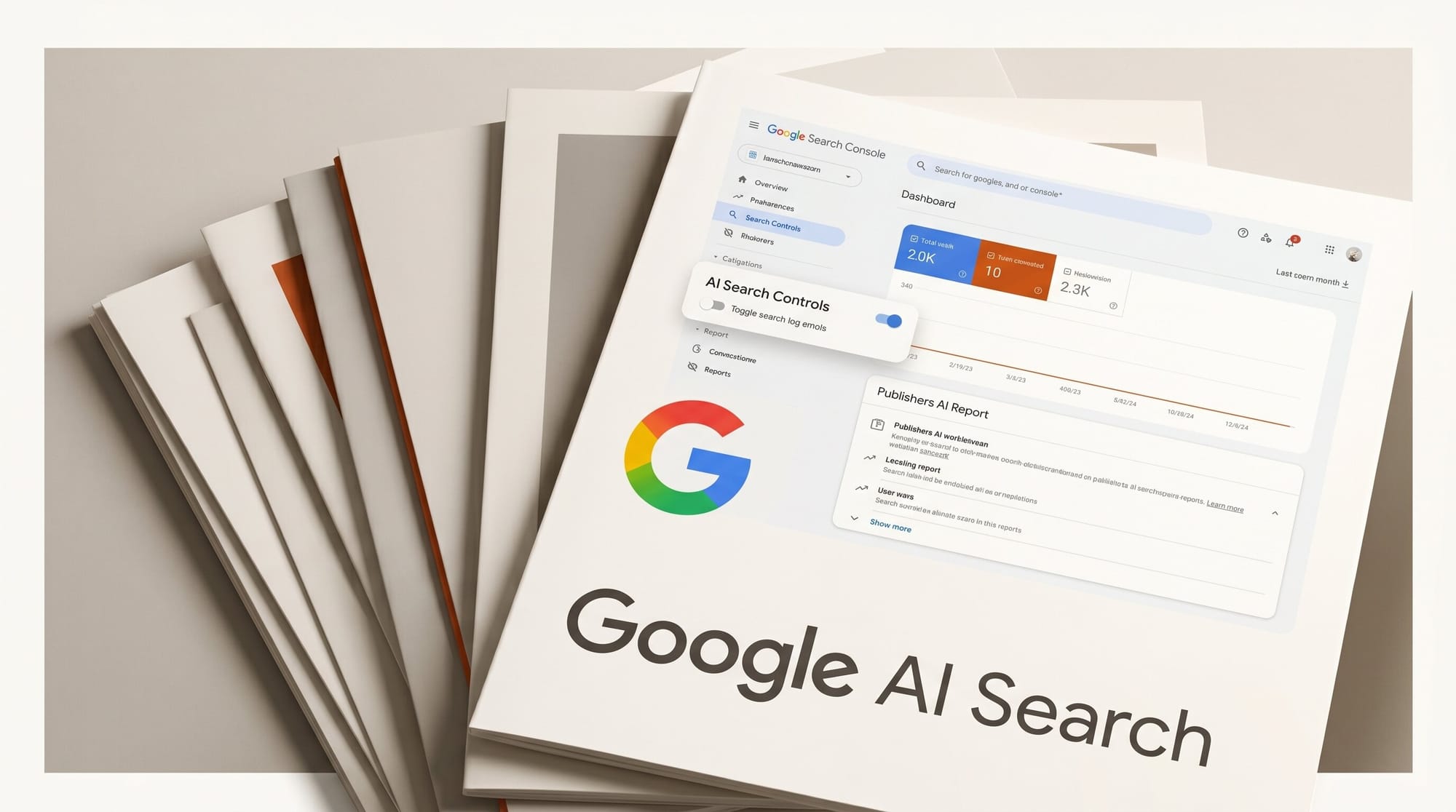
Google launched two significant tools for publishers on June 3, 2026: a new Generative AI Performance Report in Search Console and controls allowing site owners to opt out of AI-generated search features. The announcements follow a binding ruling from the UK's Competition and Markets Authority requiring Google to give publishers independent control over how their content is used in AI search products, without forcing them to abandon standard search visibility.
What Happened
The UK CMA announced on June 3 that Google must allow publishers to opt out of AI Overviews and AI Mode without abandoning Google Search entirely. The ruling is described as a world first: publishers can withdraw their content from AI-powered answers while keeping their standard search rankings intact. Google has nine months to implement the full set of changes and must publish compliance reports every six months in the first year.

"With features like AI Overviews rapidly reshaping online search, it is crucial that content publishers have appropriate bargaining power over how their content is used," said CMA Chief Executive Sarah Cardell.
Google confirmed it is already rolling out early controls to a subset of UK website owners. The company also launched the AI Performance Reports simultaneously, giving publishers their first dedicated view of AI search visibility data.
The New AI Performance Reports in Search Console
The Generative AI Performance Report gives website owners a dedicated view of how their content performs inside AI-powered features, separate from standard Search Console analytics. The report currently covers five dimensions:
- Impressions: How many times your URLs appeared within AI Overviews or AI Mode responses
- Pages: Which specific URLs are appearing in AI-generated results
- Countries: Geographic breakdown of AI search visibility
- Devices: Desktop vs. mobile patterns for AI results
- Dates: Performance over time, with hourly, daily, weekly, and monthly granularity
One significant limitation: the report does not include click data. Google tracks impressions only, meaning you can see how often your content appears in AI results but not whether users follow links to your site. The company has not confirmed when click tracking will be added.
The rollout is starting with a subset of UK website owners before expanding globally. Not every account will see the report immediately after launch.
Opt-Out Controls: What Publishers Can Block
Google is testing a new controls panel in Search Console that lets publishers manage content usage at a granular level. The controls are more detailed than a simple on/off switch. Publishers can independently opt out of:
| Control | What It Covers | Scope |
|---|---|---|
| AI Overviews grounding | Stops content from informing AI-generated answers in Search | Domain or page level |
| AI Mode grounding | Blocks content from Google's dedicated AI search mode | Domain or page level |
| AI model fine-tuning | Prevents content from training or fine-tuning Google AI models | Domain level |
| Discover AI features | Controls visibility in AI-powered Discover recommendations | Domain level |
Under the CMA ruling, Google is prohibited from penalizing publishers who opt out. Using any of these controls cannot reduce standard search rankings. The Search Engine Land analysis of the announcement confirms that Google has committed to this non-retaliation guarantee as a binding legal obligation.
What the CMA Ruling Means for Publishers
The ruling emerged from the CMA's investigation into Google's dominant position in UK search. Before June 3, publishers faced a binary choice: allow Google to use their content in AI features, or block all Google crawlers and lose their entire search presence. That was not a realistic option for sites dependent on organic traffic.

The new framework separates three previously bundled permissions:
- Standard search indexing (unchanged, remains default)
- AI feature grounding (now separately controllable)
- AI model fine-tuning (now separately controllable)
VideoWeek reported that publishers were particularly concerned by the fine-tuning provision, since it meant Google could train future models on their content even after they had blocked grounding. The CMA ruling addresses this gap directly. Google must now offer both opt-outs as independent controls.
The nine-month implementation deadline means full controls should be available globally by early March 2027. However, Google has stated it expects important parts to roll out well before that deadline.
How to Access the New Controls
The features are in limited rollout as of June 3, 2026. Access path for eligible accounts:
- Log in to Google Search Console
- Select your verified property
- Look for "Generative AI" under the Performance section in the left navigation
- The AI Performance Report shows impressions by page, country, device, and date
- For opt-out controls, navigate to Settings and look for the AI content controls panel
If you do not see either feature, your account is not in the current test group. Google's blog post confirms a phased rollout with no firm date for universal availability outside the UK.
What Creators and Publishers Should Do Now
Even without immediate access, there are concrete steps to take. First, check whether you have access to the AI Performance Report in Search Console. If you do, benchmark your current AI impressions before making any opt-out decisions. That baseline data will be essential for measuring the impact of any changes later.

Before opting out of grounding, evaluate your traffic model. For sites that generate revenue from affiliate links or ads driven by AI-sourced clicks, opting out may reduce visibility without improving income. For sites that rely on authority, direct relationships, or subscription revenue, opting out may protect long-term content value.
The fine-tuning opt-out is the clearest early action for most publishers: it carries no current traffic cost and limits a future commercial use of your content that you have not agreed to. Enable it as soon as it appears in your account.
For site owners who have already added GPTBot or Google-Extended blocks via robots.txt, the new Search Console controls offer a more surgical alternative. You can keep standard Google indexing while blocking AI-specific uses through the UI controls, without maintaining separate robots.txt rules for every AI agent.
For broader context on how AI tools are treating publisher content in 2026, see the current breakdown in Best AI Tools for Designers 2026.
Frequently Asked Questions
Does opting out of AI Overviews affect my standard search rankings?
No. Under the CMA ruling, Google is explicitly prohibited from demoting sites in standard search results because of their AI opt-out choices. This is a binding legal commitment enforced by a UK regulatory body, not a voluntary policy Google can change unilaterally.
Can I opt out of AI features for specific pages rather than my whole site?
Yes, for grounding controls. The CMA ruling specifies that publishers can manage opt-outs at both domain and page level, giving editorial control over which content to protect. The fine-tuning opt-out applies at the domain level only.
What is the difference between grounding and fine-tuning in this context?
Grounding is real-time use: Google uses your content to inform the answer it generates for a user's query right now. Fine-tuning is training use: Google uses your content to improve the underlying AI model itself, permanently. The new controls let you block either or both independently.
Why is the rollout starting only in the UK?
The CMA ruling is a UK regulatory order. Google is implementing controls there first to comply with the legal deadline. The company has confirmed plans to expand globally, but has not given a timeline for markets outside the UK.
Will I be able to see how much traffic AI Overviews are sending me?
The current AI Performance Report tracks impressions only, not clicks. This tells you how often your content appears in AI results, but not how many users click through to your site. Google has not announced a timeline for adding click data.
How does this affect existing robots.txt AI blocking directives?
The Search Console controls operate separately from robots.txt. Existing directives remain in effect. If you have GPTBot or Google-Extended blocks in place, those continue to apply. The new controls are an additional layer through the Search Console UI, focused on grounding and fine-tuning within Google's own AI products specifically.
What happens if Google fails to comply within the nine-month deadline?
The CMA ruling requires Google to submit compliance reports every six months for the first year, giving the regulator visibility into implementation progress. The CMA retains enforcement authority over the UK search market investigation, which includes the ability to impose further remedies if commitments are not met on schedule.