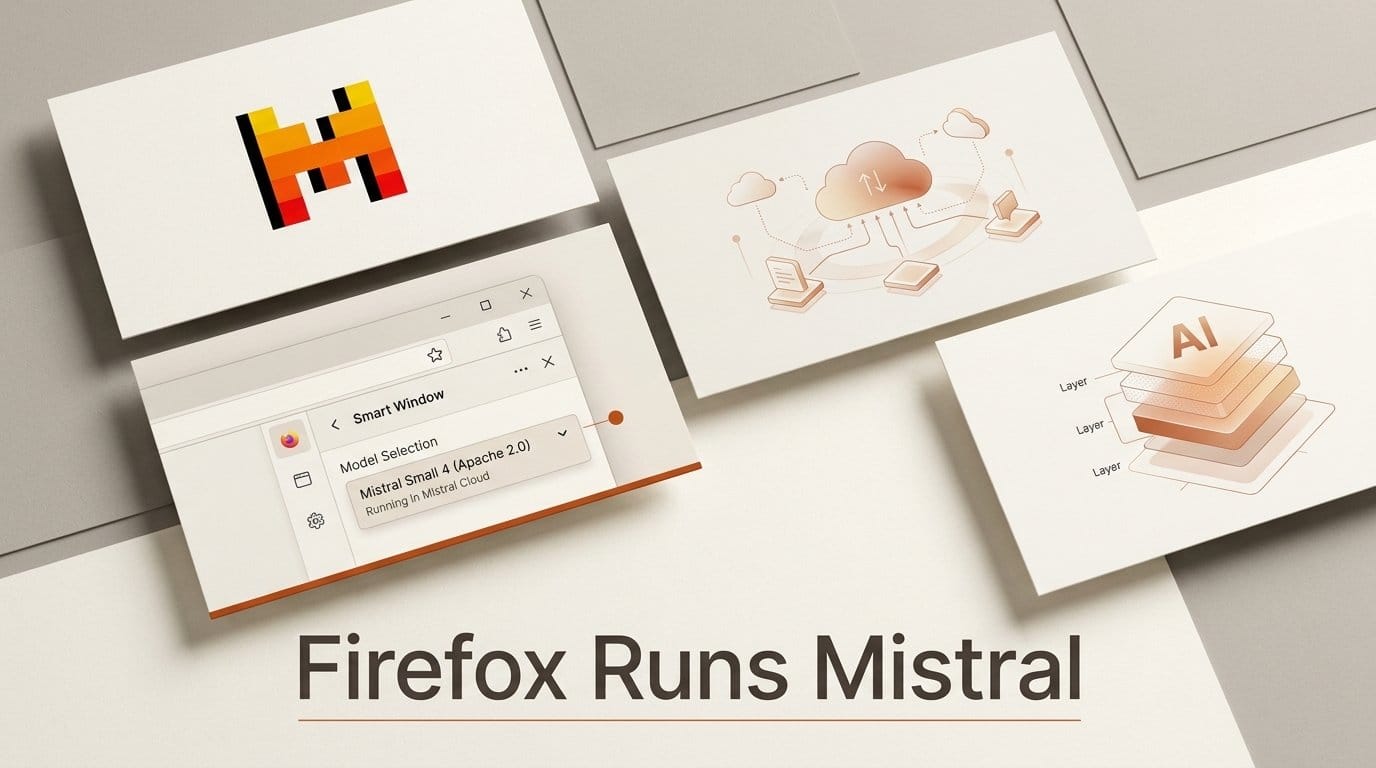
Mozilla and Mistral announced on September 16, 2026 that Mistral Small 4 is now a model option inside Firefox Smart Window, the browser's AI assistant, which remains in beta. The same announcement expands Smart Window and French-language support to users in France, adding to the United States and Canada launch from August 18. The United Kingdom and Germany are slated for later in 2026. Mistral Small 4 is a 119-billion-parameter mixture-of-experts model released under Apache 2.0, and nearly every writeup led with that license.
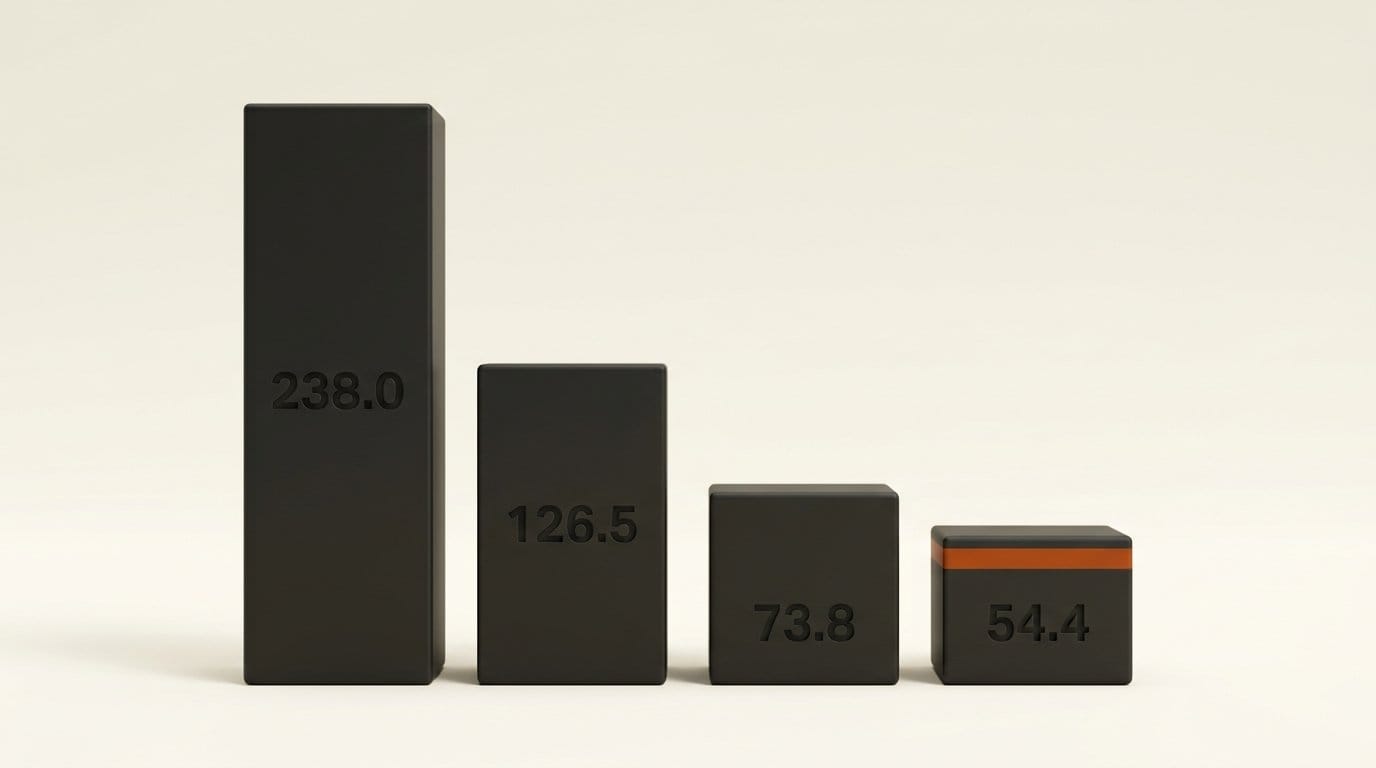
The license is real. It is also not what determines where your browsing data goes. Firefox does not run Mistral Small 4 on your machine, and the reason is a number that no coverage of this partnership has printed: the smallest usable build of the model on Hugging Face is 54.4 GB.
What Mozilla and Mistral actually announced
Mozilla's framing is narrower than the headlines suggest. Its own post, Mozilla and Mistral partner to expand AI competition, user choice, describes Mistral Small 4 as "a new AI model for Smart Window users in the US and Canada," alongside the French expansion. It is an addition to a list, not a replacement of a default.
The privacy terms are the substantive part of the deal. Mozilla says conversations are not saved on its servers by default, and that partners including Mistral agree to zero data retention. Smart Window itself, which you can install from the Firefox Smart Window download page, does a handful of concrete things: it checks answers against current web sources, groups related tabs, spots and closes duplicate tabs, and gives visual previews of history pages. Mozilla says browsing-journey recall and form filling are coming.
Both companies also agreed to fine-tune models on regional languages and dialects, which is the part of the partnership with the longest lead time and the least visible output so far.

The model is open. The inference is not.
Mistral Small 4 carries an Apache 2.0 license and its weights are downloadable at mistralai/Mistral-Small-4-119B-2603, with the model listed as mistral-small-4-0-26-03 in the Mistral model catalogue. When we covered the model's March 16 release in Mistral Small 4 Ships 119B Open Multimodal Model, we wrote that the Apache 2.0 license "means creators and developers can run it locally." Six months later, the first mainstream consumer product to adopt it serves it from Mistral's cloud instead.
That is not a contradiction, and it is not Mozilla cutting a corner. It is arithmetic. Mixture-of-experts architectures cut compute, not memory. Mistral Small 4 activates roughly 6 billion parameters per token across 128 experts, which is why inference is cheap to serve. But routing picks different experts for every token, so all 119 billion parameters have to be resident. The published quantizations make the footprint concrete:
| Build | Precision | Total size on disk |
|---|---|---|
| BF16 | 16-bit, full | 238.0 GB |
| Q8_0 | 8-bit | 126.5 GB |
| UD-Q4_K_M | 4-bit | 73.8 GB |
| UD-IQ4_XS | 4-bit, aggressive | 58.1 GB |
| UD-Q3_K_M | 3-bit, smallest | 54.4 GB |
Those totals are summed from the shard sizes published in the Unsloth GGUF repository. Squeeze the model down to 3-bit, accept the quality loss, and you still have to fit 54.4 GB in memory before the first token. No browser tab does that. Very few laptops do either.
So the privacy guarantee here is contractual, not architectural. Your text goes to Mistral's servers and Mistral has contracted not to retain it. That is a meaningfully better deal than the industry default, and it is enforceable in a way a marketing promise is not. It is simply a different kind of protection than "the weights are on your disk and nothing leaves the machine," and the open-weights headline blurs the two.
Smart Window is a model picker, not a default slot
The second thing the coverage gets slightly wrong is treating this as Mistral capturing the Firefox AI slot. There is no single slot to capture. Mozilla's August 18 Smart Window launch post already established the architecture: "Smart Window is optional. You choose when to use it, what browsing context it can use to help with a task, and which AI model you want to use." Mozilla repeated the point in the Mistral announcement, noting Firefox users "can still choose from a multitude of other AI models."
That makes the load-bearing decision August 18, not September 16. Mozilla shipped a model-agnostic shell with user-selectable back ends, and this week is the first high-profile exercise of it. Mistral's own summary of the arrangement is unusually candid about what each side gets: Mistral reaches Firefox users without owning a browser, and Mozilla recommends Mistral without removing user choice.
Worth noting that Smart Window's answer-checking runs on a separate partnership with Exa, the search company, not on the chat model at all. Two different vendors sit behind two different features in the same panel, which is the clearest evidence that Smart Window is a routing surface rather than a product built around one model.
How this compares to browser AI that actually runs locally
We have covered the alternatives, and the contrast is sharp once you line them up by where the computation happens.
| Approach | Where inference runs | Privacy mechanism | Practical model size |
|---|---|---|---|
| Firefox Smart Window with Mistral Small 4 | Mistral's cloud | Contractual, zero data retention | 119B, no local ceiling |
| LiteRT.js | On device, inside the browser | Architectural, no server round-trip | Small enough to download per session |
| Hugging Face WebGPU kernels | On device, inside the browser | Architectural, client-side only | Small enough to download per session |
| Perplexity Hybrid Compute | Split by an on-device classifier | Architectural, routing-gated | Compact locally, frontier in cloud |
Google's LiteRT.js runtime and Hugging Face's 207 WebGPU kernels both run models client-side with no inference server behind them, which is the architectural version of the guarantee. Neither runs anything near 119B parameters, because a browser has to download and hold the weights.
The most instructive comparison is Perplexity's Hybrid Compute, which shipped on September 1. It splits a single task between cloud frontier models and compact local ones, and an on-device classifier decides which side sees what before anything is transmitted. Perplexity made local-versus-cloud an automatic architectural decision. Mozilla made it a contractual one. Both are defensible. They are not the same promise, and a creator handling client material should know which one they are relying on.
There is also a strategic read here. In our analysis of the ChatGPT Atlas shutdown, we argued the standalone AI browser had hit an adoption wall, with OpenAI folding agentic browsing back into apps and extensions. Mozilla is running the opposite play: keep the browser people already use and make the AI layer swappable. On current evidence that is the better bet. And it lines up with Mozilla's own research, covered in the State of Open Source AI 2026 report, which found open-weight models power roughly a third of real-world usage while capturing only 4% of revenue. Putting an Apache 2.0 model in front of Firefox users is Mozilla acting on its own finding.
What this means if you build or create with AI
Three things follow, and they are testable this week rather than aspirational.
Pick your guarantee deliberately. If you handle client NDAs, unreleased work, or regulated material, "zero data retention by contract" and "never leaves the device" are different risk profiles. Read which one a tool offers before you paste. Smart Window is explicit that you choose which tabs it can see, so scope the context rather than granting it everything.
Treat open weights as a portability claim, not a privacy claim. Apache 2.0 on Mistral Small 4 means you can self-host it, fine-tune it, and avoid vendor lock-in. Those are genuine and valuable. It does not mean the copy you touch in a consumer product is running anywhere near you. Check the deployment, not the license.
If you actually want local, size the model to the machine. The 54.4 GB floor is the lesson generalized: parameter count sets your memory bill even when sparsity makes the model cheap to run. A 119B mixture-of-experts model is a server model with a permissive license, not a laptop model. Build local workflows on models that fit, and route to the cloud deliberately when they do not.
Frequently asked questions
Does Firefox Smart Window run Mistral Small 4 on my computer?
No. The model is served from Mistral's infrastructure. Mistral has agreed to zero data retention and Mozilla says conversations are not saved on its servers by default, but the inference itself is remote.
Why can a 119B model with only 6B active parameters not run in a browser?
Mixture-of-experts sparsity reduces the compute per token, not the memory needed to hold the model. Routing selects different experts for each token, so all 128 experts must stay resident. The smallest published build is 54.4 GB and the full-precision build is 238.0 GB.
Where is Firefox Smart Window available?
It is in beta in the United States and Canada in English since August 18, 2026, and in France in French as of September 16, 2026. Mozilla expects the United Kingdom and Germany later in 2026.
Is Mistral now the default AI in Firefox?
No. Smart Window lets you choose which model to use, and Mozilla states that users can still select from other AI models. Mistral Small 4 is an added option in a model picker.
Can I download and self-host Mistral Small 4 myself?
Yes. It is Apache 2.0 licensed and the weights are public, including quantized GGUF builds. You need hardware that can hold at least 54.4 GB for the smallest quantization, so this is a workstation or server task rather than a laptop one.
What does Exa do in Smart Window?
Exa powers the answer-checking feature, which verifies responses against current web sources. It is a separate partnership from the Mistral chat model, so two vendors sit behind different features in the same panel.
Is Smart Window opt-in?
Yes. Mozilla describes it as optional, and says you control when it is used, which browsing context it can access, and which tabs you share. It can be turned off entirely through Firefox's AI Controls.