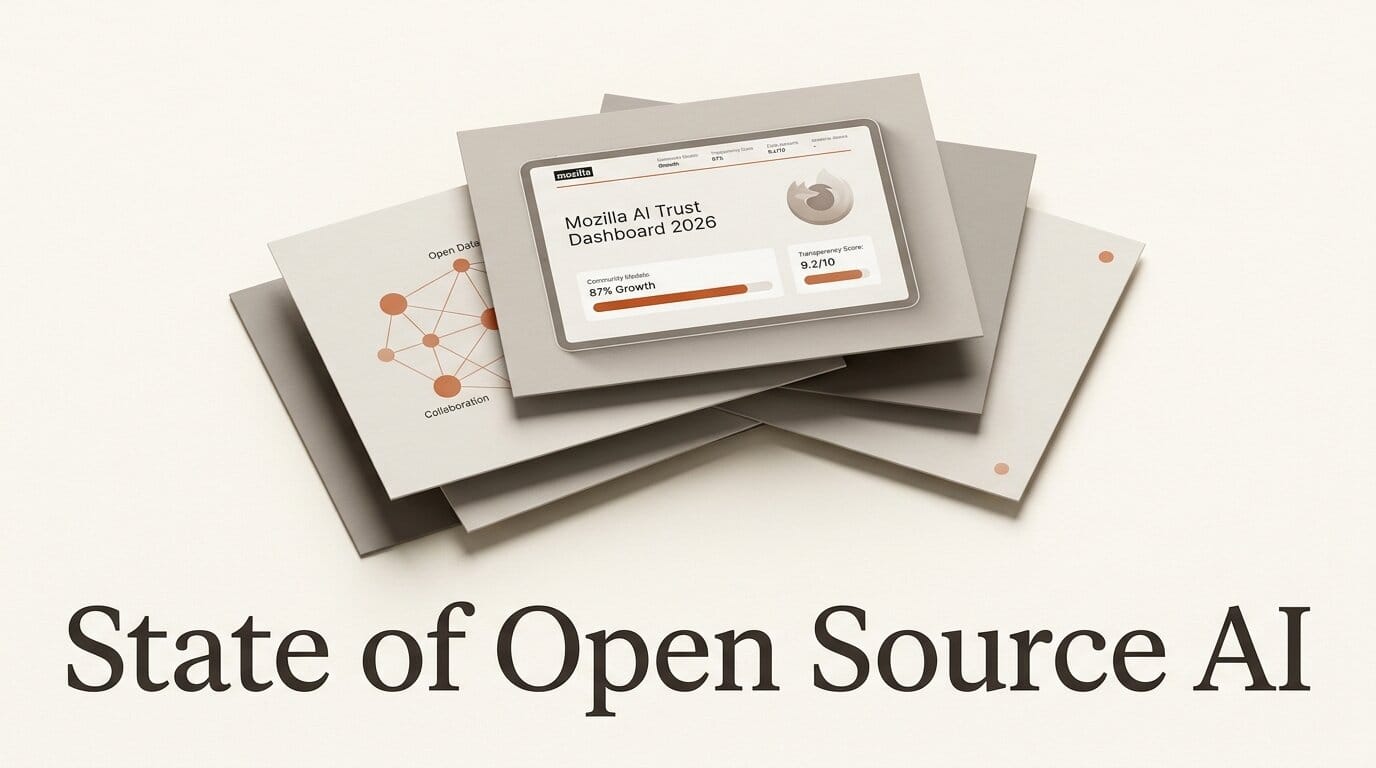
Mozilla released its inaugural State of Open Source AI report on July 14, 2026, and the headline finding is one every creator choosing tools should sit with: open-weight models have closed the capability gap with closed frontier systems from 8.04% to just 3.3% over 24 months, while inference costs fell roughly 50 times in three years. The full report argues that open models now power about a third of real-world AI usage but capture only 4% of the revenue. For anyone building with AI on a budget, that gap between usage and cost is the whole story.
What the Report Found
Mozilla's assessment, published as a V1.0 that it plans to update, pulls data from public benchmarks, developer surveys, and inference marketplaces. The standout numbers: open models have reached parity on coding tasks while still trailing closed systems on complex reasoning, and inference pricing dropped from around $20 to about $0.40 per million tokens over 36 months. By mid-2026, open models represented a majority of production tokens routed through OpenRouter, the marketplace where developers pick models by price and performance. You can download the complete report as a PDF.

Open vs Closed: What Actually Changed
The report is careful to separate capability from adoption. Open models have caught up on raw benchmarks, but the barriers to shipping them are now operational, not technical. As heise reported, the money has not followed the usage. Here is how the two ecosystems compare on the numbers Mozilla published.
| Metric | Open Models | Closed Models |
|---|---|---|
| Capability gap vs frontier | 3.3% behind (was 8.04%) | Frontier baseline |
| Developers using them | 79% of teams adding AI | 71% of teams adding AI |
| Teams reaching production | 51% | 63% |
| Share of real-world usage | ~33% | ~67% |
| Share of revenue | ~4% | ~96% |
The 79% versus 71% figures overlap because most teams use both. The more revealing pair is production readiness: closed models still convert experiments to shipped products more often, and Mozilla attributes the difference to infrastructure cost, security and compliance concerns, and maintenance complexity rather than model quality.
The Money Problem

Open-weight developers are growing fast but earning little relative to their usage. Mistral reached roughly $400M in annual recurring revenue, a 20x jump in twelve months. DeepSeek sits near $220M ARR after a $7.4B funding round, and Databricks is at a $5.4B revenue run-rate. Impressive on their own, these figures are small against the usage share open models command, which is exactly the imbalance Open Source For You highlighted in its coverage. Mozilla frames open weights increasingly as a "sovereignty choice" for nations and enterprises that want independence from vendor lock-in.

What This Means for Creators
If you build with AI, the practical read is that open models are now a real default rather than a fallback. A 3.3% capability gap is invisible for most creative and coding tasks, and a 50x cost drop changes what is affordable to run at scale, a theme we covered in our look at AI token costs for creators. The catch is operational: self-hosting or routing to open models still asks more of you than clicking a closed API. Here is a simple way to decide.
- Prototype on a marketplace. Use a router to A/B an open model against your current closed one on real prompts before committing. You pay per token and swap freely.
- Match the model to the task. For coding and generation, open models are at parity. For hard multi-step reasoning, keep a closed model in the loop.
- Weigh the operational cost honestly. If you lack infrastructure to host and maintain a model, a hosted open-weight endpoint captures most of the savings with none of the ops burden. Browse current options on Hugging Face.
- Revisit quarterly. The gap is closing fast enough that a model you ruled out six months ago may now clear your bar.
Frequently Asked Questions
Who published the State of Open Source AI report?
Mozilla, as an inaugural V1.0 assessment released on July 14, 2026. The organization plans to update it as a recurring measure of the open model ecosystem.
Are open models really as good as closed ones now?
On coding and many generation tasks, effectively yes, with a measured capability gap of 3.3%. On complex reasoning they still trail, so the honest answer is task-dependent.
Why do open models make so little money?
They drive about a third of usage but capture only 4% of revenue. Much of open-model usage is self-hosted or free, and the commercial value still concentrates in closed API providers.
What is stopping teams from shipping open models?
Mozilla found the barriers are operational: infrastructure cost, security and compliance, and maintenance complexity. Only 51% of open-model teams reach production versus 63% for closed.
How much cheaper is inference now?
Roughly 50 times cheaper over 36 months, from about $20 to $0.40 per million tokens. That drop is a major reason open models now handle a majority of production tokens on marketplaces like OpenRouter.
Should I switch my workflow to open models?
Test them against your current stack on real tasks. For cost-sensitive, high-volume, or coding-heavy work, open models are often the better choice. For your hardest reasoning steps, a closed model may still earn its price.