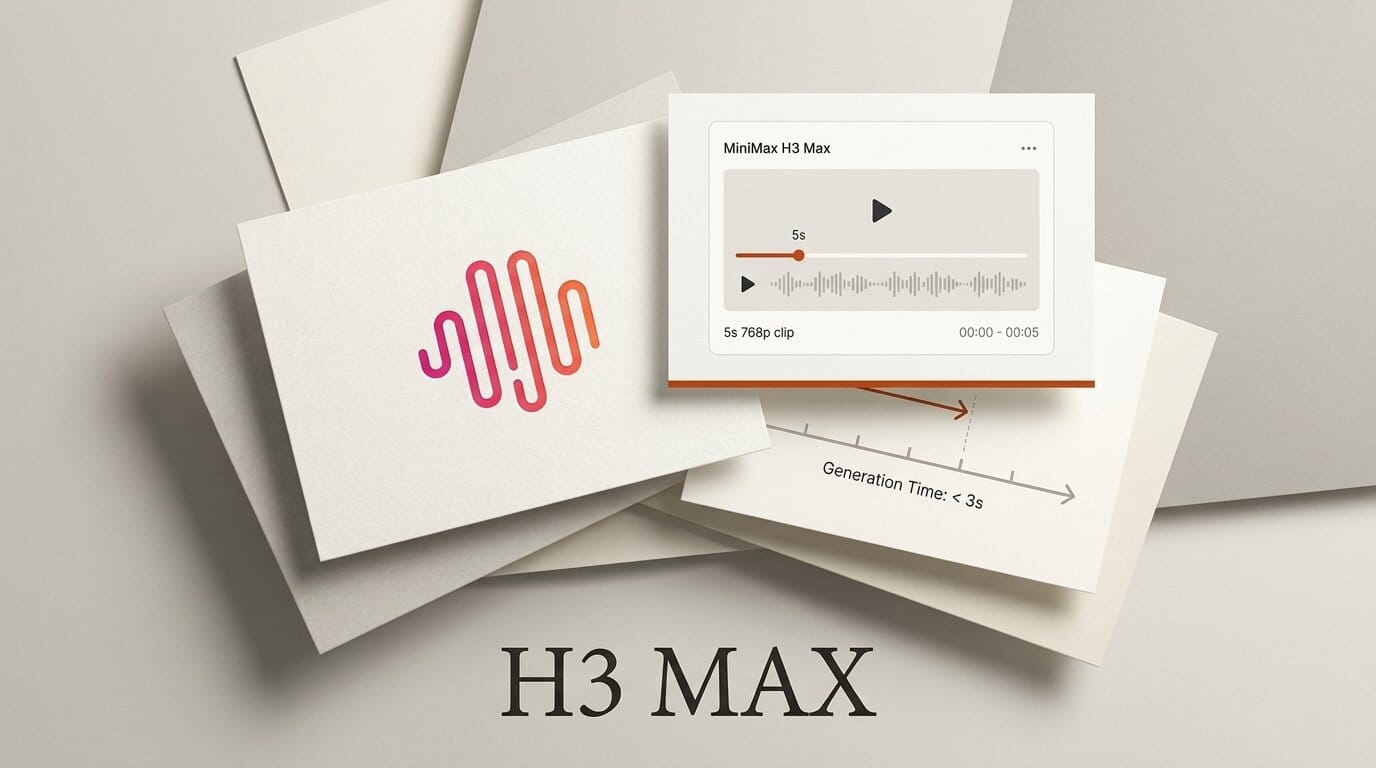
Fal has released MiniMax H3 Max, a post-trained version of MiniMax's open-weights H3 video model tuned for speed. It renders a 5-second, 768p clip with synchronized audio in under three seconds, and it landed at the top of the image-to-video arena the week it shipped.
Try It: Five Free Clips a Day
Sign in to fal and you get five free H3 Max generations every 24 hours, each up to 15 seconds at 768p with synced audio. Open the text-to-video endpoint, write a prompt, and pick an aspect ratio from 21:9 down to 9:16 for vertical shorts. Because a 5-second clip comes back in roughly the time it takes to read this sentence, you can iterate on shot ideas in a single sitting instead of queuing renders and walking away.
Why It Matters for Creators
H3 Max is not a new base model. Fal took the open weights of MiniMax H3 and retrained them for stronger prompt adherence and better aesthetics, then served the result on its own inference stack. The trade is resolution for speed: H3 Max caps at 768p where the base model reaches 2K, but it generates fast enough to feel interactive. For creators who tested audio-synced generation in our ComfyUI H3 sound-sync coverage, this is the same model family with a free, hosted, near-real-time front end.
Key Details
Base model: Post-trained from MiniMax H3 open weights by fal, developed by MiniMax.
Resolution: 480p or 768p (default 1344x768 at 24 FPS), tuned for speed over maximum resolution.
Speed: A 5-second 768p clip renders in under three seconds; 15-second clips take about 15 seconds.
Free tier: Five 15-second generations every 24 hours with synchronized audio.
Pricing: $0.06 per second at 768p, with a 50 percent introductory discount for the first 14 days.
Rankings: First for image-to-video on Design Arena and first with audio on the Artificial Analysis video leaderboard.
What to Do Next
Run the same prompt through H3 Max and your current video tool and compare prompt adherence and motion. If the 768p ceiling works for social shorts and rough cuts, the free daily quota makes it a low-cost way to storyboard before committing paid credits on a higher-resolution model for the final render.