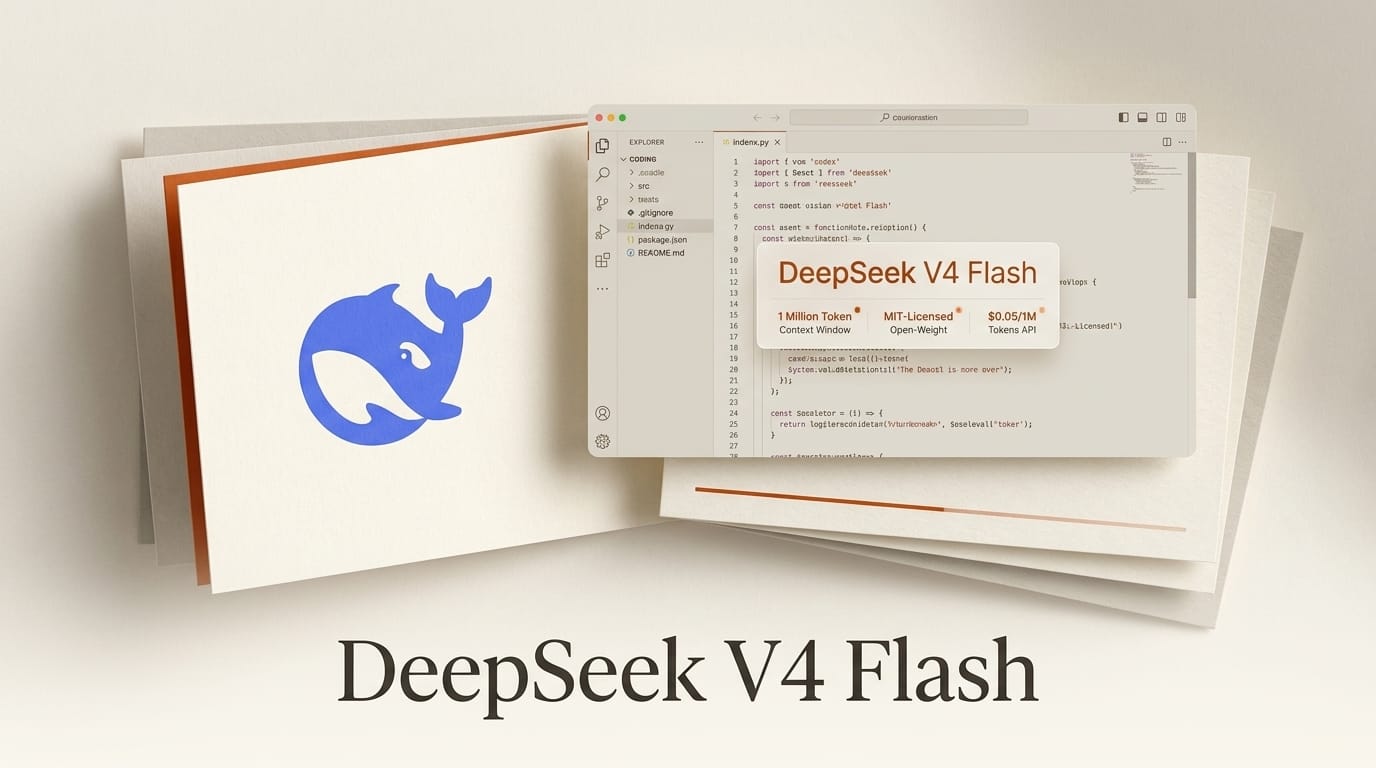
DeepSeek shipped the official production build of DeepSeek V4 Flash on July 31, 2026, promoting the model from its April preview to a stable deepseek-v4-flash API endpoint and an open-weight release under the permissive MIT license. The Mixture-of-Experts model carries 284 billion total parameters with just 13 billion activated per token, runs a 1 million token context window, and natively speaks the OpenAI Responses API format so it drops into Codex-style agent harnesses with almost no glue code. DeepSeek says the architecture is identical to the preview and that every gain came from re-post-training, which is why the headline story here is agentic coding performance at a price that undercuts most frontier options. For a full walkthrough of the release, DeepSeek published the change in its developer changelog.
What DeepSeek Shipped
The 0731 build is not a new architecture. DeepSeek states plainly that "DeepSeek-V4-Flash-0731 keeps the same model architecture and size as DeepSeek-V4-Flash-Preview, and was only re-post-trained." What that post-training bought is a large jump in autonomous agent capability: tool use, multi-step task completion, and terminal-driven coding. The V4 Flash weights family is available on Hugging Face under MIT, a genuinely permissive license that allows commercial use and self-hosting. DeepSeek's own reporting on the launch, covered by Caixin Global, frames it as a deliberate open-source play as China's model race intensifies.
Two engineering details matter for anyone running long-context workloads. The model uses a hybrid attention mechanism that DeepSeek calls Compressed Sparse Attention paired with Heavily Compressed Attention, and it ships with a DSpark speculative-decoding draft module. Together these let V4 Flash use roughly 27 percent of the single-token inference compute of its predecessor when working at the full million-token context, which is the difference between an open-weight model that is theoretically long-context and one you can actually afford to run at that length.

The Benchmarks (Vendor-Stated)
Every number below is reported by DeepSeek and has not yet been independently reproduced, so treat them as claims awaiting third-party verification rather than settled fact. The scores also depend on mode: DeepSeek reports SWE-bench Verified at 66.0 for the default API configuration, rising toward the high-70s in its extended "Flash-Max" reasoning mode, a distinction the official-release write-up on Hugging Face walks through in detail. That mode split explains why different reports cite different figures for the same benchmark.
| Benchmark | DeepSeek V4 Flash (vendor-stated) | What it measures |
|---|---|---|
| Terminal-Bench 2.1 | 82.7 | Autonomous terminal/coding tasks |
| SWE-bench Verified | 66.0 default, up to ~79% Flash-Max | Real GitHub issue resolution |
| LiveCodeBench | 91.6% pass | Competitive coding |
| Codeforces (rating) | 3052 | Algorithmic problem solving |
| Toolathlon | 70.3 | Multi-tool agent orchestration |
| GPQA Diamond | 88.1% | Graduate-level reasoning |
| MMLU-Pro | 86.2% | Broad knowledge |
The independent Artificial Analysis Intelligence Index scored the model at 50 against a field median of 17, a general-intelligence signal rather than an agent-specific one. For an outside read on the agent claims, DigitalApplied's breakdown of the 0731 benchmarks is worth reading precisely because it flags how much is vendor-reported.

Pricing: The Real Story
V4 Flash is priced to make agent loops cheap. At the API, output runs $0.28 per million tokens, cache-miss input is $0.14, and cache-hit input drops to $0.0028. DeepSeek positions Flash at roughly one-third of the forthcoming V4-Pro rates, and Flash also serves 2,500 concurrent requests versus Pro's 500, which matters when you are fanning out dozens of agent sub-tasks at once. Independent trackers such as BenchLM's V4 Flash page are already logging pricing and benchmark data as the model rolls out.
| Tier | Input (cache-miss) | Input (cache-hit) | Output | Concurrency |
|---|---|---|---|---|
| V4 Flash | $0.14 / 1M | $0.0028 / 1M | $0.28 / 1M | 2,500 |
| V4 Pro (announced) | $0.435 / 1M | $0.003625 / 1M | $0.87 / 1M | 500 |
For comparison-heavy shoppers, that output price sits well below most closed frontier models. If you are weighing an open-weight agent model against a closed frontier one, our look at Anthropic's Claude Opus 5 lays out what the premium tier buys and where a cheaper open model closes the gap.

How to Use V4 Flash in Your Workflow
This is where the release earns its keep for builders. V4 Flash natively supports the OpenAI Responses API and is specifically adapted for Codex, so an existing Codex or Responses-based agent can point at DeepSeek with a base-URL swap. Both Flash and the forthcoming Pro also expose an /anthropic endpoint, meaning Claude-format tooling works too without rewriting message schemas.
- API route: Set your OpenAI-compatible client's base URL to the DeepSeek endpoint and the model to
deepseek-v4-flash. Existing Responses API agents and Codex configs work unchanged. - Claude-format route: Point Anthropic-style tooling at the
/anthropicendpoint to reuse message and tool-call schemas you already have. - Local route: Pull the MIT-licensed weights from Hugging Face and serve with vLLM or SGLang, or run a quantized build in Ollama, LM Studio, or llama.cpp for offline agent work.
- Agent loop: Lean on cache-hit input pricing by keeping a stable system prompt and tool schema, then let the cheap output price carry long multi-step runs.
What this enables: an open-weight, self-hostable coding agent with frontier-adjacent benchmarks at a fraction of closed-model output cost. If your build is a review or refactor pipeline, pairing a cheap high-throughput model like Flash with a structured review pass, as we covered in our two-agent code review workflow, is exactly the kind of loop this pricing was designed for.

How to Wire V4-Flash Into Codex
The integration is genuinely a few minutes of setup. DeepSeek ships an automated installer, but the manual path is worth understanding because it shows exactly what is happening. Full details live in the official Codex integration guide and the community awesome-deepseek-agent repo.
The one-line automated route on macOS or Linux:
bash <(curl -fsSL https://cdn.deepseek.com/api-docs/codex-deepseek-setup-en.sh)The script prompts for your API key (it starts with sk-) and writes the config for you. If you prefer to do it by hand, the manual steps are:
- Create
~/.codex/models.jsonwith the DeepSeek model metadata (the docs provide the full JSON for both Flash and Pro). - Edit
~/.codex/config.tomlto setmodel = "deepseek-v4-flash",model_provider = "deepseek", andmodel_reasoning_effort = "high". - Under
[model_providers.deepseek], setbase_url = "https://api.deepseek.com/"andwire_api = "responses". - Drop your key into
experimental_bearer_token. - Run
codexinside a project and confirm the startup banner showsdeepseek-v4-flash.
The wire_api = "responses" line is the important one: it tells Codex to talk to DeepSeek through the Responses API rather than the older chat-completions shape, which is what unlocks the improved agent behavior.
Frequently Asked Questions
Is DeepSeek V4 Flash open source?
The V4 Flash weights are released under the MIT license on Hugging Face, which permits commercial use and self-hosting. Note that reporting differs on whether the exact 0731 checkpoint is downloadable yet versus the architecturally identical April preview weights; DeepSeek says the 0731 build shares the preview's architecture and size and was only re-post-trained.
How much does the API cost?
Output is $0.28 per million tokens, cache-miss input is $0.14, and cache-hit input is $0.0028. That is roughly one-third of the announced V4-Pro pricing.
What is the context window?
One million tokens, with support for up to 384,000 max output tokens, and a hybrid attention design that keeps long-context inference to about 27 percent of the prior generation's per-token compute.
Can I use it with my existing OpenAI or Claude code?
Yes. V4 Flash natively supports the OpenAI Responses API and is Codex-adapted, and it also exposes an Anthropic-format /anthropic endpoint, so most existing agent tooling works with a base-URL change.
How does it compare to V4-Pro?
Pro is the larger, pricier tier and had not received its official 0731 upgrade at Flash's launch; DeepSeek says the official V4-Pro release "will follow soon" with Responses API and Codex support expected in early August 2026.
Are the benchmark numbers reliable?
They are vendor-stated and not yet independently reproduced. Scores also vary by mode, with the higher figures coming from the extended Flash-Max reasoning setting rather than the default API configuration.