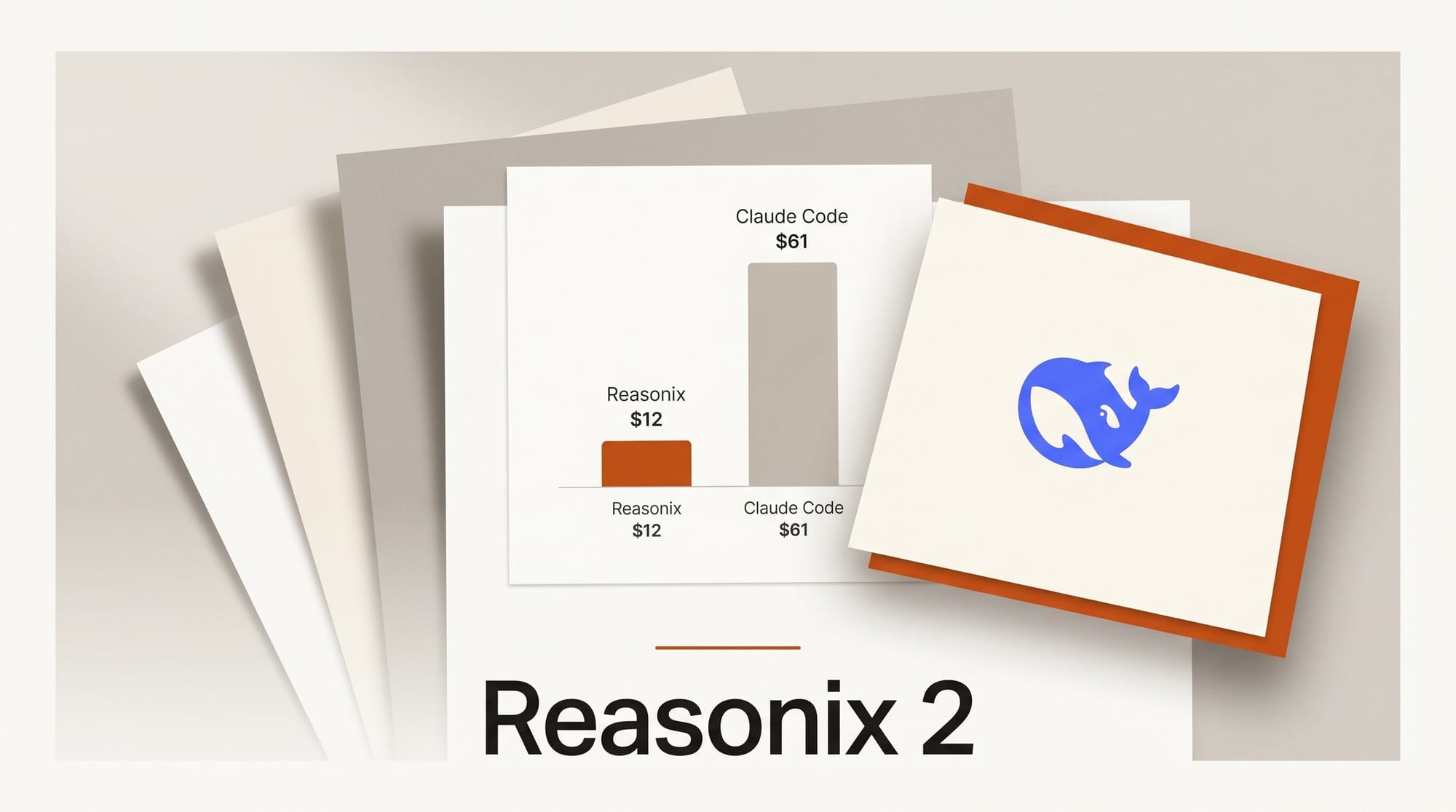
A 6.4k-star open-source project called DeepSeek-Reasonix (or just Reasonix) shipped its desktop v0.50.0 release on May 24, 2026, and the headline number is hard to ignore: a real-world coding session that burned 435 million input tokens cost roughly $12 on Reasonix versus an estimated $61 on an equivalent Claude setup. The agent is engineered around DeepSeek’s prefix-cache so that long-running sessions stay cheap, and the project has been iterating at a punishing pace, with v0.47 through v0.50 all shipping inside one week.
Reasonix is community-built (publisher: esengine, MIT license) rather than a first-party DeepSeek release, but it treats the DeepSeek API as a first-class citizen the way Claude Code treats Anthropic’s. The pitch in the landing page is straightforward: a terminal coding agent you can leave running for hours without watching your bill climb. Hacker News noticed, pushing the project to 197 upvotes within a day.
What Happened
On May 22, 2026 the Reasonix team shipped desktop-v0.49.0. Two days later, on May 24, v0.50.0 followed with a polished Tauri client and signed installers for macOS, Windows, and Linux. The releases page shows the project moving from CLI-first to a hybrid terminal-plus-GUI shape, with multi-tab sessions, per-workspace state, and the same cost and cache meters in both surfaces.
The architectural bet is three layers: cache-first loop, tool-call repair, and cost control. Reasonix structures every prompt so DeepSeek’s automatic prefix-cache hits as often as possible (DeepSeek bills cached input tokens at roughly a tenth of the uncached rate). Its REASONIX.md describes a four-pass tool-call repair pipeline that catches malformed function calls before they trigger a retry round-trip, which is where most agent frameworks quietly leak money.
Why It Matters
The coding-agent category split this month into two pricing tiers. Frontier-tier agents like Claude Code and the recently launched Cursor Composer 2.5 sit on top of $0.50 to $15-per-million-token models. Budget-tier agents like Reasonix and the xAI Grok Build / OpenCode path lean on cheaper underlying APIs and aggressive caching to make long agentic loops economically viable.
For solo creators, indie hackers, and small studios, that gap is the difference between running an agent for an hour at lunch and leaving one running on a backlog overnight. A 99.82% cache-hit rate on a 435M-token session is not a benchmark number, it is a real case study cited in the Reasonix README, and it lines up with what DeepSeek’s own pricing page predicts for repeated-context workloads. If you have ever paused mid-task to estimate whether the next prompt is worth $2, the cost shape Reasonix targets removes that decision from your workflow.
Reasonix vs Claude Code vs Cursor Composer 2.5

The three agents now sit at very different points on the price-versus-capability curve. The table below captures the May 24, 2026 snapshot.
| Dimension | Reasonix v0.50 | Claude Code 2.1.147 | Cursor Composer 2.5 |
|---|---|---|---|
| Underlying model | DeepSeek (Reasoner / V4-Pro) | Claude Opus 4.7 / Sonnet 4.7 | Cursor Composer 2.5 (Kimi K2.5 base) |
| License | MIT, open source | Proprietary, BYO API key | Proprietary, subscription |
| Surface | CLI + Tauri GUI | CLI | IDE |
| Cache strategy | DeepSeek prefix-cache, 99% target | Anthropic prompt caching (5 min default) | Composer-native caching |
| Case-study cost (435M input tokens) | ~$12 | ~$61 (Reasonix README estimate) | ~$30 (Composer 2.5 list pricing) |
| MCP support | Server-side and client-side | Yes | Yes |
| Plan mode / hooks | Yes | Yes | Partial |
| Semantic indexing | Local Ollama or OpenAI-compatible | External (Sourcegraph, Cody, etc.) | Built-in |
| Web search | Mojeek, SearXNG, Metaso | External tools | Built-in |
The honest summary: Claude Code still has the strongest model for complex multi-file refactors, and Cursor Composer 2.5 is the smoothest IDE experience, but Reasonix is the only one of the three that you can run for hours of routine work without budgeting around it.
Try It: 10-Minute Reasonix Setup

If you want to test Reasonix against your current agent on a real backlog, the steps below will get you from zero to a working session in under ten minutes.
- Get a DeepSeek API key. Sign up at platform.deepseek.com, add credit (the minimum top-up is $2), and copy your key.
- Install Node 22+. Reasonix requires Node 22 or newer. Use
nvm install 22if you are on an older version. - Install the CLI. Run
npm install -g reasonixor, if you prefer not to install globally,npx reasonix codefor a one-off session. - Set the key. Export
DEEPSEEK_API_KEYin your shell or paste it into the first prompt Reasonix shows on launch. - Open a workspace. Run
reasonix codein the root of a real project. Reasonix creates a persistent session file in.reasonix/so the cache state survives restarts. - Pick a real task. A migration, a test-coverage pass, or a dependency upgrade are the workloads where prefix caching pays off most, because the agent rereads the same files dozens of times.
- Watch the cache meter. Reasonix shows a live cache-hit percentage at the bottom of the screen. If it dips below 90% on a long session, restructure the prompt so stable context (file tree, conventions, key files) leads and volatile context (the current change) trails.
- Optional: install the desktop client. Download the v0.50 installer from the GitHub releases page if you want multi-tab sessions and a GUI file panel.
Key Details

A few specifics worth knowing before you commit to a Reasonix workflow. The agent supports SEARCH and REPLACE edit proposals with an explicit /apply review step, so it never writes to disk without your acknowledgement. It speaks MCP both as a server (other tools can connect to it) and as a client (it can call your MCP servers), which puts it on roughly the same surface as Qwen3.7-Max-based agents and Claude Code. Web search is pluggable across Mojeek, SearXNG, and Metaso, all of which work without API keys for moderate volume.
Semantic indexing runs locally via Ollama or any OpenAI-compatible embedding endpoint, which is the configuration most teams will want for proprietary codebases. Plan mode, hooks, and custom skills are present (the project explicitly aligns these with Claude Code conventions in v0.47), making Reasonix one of the only third-party agents that ports your existing skill library without rewrites.
Frequently asked questions
Is Reasonix an official DeepSeek product?
No. Reasonix is a community project built by esengine and distributed under MIT license. It calls the DeepSeek API but is not affiliated with DeepSeek the company. DeepSeek users have responded positively in the Hacker News thread, but the relationship is informal.
Which DeepSeek model does Reasonix call?
The README does not lock in a specific model and exposes the choice through configuration. In practice, most users pair Reasonix with DeepSeek-Reasoner for planning and DeepSeek-V4-Pro for code edits, taking advantage of the recently announced 75% permanent pricing cut on V4-Pro.
How does the 99.82% cache hit rate work in practice?
DeepSeek’s API automatically caches prefix tokens across requests. Reasonix structures every prompt so the stable context (system prompt, project metadata, key files) sits at the front and the volatile context (the current diff or question) sits at the end. As long as the prefix does not change between turns, the cache hit rate stays above 99% on multi-hour sessions.
Can I use Reasonix with my existing Claude Code skills and MCP servers?
Yes. Plan mode, hooks, and skills explicitly mirror the Claude Code conventions starting in v0.47. MCP servers configured for Claude Code work in Reasonix without changes, and the reverse is true for new MCP servers you build for Reasonix.
What is the realistic cost of a full working day on Reasonix?
The Reasonix case study (435M input tokens, full working day, ~$12) maps to roughly 30 to 50 cents per hour of active agent time at current DeepSeek pricing. Long sessions with high cache hit rates cost less per hour than short sessions, which inverts the cost shape of most pay-per-token agents.
Why has Reasonix shipped four versions in five days?
The project is in a rapid maturation phase moving from CLI-only to a hybrid CLI plus Tauri desktop client. The v0.47 to v0.50 sequence is mostly desktop client work (KaTeX math rendering, window restoration, signed installers) plus stability fixes. CLI behavior has been comparatively stable since v0.47.
What to Do Next
If you already run a paid coding agent, the quickest evaluation is to pick one routine workload (a dependency upgrade, a test-coverage pass, or a documentation refresh) and run it once on your current agent and once on Reasonix. Compare wall-clock time, edit quality, and dollar cost. If you do not yet run a coding agent at all, Reasonix is the lowest-financial-risk way to start. A $2 DeepSeek top-up is enough to evaluate the prefix-cache claim on a real project.