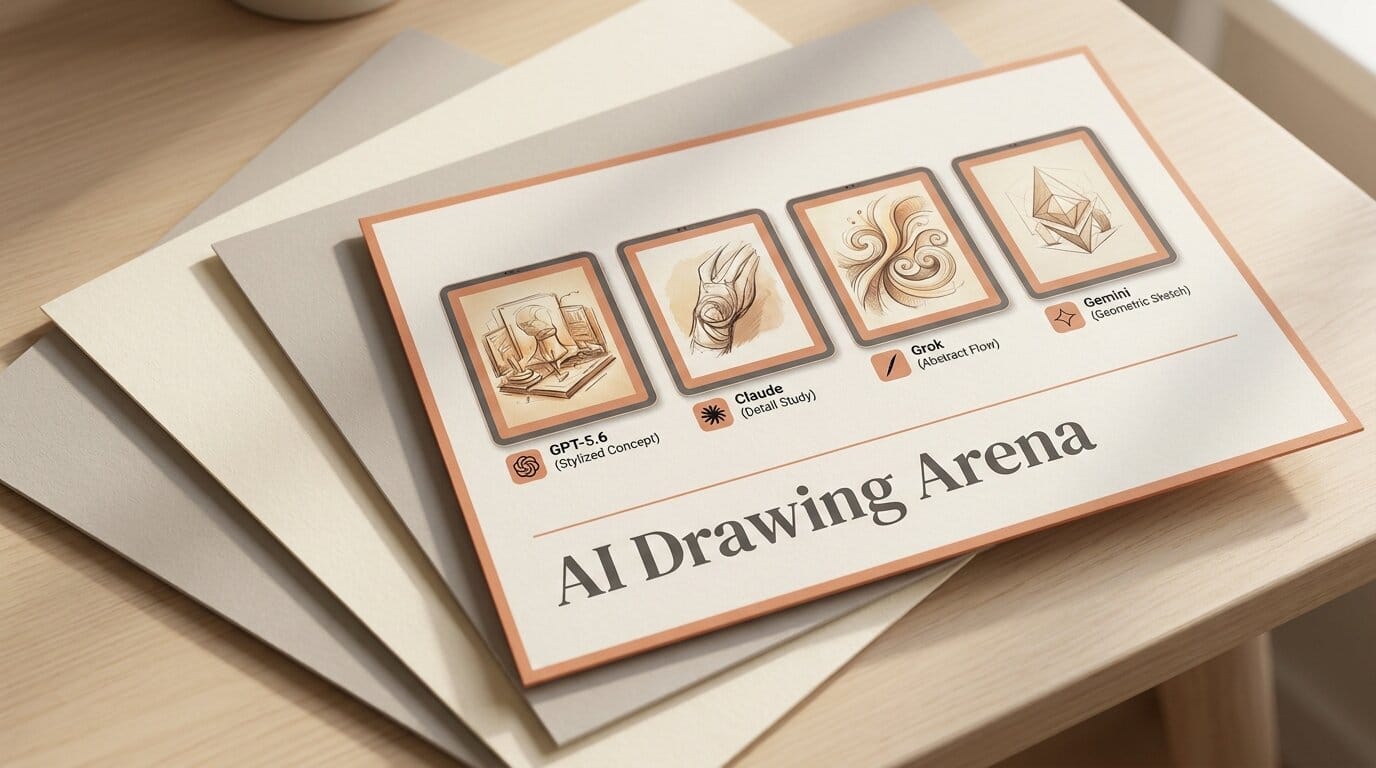
Four frontier AI models were handed a blank canvas and a box of simulated colored pencils, then told to paint the Mona Lisa. The results, published July 21, 2026 in TryAI's drawing-arena experiment, were lopsided: GPT-5.6 Sol produced the best artwork at a total cost of $7.74, while Claude Fable 5 spent $160.58 for a lower-ranked result and took twice as long per drawing. Grok 4.5 and Gemini 3.6 Flash landed in between on price but split on quality. For creators building agentic image workflows, the test is a rare apples-to-apples look at how the big models actually behave when they have to use tools to make art instead of generating a finished image in one shot.
What the Drawing Arena Actually Tested
This was not a text-to-image benchmark. The open-source canvas-arena harness gives each model a real drawing loop: it plans, views a target image, sets a color, tip width, and pressure, lays down batches of strokes, smudges to blend, erases mistakes, and calls a review function to look at its own canvas before deciding what to fix next. The full tool set was plan, view_target, view_canvas, set_color, set_brush, set_pressure, draw, smudge, erase, and clear_canvas.
Each model ran the same 7 drawings: two objective reproductions scored against the source art, the Mona Lisa and Van Gogh's The Starry Night, plus five open-ended prompts (an elderly fisherman, a sunset over the ocean, a red rose with dramatic lighting, a tabby cat on a windowsill, and a cozy cabin with a fireplace). Because the loop is agentic, the cost of a single drawing depends entirely on how many tool calls a model burns getting there, which is exactly where the four models diverged.
The Results: Cost and Quality Diverge Hard
The headline finding is that price and quality were almost inversely correlated. The two cheapest runs were not the worst, and the single most expensive run finished second, not first. Here is the full breakdown across all seven drawings per model.
| Model | Total cost (7 drawings) | Avg time per drawing | Quality rank |
|---|---|---|---|
| GPT-5.6 Sol | $7.74 | 6.2 min | 1 (runaway leader) |
| Claude Fable 5 | $160.58 | 12.5 min | 2 |
| Gemini 3.6 Flash | $12.87 | 6.9 min | 3 |
| Grok 4.5 | $9.21 | 4.8 min | 4 |
Claude Fable 5 cost roughly 20 times more than GPT-5.6 Sol and still finished behind it. Reproductions were scored objectively using SSIM (structural similarity) against the target painting, so the ranking on the Mona Lisa and Starry Night runs is not a matter of taste. The open-ended prompts were judged separately, but the ordering held.
Why GPT-5.6 Sol Ran Away With It
The behavioral logs explain the cost gap better than any benchmark score. The models used the same tools in radically different proportions, and the winner was the one that spent the fewest calls fussing.
- GPT-5.6 Sol never called
set_color,set_brush, orset_pressurea single time. Instead it passed color and brush parameters inline with each draw call, collapsing three round-trips into one and cutting its token bill dramatically. - Grok 4.5 did the opposite: 65% of its 1,349 tool calls were
set_color,set_brush, orset_pressure. It was fast and cheap but spent most of its actions on setup rather than strokes, which showed in the weakest final art. - Claude Fable 5 leaned hard on
smudge(123 calls) and reviewed its canvas constantly. That perfectionism drove both its $160 bill and its second-place finish; it made better art than Grok or Gemini but paid an enormous premium for the extra deliberation. - Gemini 3.6 Flash spent nearly a third of its calls on
view_canvasreviews, a middle-ground strategy that produced middle-ground results. Gemini 3.6 Flash is Google's new agent-focused tier; our Gemini 3.6 Flash deep dive covers why token efficiency is its headline feature.
The Peak-Then-Degrade Problem Nobody Expected
The most surprising result had nothing to do with which model won. In all eight target runs, the final drawing scored below the best the model reached mid-run. The models were, in effect, ruining their own best work by continuing to edit. GPT-5.6 Sol's Mona Lisa peaked at 0.352 SSIM and ended at 0.325, a measurable regression from over-polishing.
This is a known failure mode in agentic loops: without a strong stopping signal, a model keeps taking actions because it can, not because they help. For creators, it is a direct argument for capping iterations or snapshotting intermediate outputs rather than trusting the model to know when to stop. The best frame is often not the last one.
What This Means for Creators
The practical takeaway is that model choice for agentic visual tasks is not the same as model choice for chat. A model that writes brilliant prose can be a spendthrift with a paintbrush, and the cheapest model can quietly waste its budget on setup calls. Here is how to apply the findings:
- Match the tool interface to the model. GPT-5.6 Sol's win came largely from passing parameters inline. If you are designing an agent's tool schema, fewer stateful setup calls means lower cost and less room to loop.
- Cap iterations and keep snapshots. Given the peak-then-degrade finding, save the canvas after each review pass and score them, rather than shipping whatever the model produces on its final turn.
- Do not assume expensive equals better. Claude Fable 5 made genuinely good art but at a price that would make batch work uneconomical. For high-volume creative pipelines, GPT-5.6 Sol's cost-to-quality ratio is in a different league.
- Test on your own targets. The rankings here are for pencil-simulation drawing. Your workflow, whether it is diagramming, UI mockups, or storyboard sketches, may reorder them entirely.
How to Run Your Own Model Bake-Off
The whole harness is open source, so you can reproduce or extend the test on tasks that match your actual work. A minimal run looks like this:
- Clone the canvas-arena repository and install its dependencies.
- Add API keys for the models you want to compare (the arena supports the four tested here plus any tool-capable model you wire in).
- Point the arena at a target image for objective SSIM scoring, or supply a text prompt for open-ended generation.
- Run the loop and let each model plan, draw, smudge, and review until it decides it is finished.
- Compare total token cost, wall-clock time, and the per-step SSIM curve, not just the final frame, so you catch the peak-then-degrade dip.
- Repeat across several targets to average out luck before you trust the ranking for production.
For a broader view of how the current crop of image and multimodal models stack up, see our MAI-Image 2.5 arena comparison and our Qwen3.7-Max frontier benchmark.
Frequently Asked Questions
Which AI model draws the best?
In TryAI's colored-pencil drawing arena, GPT-5.6 Sol produced the highest-quality art and was a runaway leader, followed by Claude Fable 5, Gemini 3.6 Flash, and Grok 4.5. This is specific to tool-based pencil drawing scored with SSIM, not text-to-image generation.
Why did Claude Fable 5 cost $160 when GPT-5.6 Sol cost under $8?
Claude Fable 5 made far more tool calls per drawing, leaning heavily on smudging (123 calls) and constant canvas reviews, and averaged 12.5 minutes per drawing versus GPT-5.6 Sol's 6.2. Each extra tool round-trip adds tokens, and that deliberation compounded into a roughly 20x cost difference.
Is this the same as an image generator like Nano Banana or Midjourney?
No. Standard image generators output a finished picture in one pass. The drawing arena forces models to use discrete tools (set color, draw strokes, smudge, erase, review) in an agentic loop, so it measures tool-use skill and cost discipline, not raw generation quality.
What is SSIM and why does it matter here?
SSIM (structural similarity index measure) is an objective metric that compares two images for perceived structural similarity. The arena used it to score the Mona Lisa and Starry Night reproductions against the originals, removing subjective judgment from those rankings.
What was the peak-then-degrade finding?
In all eight target runs, the model's final drawing scored below its best mid-run score. Models kept editing past their peak and made the work worse. GPT-5.6 Sol's Mona Lisa peaked at 0.352 SSIM but ended at 0.325.
Can I run this test myself?
Yes. The canvas-arena harness is open source on GitHub and can be pointed at any target image or text prompt, so you can benchmark the models on tasks that match your own creative workflow.