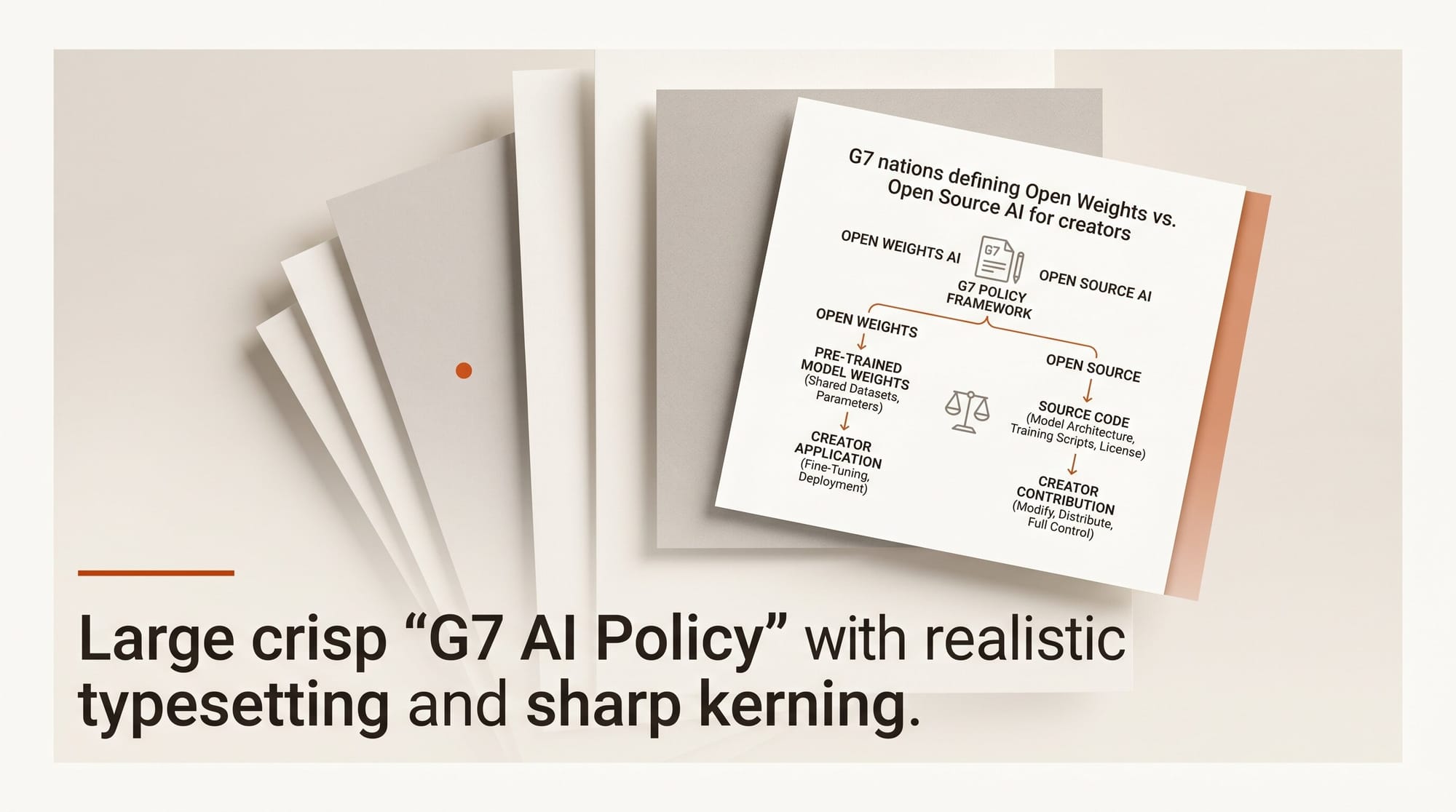
The G7 Digital and Technology Ministers agreed on May 29, 2026 on a shared classification framework for AI systems based on how openly their components are released. The four-tier vocabulary, published ahead of the 52nd G7 Summit in Evian, France, distinguishes between models whose weights, code, and training data are fully open versus those released under restrictive or partial terms. For creators who build workflows around tools like Stable Diffusion, Mistral, or LLaMA, the framework has direct implications for what you can legally do with model outputs in commercial projects.
What Happened

The G7 Digital and Technology Ministers, representing Canada, France, Germany, Italy, Japan, the United Kingdom, and the United States, finalized a formal vision document titled "AI Openness: Opportunities and Shared Language." The document establishes four standardized categories for AI openness and signals that G7 governments will begin using this vocabulary in policy, procurement, and regulatory contexts.
The G7 explicitly frames AI openness as a spectrum rather than a binary open-vs-closed distinction. Phoronix reported on the agreement on May 30, 2026, one day after the document was signed.
The Four Categories Explained
Here is what each category means and what it requires:
| Category | Weights | Training Code | Training Data | License Type |
|---|---|---|---|---|
| Open Source AI with Open Data | Yes | Yes | Yes (full) | OSI-approved open source |
| Open Source AI | Yes | Yes | Partial (documented gaps) | OSI-approved open source |
| Open Weights AI | Yes | Deployment only | No | OSI-approved open source |
| Weights Available AI | Yes | Deployment only | No | Restricted (commercial/geo/use limits) |
The key distinction between "Open Weights AI" and "Weights Available AI" is the license. Open Weights AI uses an OSI-certified open source license such as Apache 2.0 or MIT, meaning anyone can use, modify, and distribute the weights commercially. Weights Available AI covers models whose weights are downloadable but whose license restricts certain uses, including commercial deployment, geographic regions, or specific applications.
Where Popular Creative AI Models Fall

Most of the models powering creative workflows today are not fully open source under this framework. Here is how they map:
| Model | G7 Category | Key License Constraint |
|---|---|---|
| Mistral 7B, Mixtral 8x7B | Open Weights AI | Apache 2.0, commercial use allowed |
| FLUX.1 Schnell | Open Weights AI | Apache 2.0, commercial use allowed |
| FLUX.1 Dev | Weights Available AI | Non-commercial license only |
| LLaMA 3.x (Meta) | Weights Available AI | Restricted for companies above 700M users |
| Stable Diffusion XL | Weights Available AI | CreativeML RAIL++-M, some use restrictions |
| DeepSeek V3, V4-Pro | Open Weights AI | MIT License, commercial use allowed |
| GPT-4, Claude, Gemini | None (closed source) | No weights released |
Note that most creators using local inference tools like llama.cpp or LM Studio are running Open Weights AI or Weights Available AI models, not fully open source systems. For personal and most small-business use, this distinction rarely matters. It becomes critical when you are building a commercial product on top of a model or distributing modified weights.
Why This Matters for Commercial Projects
G7 governments will use this taxonomy in public procurement, research funding, and future AI regulation. Several implications are already visible:
Procurement and compliance: Public sector contracts in G7 countries may begin specifying that vendors use "Open Source AI" or "Open Weights AI" systems. If your pipeline relies on Weights Available AI models, you may face friction in government or enterprise bids.
Licensing clarity at scale: Until now, creators would say "I use an open source model" when they actually mean "I use a model with publicly available weights." The G7 framework forces precision. A model released under Apache 2.0 with weights but no training data is Open Weights AI, not Open Source AI. This is not a trivial distinction when auditors or legal teams get involved.
Pressure on model providers: The framework creates a ranking system. Providers who achieve "Open Source AI" status will have a competitive advantage in markets where openness is valued. Expect providers like Mistral and Cohere to clarify and potentially upgrade their licensing to reach higher categories. Cohere's recent Apache 2.0 release of Command A+ already aligns with the Open Weights AI category under this framework.
Training data transparency: The framework explicitly requires that Open Source AI providers document what training data was withheld and why when full data sharing is impossible. This will increase scrutiny on models that claim openness but withhold training datasets.
The Framework Does Not Override Individual Licenses

The G7 document is a policy vocabulary agreement, not a law. It does not change the license terms of any existing model. LLaMA 3 still uses Meta's custom community license; FLUX.1 Dev is still non-commercial. What the framework does is give regulators, procurement officers, and researchers a shared language when discussing AI openness at the policy level.
For creators, the practical takeaway is straightforward: check the actual license of every model in your workflow. If it is Apache 2.0 or MIT and weights are available, you are working with Open Weights AI. If the license restricts commercial use or has geographic limitations, you are working with Weights Available AI regardless of how the model provider labels it.
What to Do Next
- Audit your model stack: List every model you use in production. Check whether its license is OSI-certified. The GNU license list and the Open Source Initiative both maintain searchable databases.
- Document commercial use rights: For any Weights Available AI model in a commercial product, keep a copy of the license terms and confirm your use case is permitted. LLaMA 3, for example, is free for commercial use unless your monthly active users exceed 700 million.
- Follow the 52nd G7 Summit in June: The Evian summit may include follow-up language on AI openness that affects how these categories get codified into national policy across member countries.
- Watch for license upgrades: As providers compete to reach higher G7 categories, some models currently in Weights Available AI may relicense to Apache 2.0. FLUX and LLaMA are the most likely candidates to watch over the next 12 months.
Frequently Asked Questions
What is the difference between Open Weights AI and Open Source AI under the G7 framework?
Open Weights AI provides model weights and deployment code under an OSI-approved open source license but does not include training code or training data. Open Source AI additionally includes training code and either the full training dataset or thorough documentation of any data that could not legally or technically be released. Open Source AI with Open Data adds the complete training dataset on top of that.
Does this G7 framework change the license terms of models I already use?
No. The framework is a shared vocabulary for policy discussions among G7 governments, not a legal standard that overrides existing model licenses. LLaMA, FLUX, Stable Diffusion, and other models retain their original license terms regardless of what category they fall into under this classification.
Is FLUX.1 Schnell safe for commercial use under this framework?
Yes. FLUX.1 Schnell is released under Apache 2.0, an OSI-certified open source license. Under the G7 framework it qualifies as Open Weights AI and permits commercial use without restrictions based on company size or geography. FLUX.1 Dev is different: its non-commercial license makes it Weights Available AI, which is not suitable for production commercial workflows.
Will G7 governments require Open Source AI in procurement contracts?
The framework does not include binding procurement mandates, but it creates the vocabulary for future regulations to do so. Governments that prioritize AI transparency may begin specifying Open Weights AI or Open Source AI in tender documents, particularly for public-sector AI projects in healthcare, education, or infrastructure.
What happens to models that do not fit any G7 category?
Closed-source models where no weights are released, such as GPT-4, Claude, and Gemini, do not fit any of the four categories. The framework covers only systems where some form of model artifacts are publicly available. Fully proprietary models fall outside the openness spectrum the G7 document addresses.
How should I label open-weight models in client deliverables or contracts?
Use the G7 terminology where precision matters. Say "Open Weights AI" when the weights are freely downloadable under an OSI-certified open source license such as Apache 2.0 or MIT. Say "Weights Available AI" when the license has commercial restrictions or geographic limitations. Avoid calling any model "open source" unless you have confirmed it meets the full Open Source AI criteria, including training code and documentation of any withheld training data.