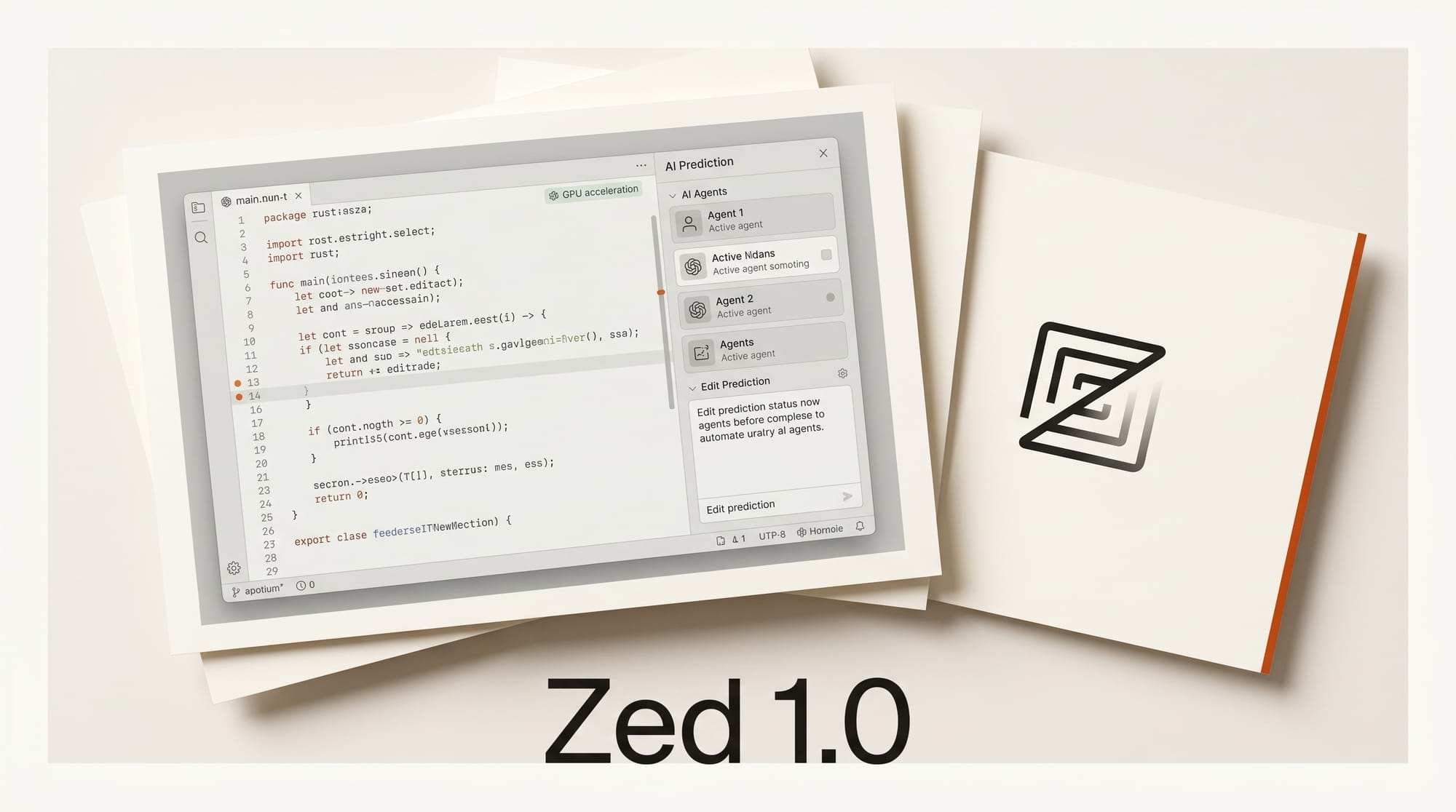
Zed Industries shipped Zed 1.0 on April 29, 2026, marking the stable release of a Rust-built, GPU-accelerated code editor that hundreds of thousands of developers already use daily. The 1.0 milestone formalizes a tooling stance the team has been pushing for years: AI agents are first-class citizens of the editor, not a side panel. For creators who write code as part of their workflow, that shift matters.
The release also lands as the editor wars enter a new phase. Cursor is racing to add agent windows, GitHub Copilot is metering tokens, and remote vibe-coding agents are now table stakes. Zed's pitch is a leaner, faster surface that talks to whichever model you want to drive.
What Happened
The Zed team, originally the engineers behind GitHub's Atom editor, declared 1.0 after a long public beta. The version 1.0 designation, per the team, means the editor has crossed the threshold where most developers can land in it without friction. Coverage from The Register framed the release as both a traditional editor and an AI tool, and the GitHub releases page confirms the 1.0.0 tag dropped on April 29.
Zed runs on macOS, Windows, and Linux, and the codebase remains open source under Apache 2.0. Built from scratch in Rust on top of a custom GPU UI framework called GPUI, it ships keystroke-level responsiveness that older Electron-based editors cannot match.
Why It Matters
Two AI capabilities define the 1.0 story. The first is parallel agents: developers can run multiple coding agents at the same time inside one workspace, watching them work in separate panes. The second is the Agent Client Protocol, an open spec Zed uses to plug in third-party agents. Phoronix's coverage notes that ACP already wires up Claude Agent, OpenAI's Codex, OpenCode, and Cursor, with DeepSeek V4 available through the assistant.
That matters because creators who code, technical artists building ComfyUI nodes, indie devs shipping shaders, designers prototyping interactive sites, get a single editor that does not lock them into one model vendor. Switch agents per task, run two in parallel, keep your keybindings.
Key Details
The 1.0 release adds bookmarks, a "view commit" command palette action, refreshed Git integration, an SSH remoting mode, and a debugger. Edit prediction now offers next-change suggestions at keystroke granularity, similar in spirit to Claude's connector workflow for design and writing apps but tuned for code.
Zed Industries also launched Zed for Business, a paid tier that adds centralized billing, role-based access controls, and team management. Pricing was not disclosed in the launch post. The team is building DeltaDB, a synchronization engine that will let humans and agents share a consistent view of the codebase, signaling that real-time multiplayer coding with AI participants is the next direction.
What to Do Next
If you write code as part of your creative pipeline, install the 1.0 build and try the parallel-agent workflow. The fastest test is opening one agent for refactoring and a second for documentation, both pointed at the same project. Anyone curating their own AI coding stack should also revisit the 2026 AI coding tools landscape to see how Zed sits next to Cursor, GitHub Copilot, and Claude Code.