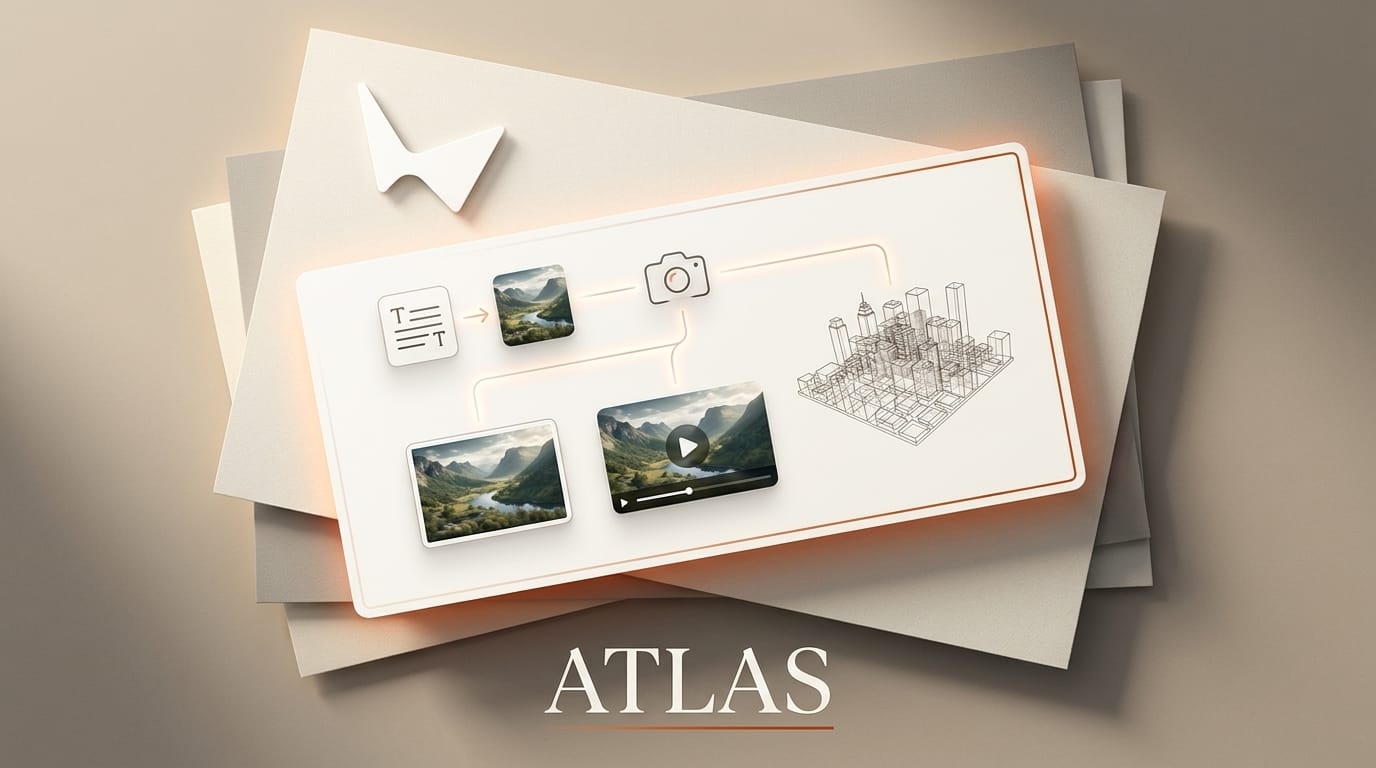
World Labs, the spatial intelligence company founded by Fei-Fei Li, unveiled Atlas on September 1, 2026, a single model trained from scratch to work natively across text, images, video, and 3D. Rather than stitching together separate tools for each medium, Atlas treats space and time as one problem, and it is entering early access with select partners.
What this enables
Atlas gives creators one engine for four jobs that used to need four pipelines. You can generate an image or a video up to one minute long at 1440p with precise camera control, reconstruct a real-world scene from anywhere between one and dozens of photos, simulate how a space changes over time for VFX shots, or spin up 360-degree panoramas from a text prompt. For a 3D artist or virtual production team, that means blocking out a set, a camera move, and a lighting pass inside a single model instead of exporting between a generator, a reconstruction tool, and a compositor.
Why it matters for creators
Most generative video tools still hallucinate geometry the moment the camera moves. Atlas is built as a world model, so it holds a consistent sense of the scene as the viewpoint changes, which is exactly what breaks in clip-to-clip video generation today. World Labs says the reconstruction quality outperforms specialized 3D models, and the same foundation powers its existing product Marble. This is the same shift toward persistent, camera-aware generation that also drove photo-to-3D workflows in ComfyUI, now pushed into a single foundation model.
Key details
Model: Atlas, an omni model pretrained from scratch on text, images, video, and 3D.
Output: Images and video up to one minute at 1440p, plus scene reconstruction and 360 panoramas.
Access: Early access with select partners, with a developer platform for building on top of it.
Availability: Not generally available yet. Access is gated behind an application.
What to do next
If your work touches 3D, virtual production, or spatial capture, request access through the Atlas early access form and line up a test scene you already have reference photos for, so you can benchmark its reconstruction against your current pipeline the moment you get in.