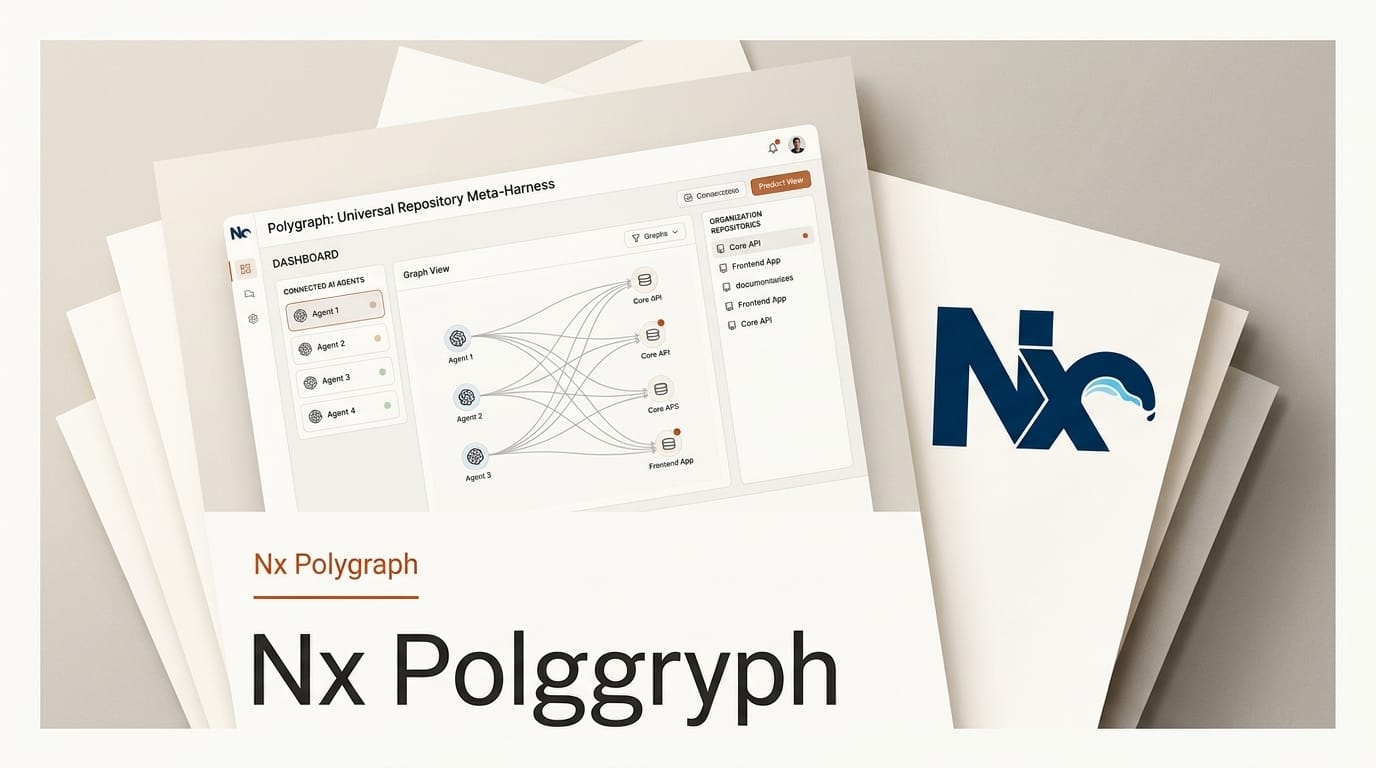
Nx, the company behind the popular monorepo build system, has launched Polygraph, an agent-agnostic "meta-harness" that lets AI coding agents work across all of an organization's repositories instead of one at a time. It went live on June 26, 2026, and is free during early access at trypolygraph.com.
What Happened
Nx (formerly Nrwl) released Polygraph as a layer that wraps around existing coding agents rather than replacing them. As The New Stack reports, it links multiple repos into a single "synthetic monorepo" that an agent can navigate as if it were one codebase. Nx draws the analogy to a meta-framework: just as Next.js adds the missing pieces that make React useful for building real apps, Polygraph adds the missing pieces that make agents autonomous in real workflows. It supports Claude Code, Codex, and OpenCode today, wiring them together over the agent-to-agent (A2A) protocol, with Google's Antigravity and other agents on the roadmap.
Why It Matters
Coding agents are strong inside a single repo but stall the moment a change spans services or depends on someone else's prior work. They also start every session blank, forcing you to re-explain context. Polygraph attacks both limits: it indexes every repo you can access, builds a dependency graph of how they relate through packages and APIs, and records sessions so an agent can resume work and read past decisions. Nx ships it as part of Nx Cloud, positioning it as org-wide infrastructure rather than a single-developer add-on. For anyone building software with AI assistants, that turns a per-repo helper into something closer to an org-wide teammate that can plan a change across services, open the right pull requests, and remember why it made a decision last week. It is the same consolidation pressure reshaping agent tooling from Cursor's acquisition of Continue onward.
Key Details
- Maker: Nx (Nrwl), built on top of Nx Cloud.
- What it does: Connects private and open-source repos into one dependency graph, orchestrates pull requests and CI across them, and keeps persistent, cross-machine session memory.
- Agents supported: Claude Code, Codex, and OpenCode now, with more planned.
- Setup: Nx publishes skills, subagents, and a Claude plugin to wire agents into Polygraph.
- Price: Free during early access.
What to Do Next
If you already run an AI coding agent across more than one repo, sign up for early access at trypolygraph.com and point it at two related projects to see whether cross-repo planning holds up on a real change. Pair it with an agent-aware workflow like version control built for AI agents so the changes your agent makes stay reviewable before they merge.