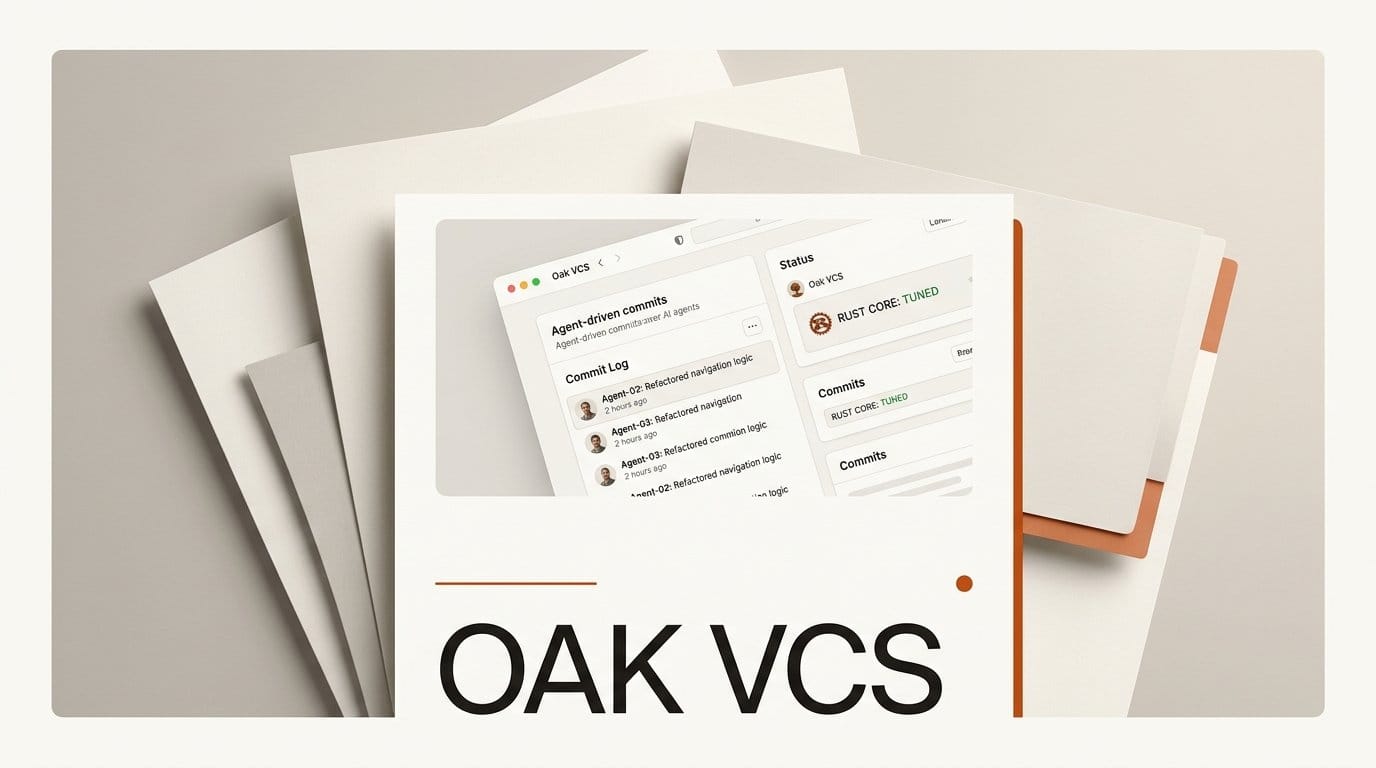
Oak is a new version control system built specifically for AI agents, and it is now in public beta. Where Git was designed for humans committing in bursts, Oak is tuned for the way coding agents actually work: thousands of branches, constant snapshots, and parallel sessions that each need a working tree in seconds, not minutes.
What Happened
Oak reached version 0.99.0 as an open public beta, with prebuilt binaries for macOS on Apple Silicon, Linux on x86_64, and Windows. It is built by Zach Geier with product and visual design from Adam Morse, on top of an open-source Rust core. The pitch is blunt: "version control at the speed of agents." You bring your own agent, whether that is Claude Code, Codex, or Cursor, and Oak is the version control layer underneath.
Why It Matters
Agents generate far more branches and commits than a human ever would, and Git's clone-everything model becomes a bottleneck at that volume. Oak uses content-addressed storage with lazy mounts, so files hydrate on first access instead of up front. According to the project's dev blog, an 800 MB repository is ready to work in before a normal git clone finishes enumerating objects. For a fleet of agents spinning up and tearing down sessions, that startup time compounds quickly.
Key Details
Oak is not a Git wrapper. It is a Rust VCS with its own model, built around BLAKE3 hashing, chunking, and content-addressed diff and merge. The surface stays familiar, though: repos, branches, pull-request-style merges, webhooks, and large-file support. The model swaps per-commit messages for branch descriptions and treats branch-per-session as the unit of work. The documentation covers the CLI commands agents call directly. The core is open source and the project has passed 1,500 stars. Notably, the team says Oak itself was written almost entirely with AI under human oversight, which doubles as a real-world stress test of the agent workflows it is built to support.
What to Do Next
Install the binary for your platform and run oak mount on a mid-sized repo to feel the lazy-load difference. Point one agent session at a branch, let it work, and review the merge as you would a pull request. Because each session is its own branch, you can run several agents in parallel and compare their results side by side before merging the one that worked. If you are mapping out agent-native tooling, our coverage of Cursor's Origin git forge shows where a purpose-built VCS fits next to the editor and the model.