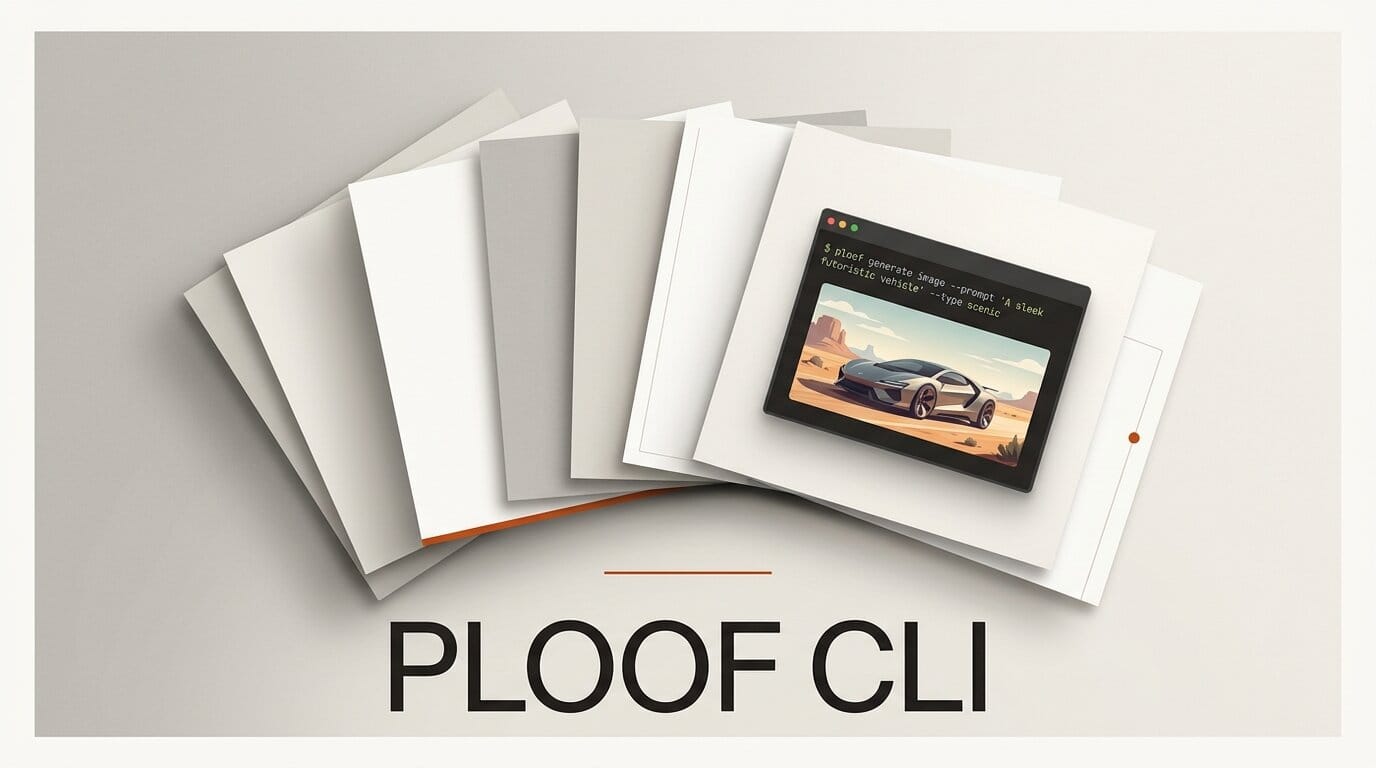
A developer named Mike Tromba has launched Ploof, an open-source command-line tool that lets AI coding agents generate images, video, and audio without leaving the terminal. It went live as a Show HN post on June 29, 2026, and is built specifically for agents like Claude Code, Cursor, and Codex to call on their own.
What Happened
Ploof bills itself as "agent-native": instead of a human clicking through a web UI, you tell your coding agent what assets you need, and the agent installs Ploof, runs a self-documenting ploof learn command to read the current docs, authenticates, and generates the files. The MIT-licensed project surfaced on Hacker News the same day its repository received its latest push, making it one of the freshest entries in the fast-growing category of generation CLIs.
Why It Matters
Coding agents are increasingly building entire apps and sites, but they have historically had to stop and ask a human to source images, voiceovers, or video clips. A CLI designed to be driven by Claude Code and similar tools closes that gap, letting an agent produce the placeholder hero image or narration it needs and keep working. It is the same idea behind the MiniMax terminal CLI for video, music, and images, but Ploof is open source and provider-agnostic rather than tied to one model house.
Key Details
Ploof currently routes to two providers: OpenAI for image generation and editing, Sora-2 video, and speech synthesis and transcription; and fal.ai for its full model marketplace via a generic model run command. Other features built for automation include:
- Batch processing through YAML manifests with dependency management and parallel execution
- JSON and JSONL output plus stable command flags so agents can parse results reliably
- A metadata sidecar for every asset that records the prompt and parameters for reproducibility
- Local credential storage with profile support and environment-variable overrides
It installs globally through npm or Bun and requires Node 18 or later. The approach echoes the all-in-one model access of the Picsart GenAI CLI, but Ploof keeps its footprint small and leans on existing provider accounts.
What to Do Next
Want to try it inside your own agent workflow? Install the global package with bun i -g @miketromba/ploof (or the npm equivalent), then add an OpenAI or fal.ai API key. From there, ask your coding agent to "use ploof to generate a hero image for this landing page" and let it run ploof learn to pick up the latest commands. Because it is MIT-licensed, you can also read the source and adapt the manifest format to your pipeline. If you prefer Bun for speed, grab it from bun.sh first.