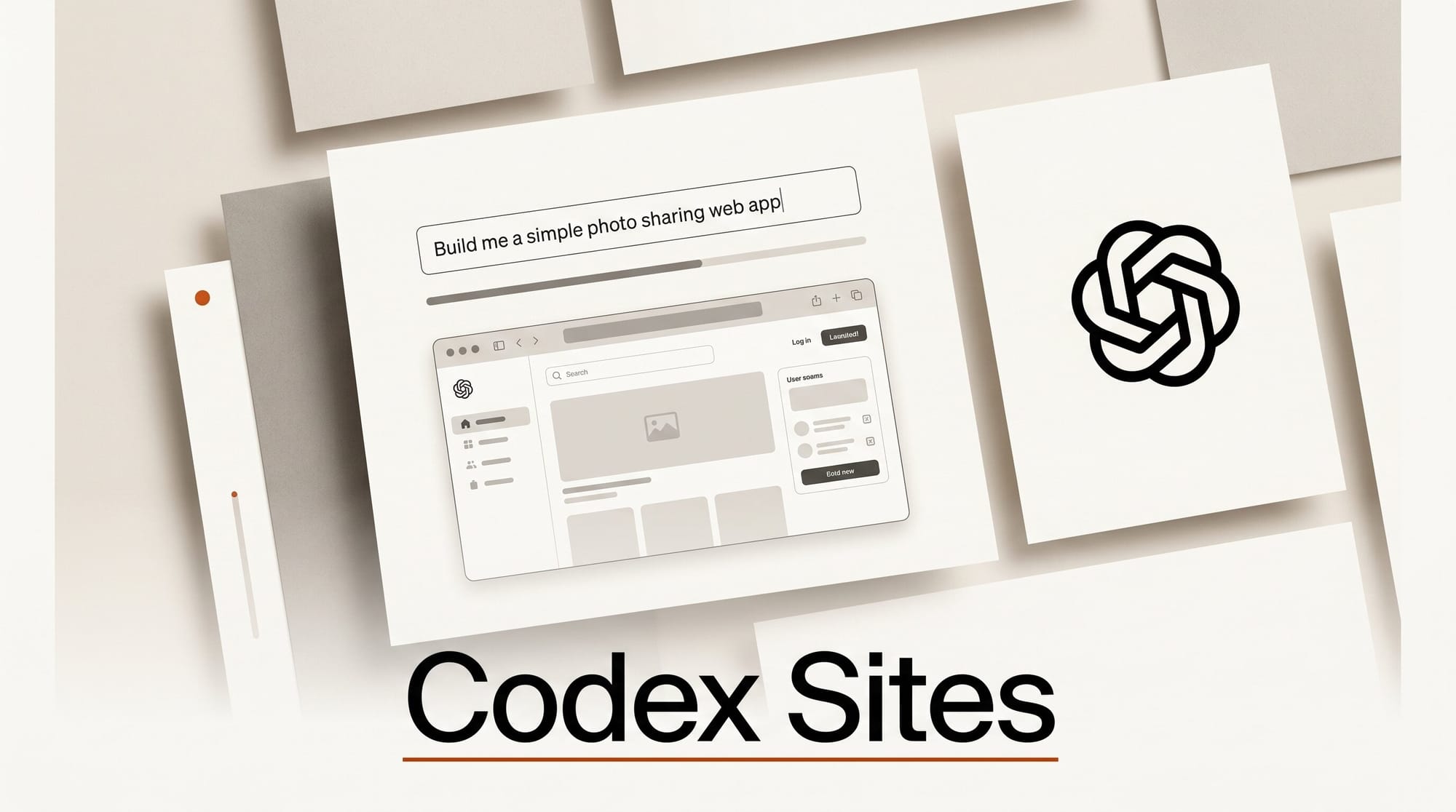
OpenAI launched Sites for Codex at its "Intelligence at Work" event on Tuesday, letting ChatGPT users describe an internal tool in plain English and get back a hosted, authenticated web app at a shareable URL. Codex builds the front-end and back-end, deploys to OpenAI-managed infrastructure, and routes access through Sign in with ChatGPT so only invited teammates can open it.
OpenAI cited 5 million weekly Codex users, with the knowledge-worker (non-developer) segment now growing three times faster than the developer segment. Sites is the surface aimed at that audience.
How to Integrate This
Open Codex inside ChatGPT, describe the tool you want ("a dashboard that pulls open issues from our project tracker, groups by team, and lets owners reassign"), and Codex returns a preview tied to a Git commit. Approve the commit, hit deploy, and Sites publishes the app to an OpenAI-hosted URL. You set the audience scope per site: owner-only, workspace-wide, or a custom invite list. Persistent storage is wired through a built-in relational store (D1) and object store (R2), and environment variables and secrets live in a Sites panel rather than in code. The two-stage save then deploy flow means you can keep iterating on a draft commit while teammates keep using the previously approved version.
Why It Matters
Internal-tool building has been the long tail of software: every team needs a status dashboard or an intake form, none of them are worth a six-week build. Sites collapses that into a prompt, and because OpenAI hosts everything, you skip the usual Vercel-plus-Supabase wiring. The competitive read here is that this puts OpenAI head-to-head with Retool and Replit Agents for the internal-tools slot inside Fortune 500 workspaces, and it ties internal tooling directly to ChatGPT seats your company already pays for. The role-specific plugins OpenAI released alongside Sites (data analytics, creative production, sales, product design, investing, and banking) plug into the same workspace fabric.
Key Details
Sites is in preview for ChatGPT Business and Enterprise tiers, with broader rollout planned. Business workspaces include Sites by default; Enterprise admins must enable it through role-based access control before members can use it. Codex generates output as ES modules, so the produced apps run in standard browsers without a custom runtime. The full Codex changelog covers companion shipping items including the Codex IDE getting persistent project memory and a new shared review surface for agent runs.
What to Do Next
If your team has a ChatGPT Business workspace, build your simplest internal request as a Site this week (a vacation-day tracker, an OKR roll-up, a vendor-contact lookup) and measure the prompt-to-deploy time against your current Notion-plus-Sheets workaround. For solo creators on ChatGPT Plus, Sites is gated by workspace tier today, so the immediate move is to track the rollout. Our prior coverage of Codex Computer Use on Windows and our 2026 image-generator comparison cover the adjacent Codex surfaces creators are pairing with Sites for end-to-end production work.