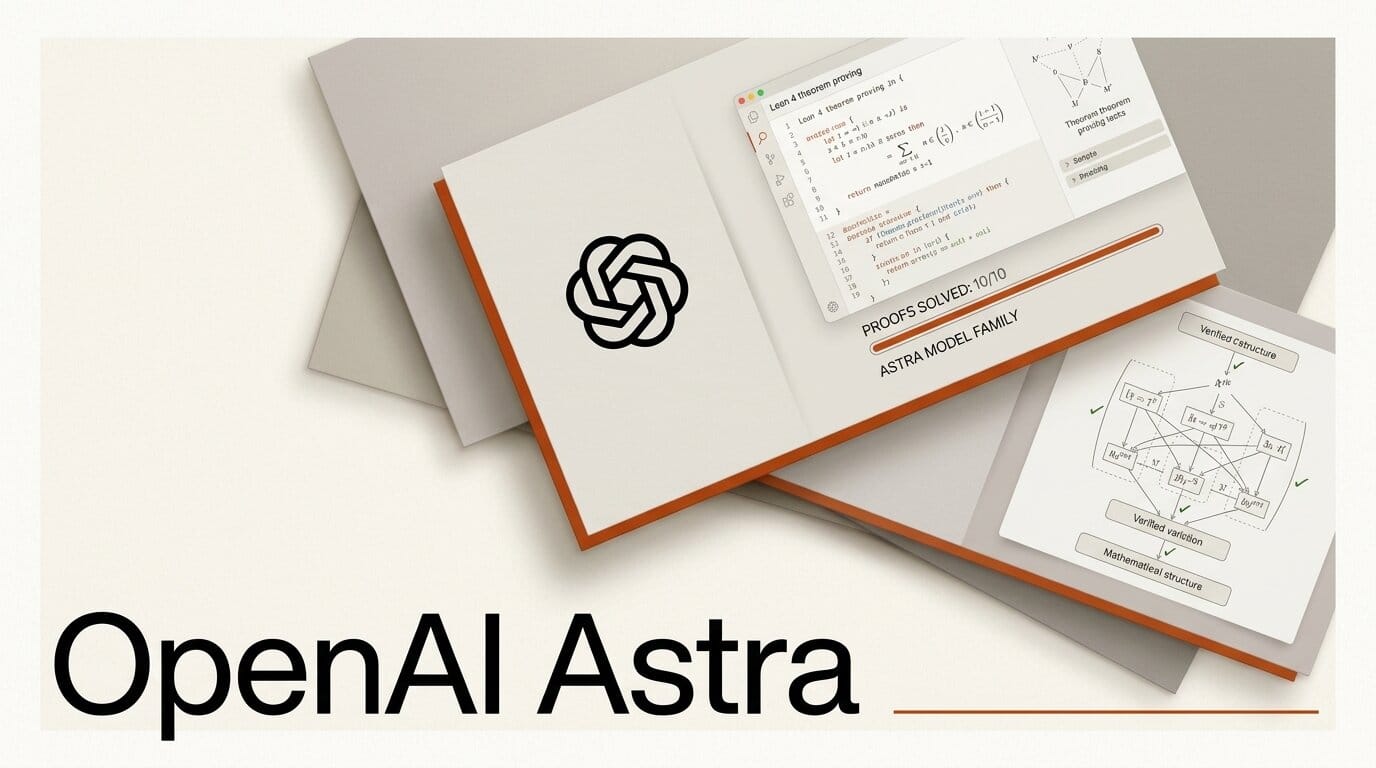
OpenAI has revealed the first results from Astra, described as its next major model family, by publishing ten solutions to math and theoretical computer science problems that had been open for at least a decade. The results landed on August 1, 2026. Astra is still in internal testing and is not available to the public, so this is an announcement of a coming model, not a product you can use today.
What Was Announced
OpenAI released the results inside a research report, with researcher Noam Brown amplifying the work on X. According to The Next Web, an internal version of Astra solved ten long-standing problems spanning high-dimensional geometry, coding theory, group theory, quantum complexity, lattice cryptography, and extremal combinatorics. The headline result is the first explicit construction of a non-sofic group, a question open since 1999.
Every proof is formalized in Lean 4 with machine-checkable certificates, and OpenAI published a 249-page manuscript alongside the code on GitHub and a full PDF of the proofs. OpenAI says the model works by coordinating multiple agents that plan, run tests, and revise over hours or days, more like a research team than a single-shot chatbot. As Gizmodo put it, the Astra name was effectively slipped into a blog post about math.
What This Means for Creators
You cannot build on Astra yet, so the near-term action is to track it, not to swap it into a pipeline. What matters for builders is the signal: OpenAI is naming a new top-tier family and pointing it at long-horizon, multi-agent tasks that run for hours. If that reasoning depth reaches a public API, the agent frameworks and coding tools most creators sit on top of are the layer that would inherit it first. Read the announcement, note the multi-agent framing, and watch for a preview or API tier before changing any workflow.
Why It Matters
A model that resolves decade-old conjectures with verifiable Lean proofs is a real capability signal, not a benchmark score that can be gamed. It is also a reminder to stay skeptical: critics including Gary Marcus argue that excelling at math, where answers are verifiable and synthetic training data is abundant, does not automatically translate to general creative or reasoning ability. The honest read is that Astra looks strong in a narrow, checkable domain, and its broader usefulness stays unproven until it ships.
What to Do Next
Bookmark OpenAI's proof manuscript and GitHub repository if you want the technical detail, and keep an eye out for any Astra preview or developer access. Until there is a public endpoint, treat this as roadmap intelligence about where the next major model generation is headed, not as a tool to adopt.