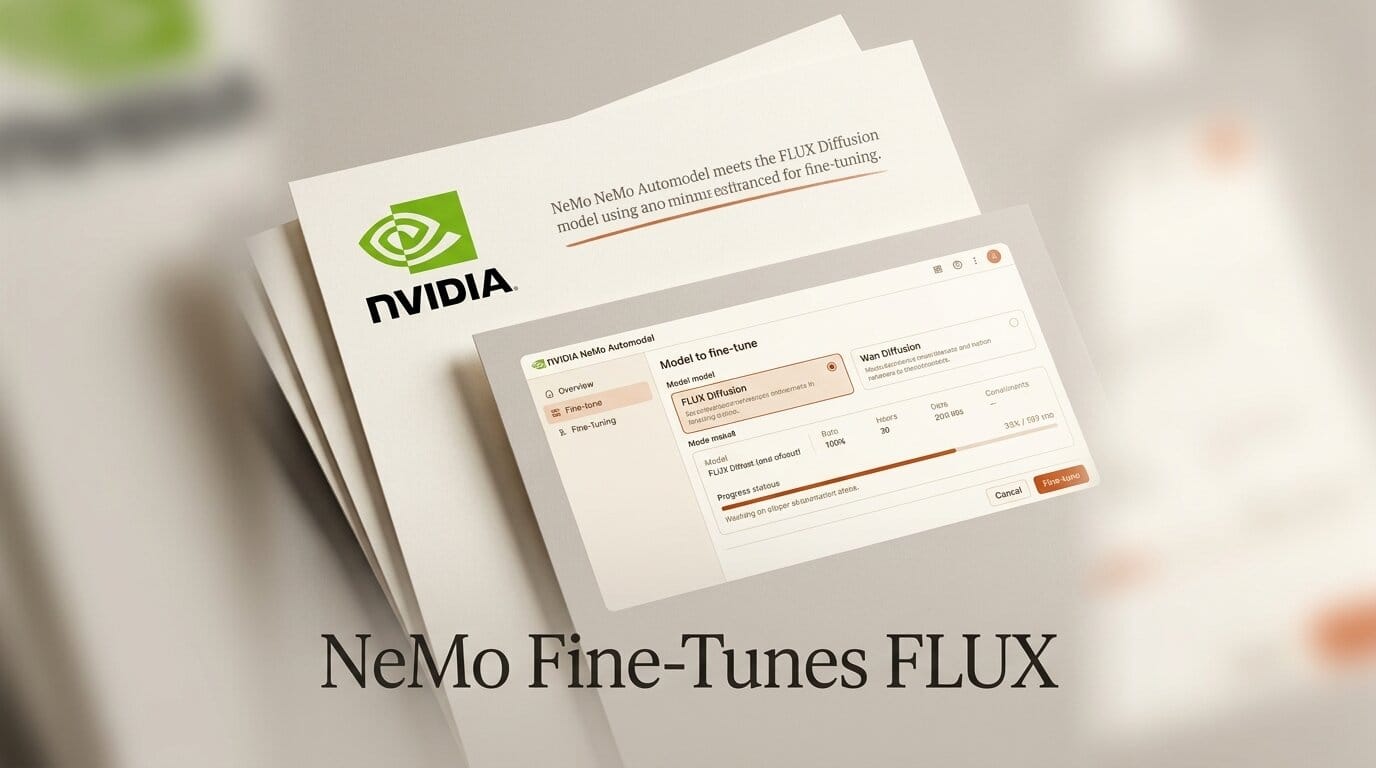
NVIDIA and Hugging Face have made it possible to fine-tune popular Diffusers image and video models at scale using NeMo Automodel. The integration, detailed on July 17, lets creators train custom versions of FLUX.2, Qwen-Image, Wan 2.2, and HunyuanVideo 1.5 with either LoRA or full fine-tuning, straight from the same Diffusers checkpoints they already use for generation.
What This Enables
If you have ever wanted a FLUX model that nails your brand style, a character that stays consistent across a video series, or a Wan model tuned to a specific look, this is the training path. NeMo Automodel reads standard Hugging Face Diffusers checkpoints, so there is no format conversion step. You pre-encode your dataset, launch training from a YAML config, and generate from the fine-tuned checkpoint. LoRA training keeps the footprint small enough for a single workstation GPU, while full fine-tuning scales across multiple GPUs for larger runs.
Why It Matters for Creators
Custom LoRAs are the backbone of consistent AI art and video, and until now most creators trained them with community scripts that broke on each new model release. Tying training directly to the Diffusers library means that the day a model like FLUX.2 or HunyuanVideo 1.5 lands, you can fine-tune it with the same tool. Once your checkpoint is ready, you can load the resulting weights into an inference workflow such as ComfyUI for production.
Key Details
Supported image models: FLUX.1-dev (12B), FLUX.2-dev (32B), and Qwen-Image (20B).
Supported video models: Wan 2.1 (1.3B and 14B), Wan 2.2 (27B MoE), and HunyuanVideo 1.5 (13B).
Training modes: Full fine-tuning and LoRA-style parameter-efficient training, both demonstrated end to end.
Install: Docker container, pip, or from source via the NeMo Automodel GitHub repo.
What to Do Next
Start with the end-to-end diffusion fine-tuning recipe, which walks through dataset pre-encoding, launching a run, and sampling from your checkpoint. If you are on a single GPU, pick LoRA first, then scale to full fine-tuning once your dataset and settings are dialed in. Clone the repo and try a small run on a handful of your own images before committing to a long training job.