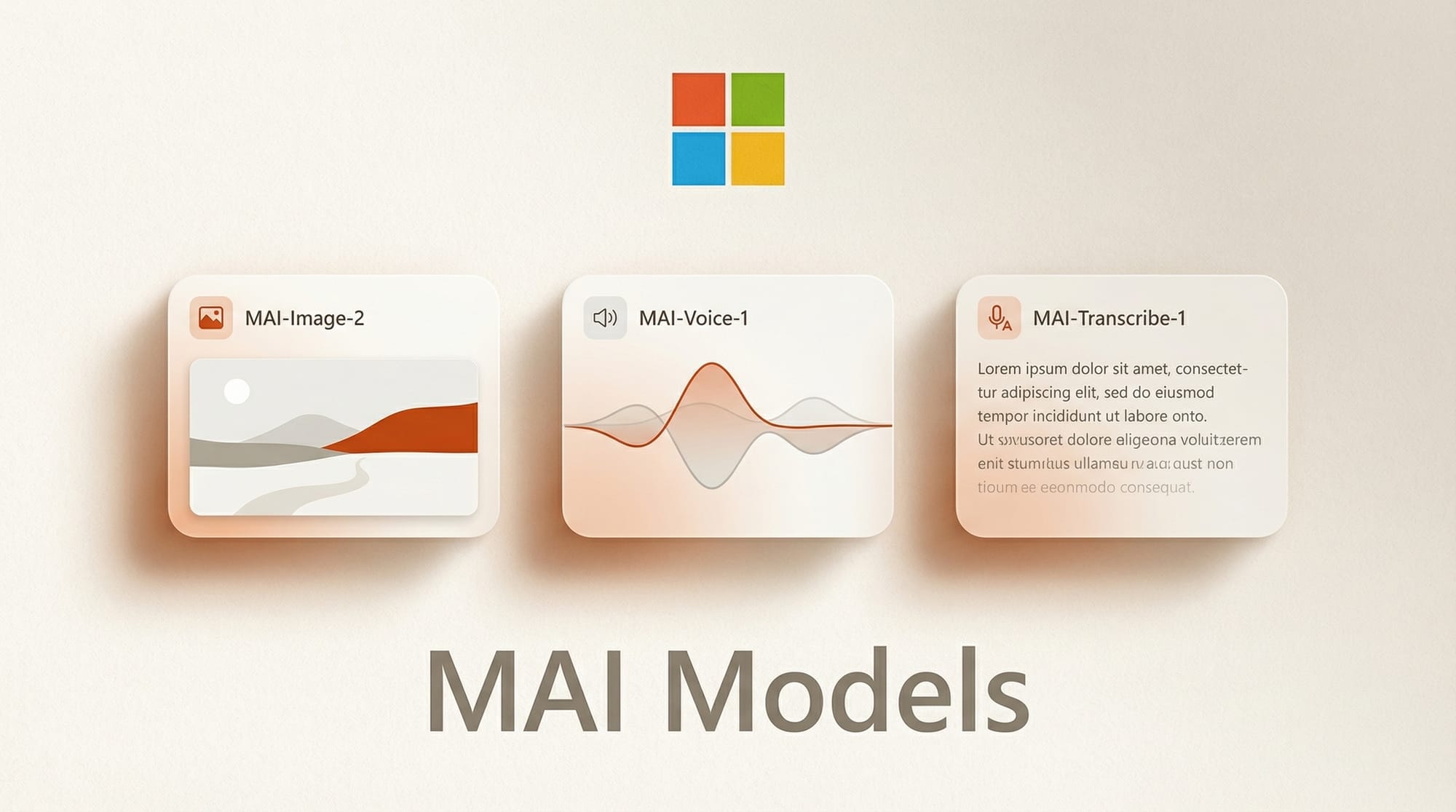
Microsoft launched three in-house AI models on April 2, reducing its dependence on OpenAI for core capabilities. MAI-Image-2, MAI-Voice-1, and MAI-Transcribe-1 cover image generation, text-to-speech, and speech recognition, all built by teams of fewer than 10 engineers using half the GPU resources of competing models.
For the broader landscape, see our complete guide to AI image generation in 2026.
What Happened
Microsoft released three foundation models through its Microsoft Foundry platform and a new MAI Playground:
- MAI-Image-2: A text-to-image model that debuted at number three on the Arena.ai leaderboard for image model families. It powers Copilot, Bing Image Creator, and PowerPoint. Pricing starts at $5 per million input tokens and $33 per million output tokens.
- MAI-Voice-1: A text-to-speech model that generates 60 seconds of expressive audio in under one second on a single GPU. It supports custom voice cloning and is priced at $22 per million characters.
- MAI-Transcribe-1: A speech-to-text model with a 3.8% word error rate, beating Whisper-large-v3 across all 25 supported languages. Enterprise pricing starts at $0.36 per hour of transcribed audio.
Why It Matters
These releases mark the clearest signal yet that Microsoft is building its own AI model stack rather than relying solely on its OpenAI partnership. Each model was developed by a small team, and the company claims they use roughly half the compute of comparable alternatives. For creative professionals, this means more competition in image generation, voice synthesis, and transcription, which typically drives prices down and quality up.
MAI-Image-2 landing third on the Arena.ai leaderboard is notable for a first-generation Microsoft image model. MAI-Voice-1 speed (60 seconds of audio in one second) makes it practical for real-time applications like video narration and podcast production. MAI-Transcribe-1 beating Whisper across every language gives creators a stronger option for multilingual content workflows.
Key Details
- All three models are available now through Microsoft Foundry and the MAI Playground
- MAI-Image-2 already powers Copilot, Bing Image Creator, and PowerPoint
- MAI-Voice-1 supports custom voice cloning for brand-consistent narration
- MAI-Transcribe-1 supports 25 languages at enterprise-grade accuracy
- Each model was built by teams of fewer than 10 engineers
- Microsoft claims approximately 50% lower GPU costs compared to leading alternatives
What to Do Next
Test MAI-Image-2 in the MAI Playground to compare it against your current image generation tools. If you produce multilingual content, try MAI-Transcribe-1 through Microsoft Foundry to see how it handles your target languages. Voice-over creators should explore MAI-Voice-1 cloning capabilities for faster audio production. All three models are available for immediate testing.