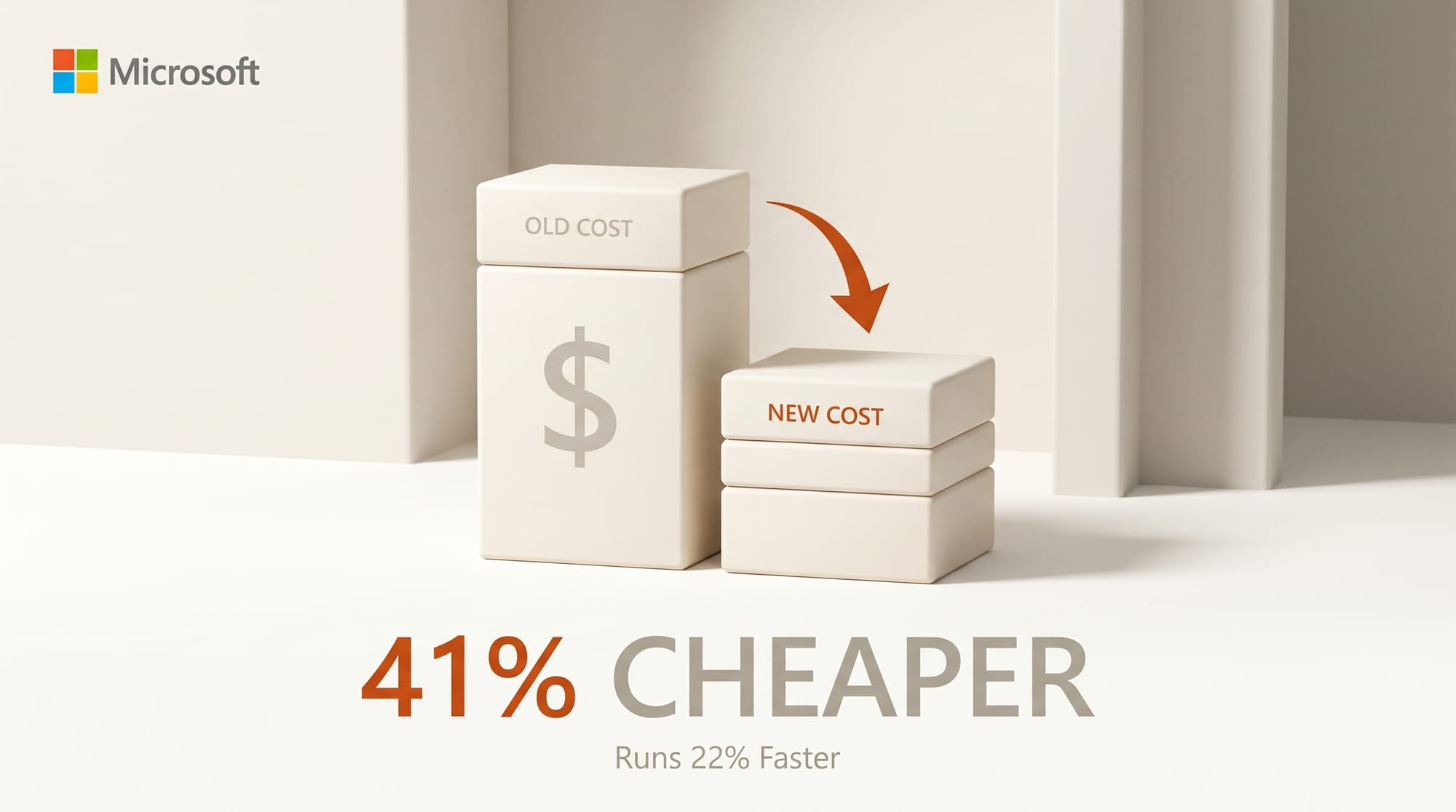
Microsoft launched MAI-Image-2-Efficient on April 14, 2026, a faster and cheaper sibling of its flagship MAI-Image-2 text-to-image model. The new variant costs $19.50 per million output image tokens, a 41% drop from the flagship's $33, and runs 22% faster per request on the same NVIDIA H100 hardware. It is available now in Microsoft Foundry and the MAI Playground for production workloads.
For the broader landscape, see our complete guide to AI image generation in 2026.
What Happened
MAI-Image-2-Efficient is a distilled, production-tuned version of MAI-Image-2, which debuted in March at No. 3 on the LMArena image leaderboard. Microsoft's AI team kept input pricing flat at $5 per million tokens but cut output pricing by nearly half, and the redesign delivers 4x greater throughput per GPU at 1024x1024 resolution. Internal benchmarks cited by Microsoft also claim 40% better latency than Google's Gemini 3.1 Flash on the same test set.
The model is positioned for what Microsoft calls "assembly line" work: product photography, marketing assets, UI mockups, branded pipelines, and real-time interactive features. Short-form in-image text like headlines, button labels, and price tags renders cleanly, which matches the e-commerce and ad-ops use cases the team highlighted. Developers can pull the model directly from the Azure AI Foundry catalog or test it in the hosted MAI Playground.
Why It Matters
The release is Microsoft's fastest turnaround yet from a flagship launch to a cost-optimized variant, and it lands just weeks after Microsoft unveiled its first fully in-house image, voice, and transcription models. The MAI family now replaces DALL-E as the default image engine in Microsoft Copilot, which means the company keeps every inference dollar instead of routing licensing fees to OpenAI. That independence gives Microsoft room to price aggressively and iterate on its own schedule.
For creators and studios running batch image pipelines, the economics are significant. At 41% cheaper output tokens, a production team generating 10,000 product shots per month sees a real dent in monthly cloud spend, and the latency win makes the model usable inside agentic workflows where an assistant might fire off dozens of iterations in a single request. The trade-off, as with any distilled model, is that creative nuance and stylistic range will likely trail the flagship on harder prompts, so art directors should treat Efficient as a workhorse and keep MAI-Image-2 in reserve for hero frames.
Key Details
- Launched: April 14, 2026
- Pricing: $5 per million input tokens, $19.50 per million output image tokens (41% below MAI-Image-2's $33)
- Speed: 22% faster per request than MAI-Image-2, 4x throughput per GPU on NVIDIA H100 at 1024x1024
- Latency claim: 40% better than Google Gemini 3.1 Flash on Microsoft's internal benchmark
- Availability: Microsoft Foundry catalog and MAI Playground, with Azure AI API access for developers
- Targets: Product photography, marketing creative, UI mockups, branded asset pipelines, real-time interactive apps
What to Do Next
If you run a high-volume image pipeline, re-run your cost model against the new output-token price and benchmark Efficient against your current generator on your actual prompt library, not marketing samples. If you work in design or marketing ops, pilot the model on throwaway assets (thumbnails, social variants, UI placeholders) before pushing it to hero campaigns where the flagship MAI-Image-2 or premium models may still have an edge. Thurrott's review notes that Microsoft is leaning on these MAI variants to make Copilot's image tools feel instant for consumer users, so expect the default image quality in Copilot to rise quietly over the next few weeks.