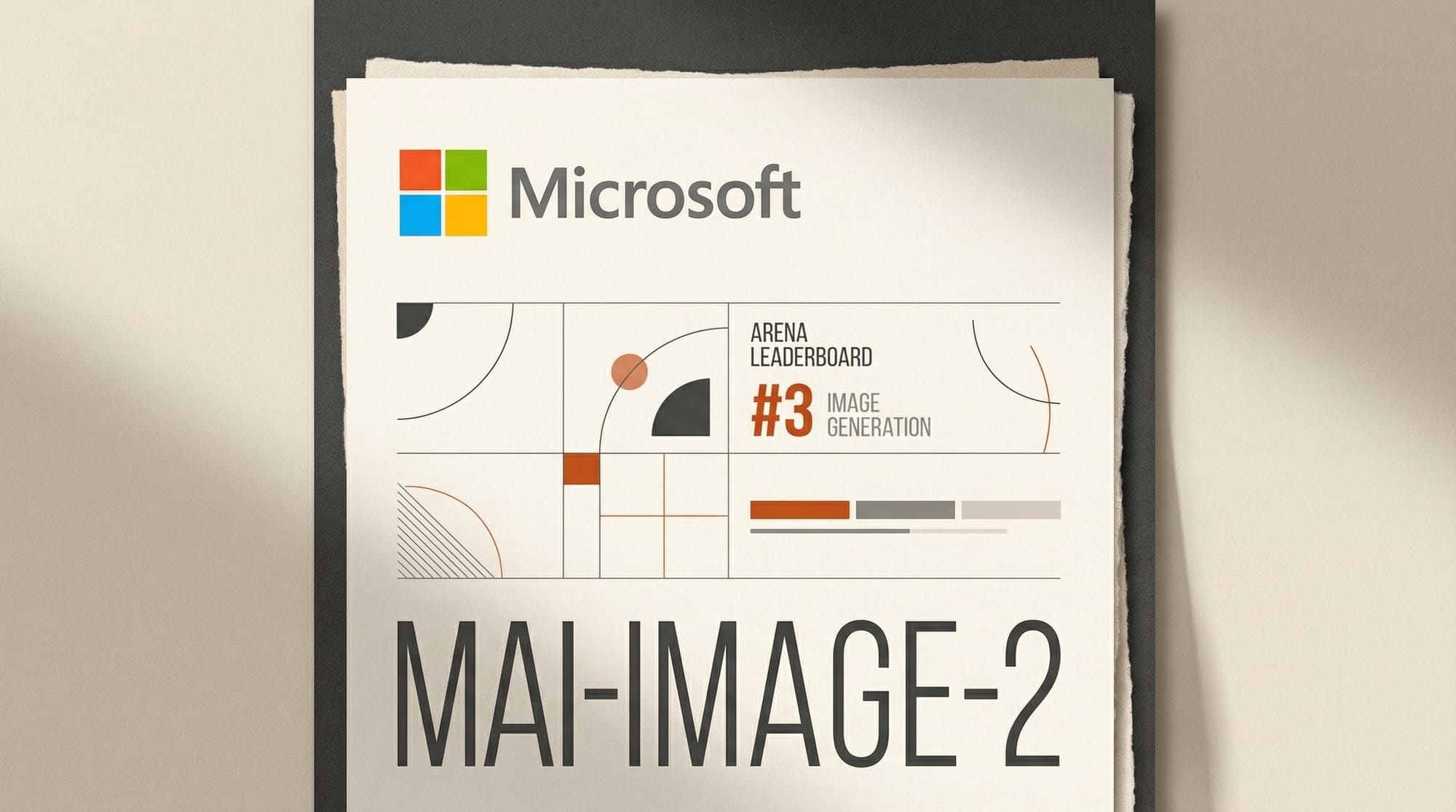
Microsoft's superintelligence team shipped MAI-Image-2, a text-to-image model that debuted at number three on the Arena.ai leaderboard. The model is available now in the MAI Playground and rolling out to Copilot and Bing Image Creator.
For the broader landscape, see our complete guide to AI image generation in 2026.
What Happened
MAI-Image-2 is a Microsoft-built image generation model, developed independently from OpenAI's DALL-E line. It launched March 19 with strong performance in photorealism, complex scene composition, and in-image text rendering, a historically weak area for AI models. The model entered the Arena.ai leaderboard at third place overall.
Microsoft is making the model available for free through the MAI Playground, with enterprise API access coming through Microsoft Foundry. The consumer rollout to Copilot and Bing Image Creator is in progress.
Why It Matters
Microsoft building its own competitive image model outside of its OpenAI partnership signals a broader strategy shift. For creators, MAI-Image-2's text rendering capabilities address one of the biggest pain points in AI image generation. Accurate text in generated images means fewer manual fixes for posters, infographics, and social media graphics, an area where even Midjourney V8 still struggles.
Key Details
- Ranked #3 on Arena.ai image generation leaderboard at launch
- Free in the MAI Playground with generation limits
- Currently limited to 1:1 square aspect ratio only
- 30-second cooldown between generations, 15-image daily limit
- Enterprise API access coming via Microsoft Foundry
- Built by Microsoft's superintelligence team, not a repackaged DALL-E product
What to Do Next
Try MAI-Image-2 in the MAI Playground for free. The model's text rendering makes it particularly useful for creating graphics with readable text, which remains a weakness across most competitors. Keep in mind the current 1:1 aspect ratio limitation means no landscape or portrait outputs yet. For professional workflows requiring flexible aspect ratios and higher volume, broader API access is expected through Microsoft Foundry in the coming weeks.