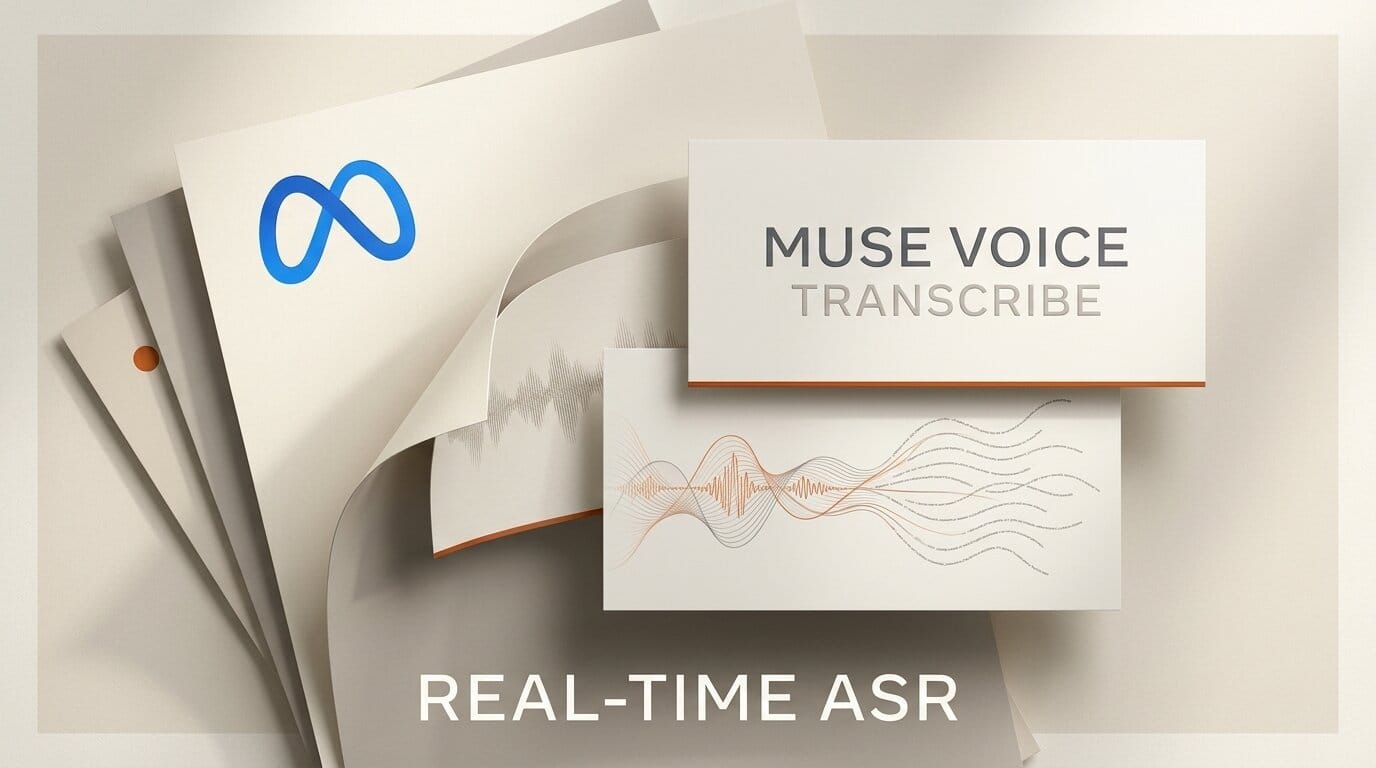
Meta shipped Muse Voice Transcribe on September 1, 2026, a real-time speech-to-text model that streams transcription, tells apart more than 20 speakers, and decides when a sentence ends, all in one model. It posts a 3.1% word error rate and ranks first on the Artificial Analysis streaming speech-to-text leaderboard, and it is available today through the Meta Model API.
What this enables
One model now covers the three jobs a caption or dictation pipeline usually stitches together from separate services: streaming recognition, speaker diarization for 20-plus voices, and endpointing. For creators, that means live captioning, podcast and interview transcripts with per-speaker labels, and voice dictation that keeps up in real time, without wiring up a multi-vendor chain. Meta already uses it to power hold-Fn dictation in Meta AI for Mac and in Muse Code, so you can type into any Mac app by voice.
Why It Matters for Creators
The differentiator is what Meta calls adaptive delay: instead of a fixed speed-versus-accuracy tradeoff, the model listens longer on hard words and moves fast through easy ones. That is why it edges out the real-time transcription field, landing ahead of Cartesia Ink-2, ElevenLabs Scribe v2 Realtime, GPT Live Transcribe, and Gemini 3.5 Transcribe Live on streaming accuracy. For anyone captioning video or building a voice interface, lower error rates on live audio translate directly into fewer manual corrections. The model also reports a 17.5% diarization error rate and was trained on more than 70 languages with 25 extensively verified, so multi-speaker and multilingual recordings are in scope rather than an afterthought.
Key Details
Model: Muse Voice Transcribe, from Meta Superintelligence Labs
Capabilities: streaming ASR, speaker diarization (20+ speakers), endpointing
Accuracy: 3.1% word error rate, 17.5% diarization error rate, first on Artificial Analysis streaming STT
Languages: trained on 70+, with 25 extensively verified
Pricing: $3 per 1,000 audio-minutes, about $0.18 per hour, via the Meta Model API
What to Do Next
If you caption or transcribe as part of your workflow, benchmark Muse Voice Transcribe against your current speech-to-text tool on your own audio, especially multi-speaker recordings where diarization matters. Mac users can try dictation immediately by holding the Fn key in Meta AI. 9to5Mac has a walkthrough of the Mac dictation setup.