Researchers from UC San Diego and Google Research published Live Music Diffusion Models (LMDMs) on May 21, 2026, demonstrating that diffusion-based music generation can run interactively in real time on consumer hardware. The paper is at arXiv 2605.22717.
What Happened
Diffusion models produce high-quality music but have been too slow for real-time generation, leaving that space to faster discrete autoregressive models like Suno. The LMDM paper closes this gap with block-wise KV Caching, a technique that batches the model's key-value computations to match and exceed the performance of existing real-time approaches while running locally on a consumer gaming laptop.
The researchers also introduced ARC-Forcing, a post-training alignment method that reduces the error accumulation that typically degrades long-form music generation. Unlike other alignment techniques, ARC-Forcing requires no reinforcement learning, no reward models, and adds only 0.06 billion parameters to the base model.
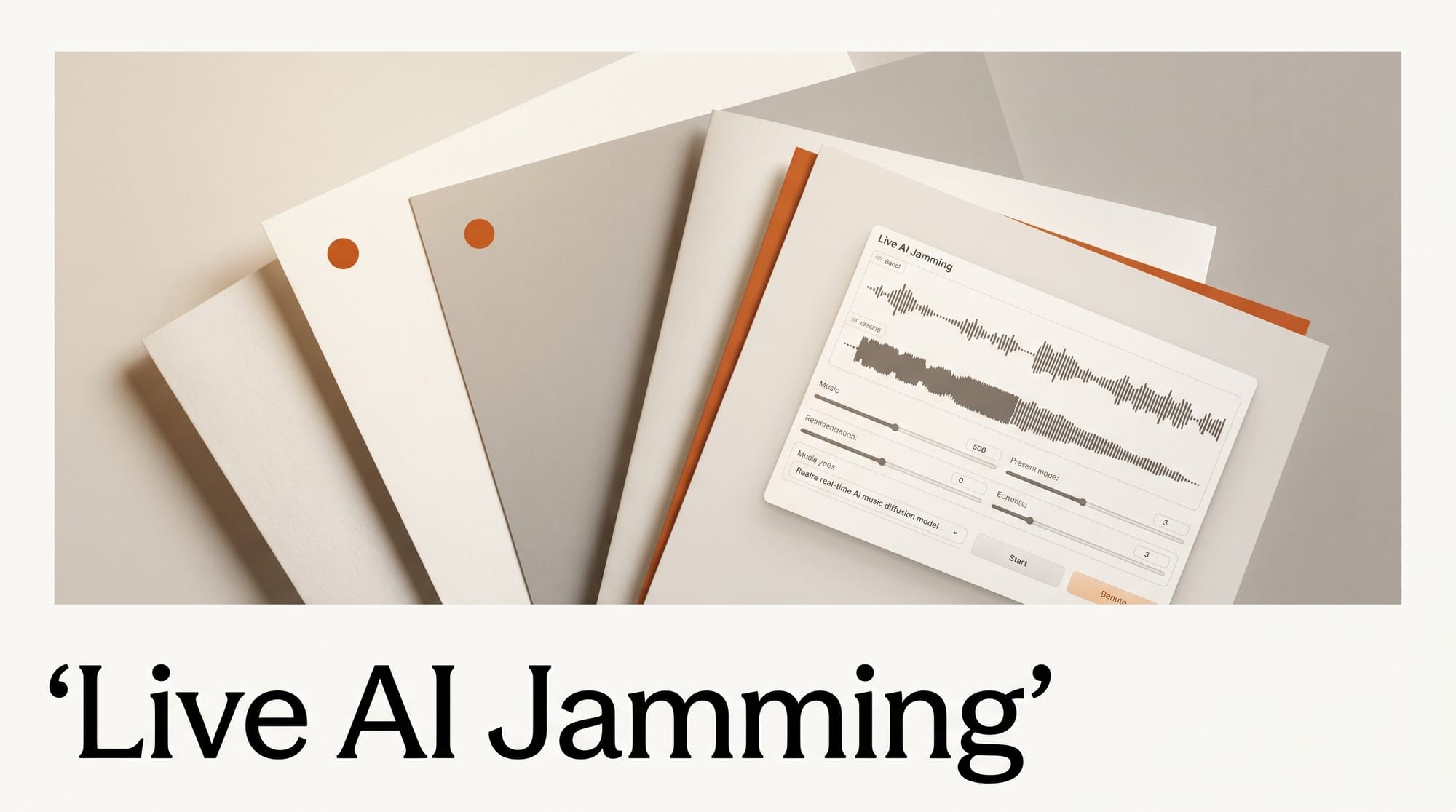
Three applications were demonstrated: text-conditioned music generation, sketch-based synthesis from melodic inputs, and real-time live jamming where an AI acts as a generative delay effect on a musician's improvisation.
Why It Matters
Most AI music tools today are prompt-in, audio-out pipelines. You describe what you want, wait for generation, and evaluate the result. The loop is one-directional.
The live jamming application demonstrated in this paper works differently. A musician plays in real time, and the model transforms that input as it arrives, producing timbral variations and extensions of the improvisation. The result is closer to playing with a human collaborator than using a generation tool.
Critically, this ran on a consumer gaming laptop, not a cloud server. For musicians who want to experiment with AI in live performance without data leaving their machine or requiring internet access, local inference at this quality level is a meaningful shift.
For context on where AI music generation stands today, see the recent coverage of Stable Audio 3 open weights release.
Key Details
- Authors: Zachary Novack and 10 collaborators from UC San Diego and Google Research
- Method: Block-wise KV Caching for real-time diffusion speed; ARC-Forcing for long-form alignment post-training
- Hardware: Consumer gaming laptop for local inference
- Applications: Text-conditioned generation, sketch synthesis, real-time live jamming
- Status: arXiv preprint; no public model or code released yet
What to Do Next
No model or code release is available yet. The project page linked from the paper includes audio demonstrations worth reviewing to hear the quality of real-time output.
For AI music creation available now, Udio generates high-quality audio from text prompts. Neither Udio nor Suno supports real-time interactive input yet, which is what this research moves toward.