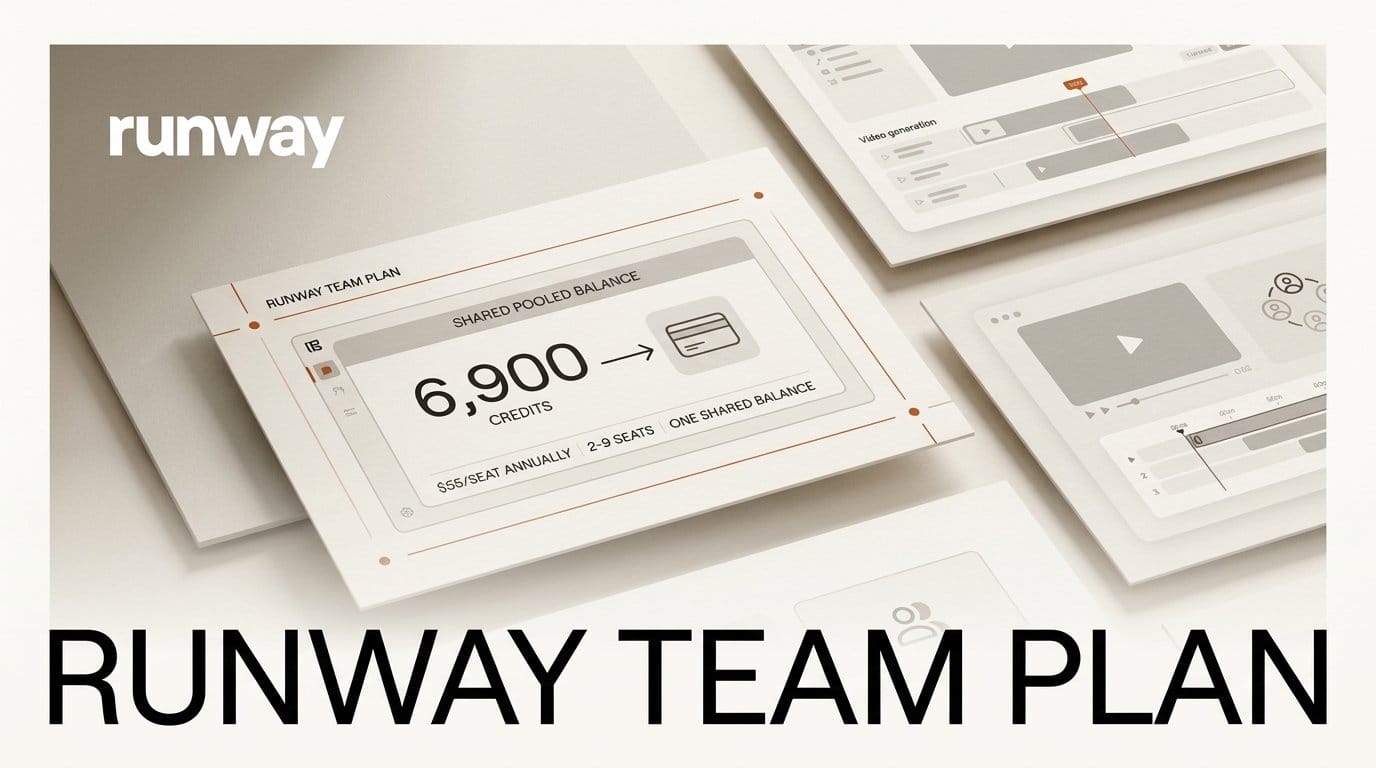
Runway launched a Team plan on September 4, 2026, its first multi-seat tier built around a shared credit balance. It costs $69 per seat per month, or $55 per seat billed annually, covers 2 to 9 seats, and adds 6,900 credits per seat into one pooled balance rather than handing each person a separate allowance. The announcement also quietly reclassifies the rest of the lineup: Standard, Pro and Max are now individual plans.
The interesting part is not the headline price. It is what happens when you divide credits by dollars. On monthly billing, Team delivers exactly 100 credits per dollar. So does Max. Runway did not charge a collaboration premium and did not offer a volume discount either. It priced the team tier at precisely the same credit rate as its top individual plan, which means the thing you are actually buying is the pool.

What Runway Shipped
Team is a workspace tier rather than a new model or a new capability. Every seat contributes 6,900 credits per month to a single shared balance, so there are no individual allowances to track and no manual transfers between teammates. The plan includes up to 100 shared projects, Brand Kits, 1TB of storage, and up to 20 agent skills shared across the workspace. Agent Connectors bring Figma, Dropbox and Notion into the creative agent.
The seat range is the constraint most teams will hit first. Team stops at 9 seats. At 10 or more you are routed to Enterprise, which is quoted rather than listed and adds things like SSO.
Existing customers are not forced to move. Runway states that if a workspace already has multiple members on Standard, Pro or Max, nothing changes: everyone keeps their access and the pricing stays the same. That grandfathering matters, because as the sections below show, the migration is not automatically a saving.
Every Runway Tier, Side by Side
The individual tiers are listed on the pricing page; the Team figures come from the launch announcement, which is currently the only place the 6,900 credit number is published. Annual prices reflect Runway's 20% annual discount, which it applies uniformly across every tier.
| Plan | Monthly | Billed annually | Credits/month | Storage | Projects |
|---|---|---|---|---|---|
| Free | $0 | $0 | 125 one-time | 5GB | Individual |
| Standard | $15 | $12 | 625 | 20GB | Up to 3 |
| Pro | $35 | $28 | 2,250 | 100GB | Up to 5, 1 Brand Kit |
| Max | $95 | $76 | 9,500 | 500GB | Up to 10, up to 3 Brand Kits |
| Team (per seat) | $69 | $55 | 6,900, pooled | 1TB shared | Up to 100 shared |
Read the storage column carefully. Team's 1TB is shared across the whole workspace, while Max's 500GB is per seat. Three Max seats therefore hold 1.5TB of siloed storage against Team's 1TB of shared storage. Team is a large jump over Pro's 100GB per seat, but it is not strictly more storage than the tier above it.
Team Costs Exactly What Max Costs Per Credit
Divide credits by price and the pattern is unmistakable:
- Standard: 625 credits at $15 is 41.7 credits per dollar; at $12 annually, 52.1
- Pro: 2,250 at $35 is 64.3 credits per dollar; at $28 annually, 80.4
- Max: 9,500 at $95 is 100.0 credits per dollar; at $76 annually, 125.0
- Team: 6,900 at $69 is 100.0 credits per dollar; at $55 annually, 125.5
On monthly billing the match is exact to the credit. On annual billing Team edges Max by 0.4%, which is rounding rather than a discount. Runway's generation volume is priced the same whether you buy it as one power user or as a team, and that is a deliberate choice worth naming: many creative tools charge more per seat for collaboration features, and some charge less to buy volume. Runway did neither.

The Product Is Pooling, Not Price
If the rate is identical, the value has to come from somewhere else, and it does: siloed allowances strand credits.
Take a three-person studio on Pro. That is $84 per month annually and 6,750 credits, but the credits arrive as three separate 2,250 buckets. If your lead editor needs 5,000 credits for a client cut this month, they hit a wall at 2,250 while two teammates leave 4,500 credits unspent. The team collectively holds more than enough capacity and still cannot finish the job. Under siloed billing the binding constraint is never the team total, it is the heaviest single user's allowance.
Three Team seats cost $165 per month annually and produce 20,700 pooled credits with no internal wall. That is 1.96 times the cost of three Pro seats for 3.07 times the credits, plus the pooling. Scale it up and the shape holds: nine seats, the Team maximum, is $495 per month annually for 62,100 pooled credits.
Pooling is worth the most to teams with uneven workloads, which describes most small studios. An agency where one animator renders constantly and two people mostly review and comment gets very little from three equal allowances. The same is true of any workspace with a burst pattern, where a pitch week consumes what the following three weeks do not.
Which Plan a Small Studio Should Actually Pick
Work through it in this order:
- Measure your heaviest month, per person. Pull the last three months of usage from your workspace billing settings and find the single largest individual figure, not the team average. That number decides whether siloed allowances can work at all.
- Check that number against 2,250. If your busiest person never exceeds a Pro allowance, individual Pro seats remain the cheapest path and Team is an upgrade you do not need yet.
- If one person regularly exceeds their allowance while others underspend, pool. This is the exact failure Team fixes, and it is the only condition under which the higher per-seat price pays for itself.
- If everyone is heavy, price Max against Team. Three Max seats deliver 28,500 credits for $228 monthly on annual billing against Team's 20,700 for $165. Max buys more raw volume per seat at the same rate; Team buys flexibility about who spends it.
- Count your seats before committing. Team caps at 9. If you expect to cross that line inside your billing year, start the Enterprise conversation now rather than migrating twice.
- Audit shared assets last. The 100 shared projects, Brand Kits and 20 shared agent skills only matter if your team actually reuses setups. If everyone works in isolation, you are paying for collaboration you will not use.
Where Team Is the Wrong Answer
Three cases argue against it. A solo creator gains nothing, because pooling a balance with yourself is not a feature and Max already offers the same rate with more credits per seat. A team of ten or more cannot use it at all. And a team of heavy, evenly matched users is arguably better served by individual Max seats, which deliver 9,500 credits each rather than 6,900, at the same price per credit and with more storage per person.
There is also a transparency gap worth flagging. The announcement says Brand Kits are included but does not state how many, where Pro and Max both publish explicit counts. Until that lands on the pricing page or in the changelog, treat the Brand Kit allowance on Team as unspecified rather than unlimited.
What Changes for Agent Workflows
The 20 shared agent skills are the most underrated line in the announcement. An agent skill encodes a repeatable job, and until now those lived with whoever built them. Sharing them across a workspace converts one person's prompt engineering into team infrastructure, which is the same argument that made shared component libraries win in design tooling.
The named Agent Connectors point the same direction. Wiring Figma, Dropbox and Notion into the creative agent means the agent can reach the brief and the brand assets where they already live. Runway has been building toward this across its developer surface for months, between the Model Router, the hosted MCP server, and the builder tooling on Runway Dev. Team is where those pieces stop being individual conveniences and start being shared operating procedure.
We covered the routing layer in detail in our look at the Runway Media Router, and the skills system in our write-up of agent skills for ad campaigns.
Frequently asked questions
How much does the Runway Team plan cost?
$69 per seat per month, or $55 per seat per month billed annually, which is Runway's standard 20% annual discount. The plan supports 2 to 9 seats, so the entry point is $138 per month monthly or $110 per month annually for two seats.
How many credits does each Team seat get?
Each seat adds 6,900 credits per month, but they go into one shared balance rather than a personal allowance. A three-seat workspace has 20,700 credits that any member can draw on.
Is the Team plan cheaper than individual plans?
Not per credit. Team delivers 100 credits per dollar on monthly billing, which is identical to Max, and 125.5 per dollar annually against Max's 125.0. It is more expensive per seat than Pro and cheaper per seat than Max, but the rate is the same. You are paying for pooling and shared assets, not for a discount.
What happens to my existing Standard, Pro or Max plan?
Those became individual plans, but Runway states that workspaces already holding multiple members on one of them keep their access and their existing pricing. There is no forced migration.
What if my team is larger than nine people?
Team caps at 9 seats. Teams of 10 or more need Enterprise, which is custom-quoted and adds capabilities such as SSO that Team does not include.
Does the Team plan include more storage than Max?
It depends how you count. Team includes 1TB shared across the workspace. Max includes 500GB per seat, so three Max seats hold 1.5TB in total, though split into three silos. Against Pro's 100GB per seat, Team is a substantial increase.
Do shared agent skills work across every seat?
Up to 20 agent skills are shared across the workspace, and Agent Connectors for Figma, Dropbox and Notion are available to the creative agent. Runway has not published a per-seat restriction on using them.