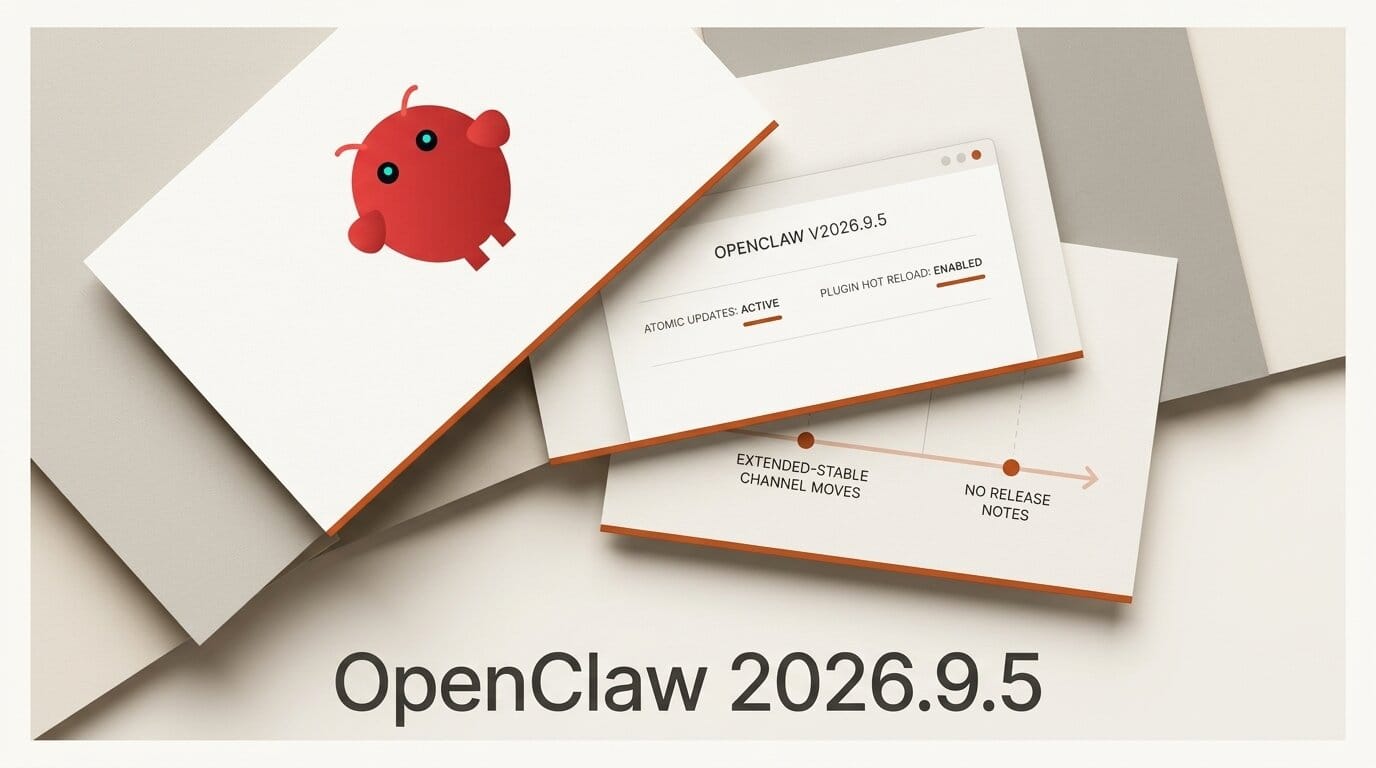
OpenClaw shipped v2026.9.5 on 19 September 2026 at 01:55 UTC, and the release page counts 64 direct commits, 4,179 pull requests and 503 contributors. The headline features are all variations on one idea: stop making people restart the agent. Atomic updates check the next version before switching over. Plugins install and reload without a Gateway restart. Conversations get read-only sharing, archives you can revisit, and GPT Live in meetings and phone calls.
It is a large release by this project's own standards. The previous version, v2026.9.4, landed eight days earlier on 11 September with 20 direct commits, 1,558 pull requests and 294 contributors. So 2026.9.5 carries roughly 2.7 times the pull requests and 1.7 times the contributors of the release before it, in the same eight-day window.
The interesting part is not the feature list. It is that a release built around never interrupting your agent has two places where the continuity promise is thinner than it looks: the hot-reload path, which already has an open regression filed against it, and the extended-stable channel underneath, which moved two versions in three days without publishing a single release note. Both are checkable, and neither has been written up anywhere.
What actually shipped
The release notes group the work into onboarding, web UI, and performance. Guided setup now walks you through building a team of specialist agents (chief of staff, researcher, writer, reviewer) and generates avatars for them, with Astra as the default model. The web UI adds agent overviews with activity previews, terminal tabs inside chat, live visibility of a teammate's draft, commenting on passages of a conversation, and git change counts with pull request previews in the activity feed.
The notes are unusually specific about limits, which is welcome and rare. Browser layout memory covers 500 sessions. Researched answers strip to a maximum of 8 cited pages. Custom session artwork is capped at 16 KiB decoded, restored inline images at 5 MiB decoded when you rewind or fork, and side-chat questions at 400 characters. Failed task placement retries across at most 3 devices.
The stated limitations are equally specific. Docker named volumes, tmpfs, and files stored only in container images remain unsupported. Browser-control connections over the default Compose bridge still do not work. ARM64 updates remain unverified on FreeBSD, rc.d services there still need external management, and git source installation is unsupported on that platform. A legacy-session import case for sole-agent setups is still unresolved.

The theme is continuity, and that is the risk
Read the two flagship features together and the design intent is obvious. Atomic updates validate the next version while the current Gateway keeps running, so a failed update rolls back and leaves you a working agent to diagnose from. Plugin hot reload means you can install or reload a plugin without taking the Gateway down, which changes the plugin development loop from edit-restart-wait into edit-reload.
For anyone running OpenClaw as real infrastructure, wiring it into messaging channels and a browser, that is the right priority. It is also the priority with the least margin for error, because both features work by mutating a live process rather than replacing it. A restart is crude but it has one virtue: everything comes back from a known state.
Hot reload already has an open regression
Within a day of release, issue #153290 was filed against 2026.9.5 and is open at the time of writing. The report is precise. After running openclaw plugins reload against one unrelated plugin, the Gateway removed the previous openclaw-plugin-build-* directories under ~/.openclaw/tmp, but the WhatsApp channel adapter, which that reload did not restart, kept running code loaded from one of the deleted directories.
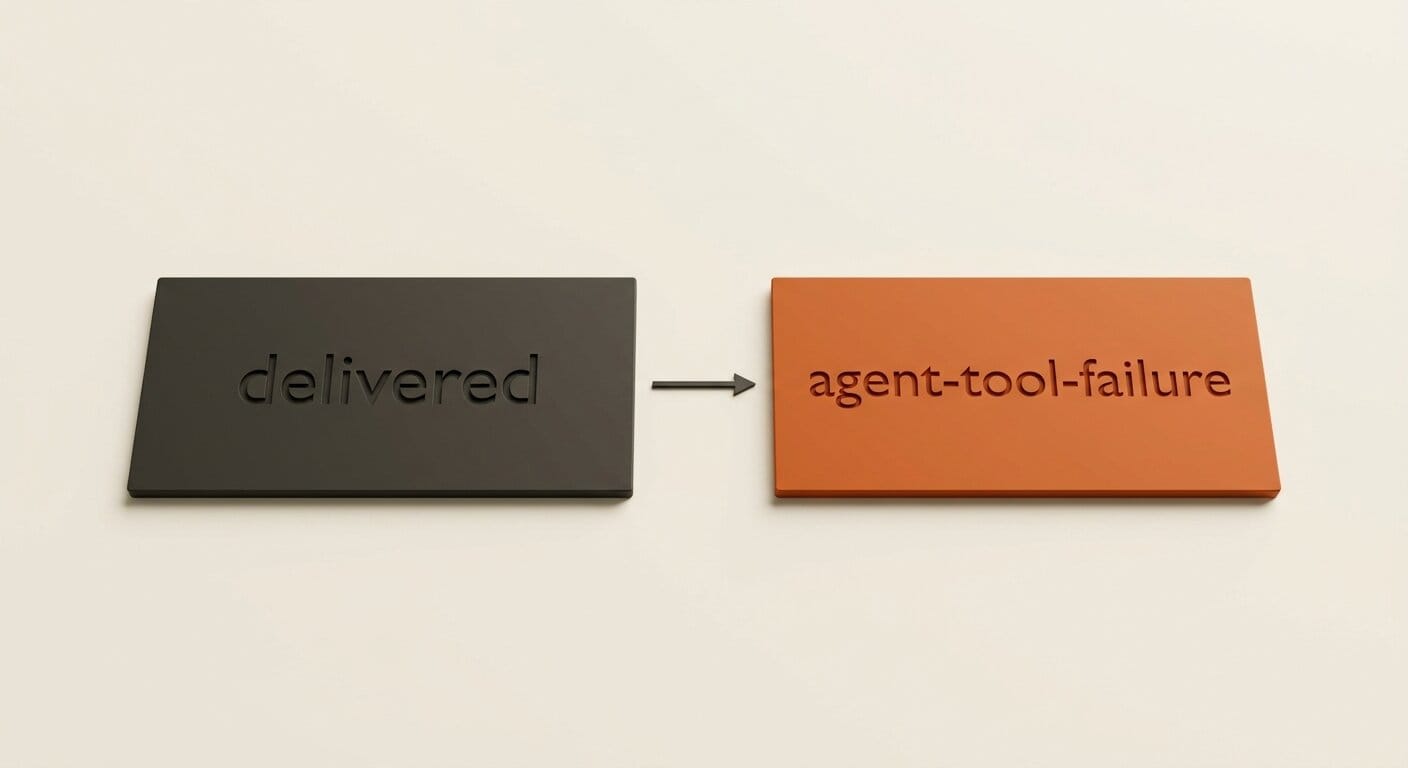
The consequence is the part worth pausing on. The adapter's after-delivery hook then failed trying to read package.json from the directory that no longer existed, throwing ENOENT. The message had already been delivered successfully. It was recorded as an agent-tool-failure anyway.
That is a specific and unpleasant failure shape. It is not that the agent stopped working; it is that the agent's own record of what it did became wrong, in the direction that makes a success look like a failure. If you have retry logic, alerting, or any automation reading those outcomes, a single plugin reload can make it fire on messages that actually went through. The feature that removed the restart also removed the guarantee that every live component is loading from the same generation of code.
The channel underneath went quiet for eight days
Most self-hosters running something in production do not track latest. OpenClaw's release policy gives them four channels: stable is the promoted release on npm latest, extended-stable is the trailing completed month's .33+ maintenance line, beta carries prerelease tags, and dev is the moving head of main.
Extended-stable is the cautious choice, and the project has been explicit that it is a stepping stone. A July 2026 post introducing the line says extended-stable releases "move us closer to supporting official LTS releases of OpenClaw." The policy is that each monthly line starts at YYYY.M.33, that patch 34 and later are maintenance releases on that line, and that a release is supported until the next extended-stable release is cut, for a minimum of one month.
Here is what that line actually did, taken from npm publish timestamps and the GitHub releases API:
| Version | Published to npm | GitHub release notes |
|---|---|---|
| 2026.6.33 | 21 July 2026 | Yes |
| 2026.6.34 | 4 August 2026 | Yes |
| 2026.6.35 | 10 September 2026 | Yes, marked final June line |
| 2026.7.33 | 18 September 2026 | None |
| 2026.7.34 | 20 September 2026 | None |
The 2026.6.35 release on 10 September describes itself as the final June 2026 Extended Stable release, carrying 166 merged pull requests of audited reliability and security backports, and it does not name a successor. The successor arrived on npm eight days later as 2026.7.33, and 2026.7.34 followed on 20 September at 02:52 UTC. As of this writing the extended-stable dist-tag resolves to 2026.7.34.
Neither 2026.7.33 nor 2026.7.34 has a GitHub release. Both tags return 404 from the releases API, and there is no changelog entry for either. So the release that got 4,179 pull requests documented in expandable sections is the fast one, and the two releases aimed at operators who explicitly asked for stability shipped with nothing to read. If you run openclaw update --channel extended-stable today you move from 2026.6.35 to 2026.7.34 with no published statement of what changed.

What the 11 September advisories actually patch
This matters more than a missing changelog usually would, because of what landed the day after the June line closed. OpenClaw published 75 security advisories on 11 September 2026: 30 high, 40 medium and 5 low. Counting each advisory by the earliest version listed as patched:
| Earliest patched version | Advisories |
|---|---|
| 2026.7.1 | 20 |
| 2026.8.1 | 48 |
| 2026.8.2 | 1 |
| 2026.8.11 | 3 |
| 2026.9.2 | 1 |
| 2026.9.3 | 2 |
Not one of the 75 lists any extended-stable version as patched. No 2026.6.3x, no 2026.7.3x. That gap was noticed: issue #151054, filed 17 September and still open, asks which of the 11 September advisories are fixed in 2026.6.35, and states the problem plainly, that "an operator pinned to extended-stable cannot tell whether moving 2026.6.34 to 2026.6.35 closes those advisories or not."
The move to the July line narrows the question without closing it. Twenty of the 75 advisories list 2026.7.1 as their earliest patch, and a line branched from completed July would be expected to contain those. The other 55, including 18 rated high and 32 medium, list their earliest patch at 2026.8.1 or later, which is a month line numbered after July. Whether those fixes were backported into 2026.7.33 or 2026.7.34 is exactly what a release note would tell you, and there is no release note. This is an unanswered question, not a demonstrated vulnerability, but it is unanswered in the one channel whose entire purpose is to let operators stop asking.

Which channel to run this week
| Channel | Resolves to now | You get | You accept |
|---|---|---|---|
latest | 2026.9.5 | Full documented notes, every advisory patched in a line at or above 2026.9.3 | An eight-day release cadence and an open hot-reload regression |
extended-stable | 2026.7.34 | A maintenance line with a slower surface area of change | No published notes for either July release and an open question on 55 advisories |
beta | 2026.9.5 | Currently identical to latest | Prerelease tags land here first |
If you already run latest, take 2026.9.5, then treat plugin reload as the one operation that still needs care. Until #153290 closes, restart your channel adapters after a plugins reload rather than assuming the reload covered them, and check whether anything in your stack treats agent-tool-failure as a trigger. A delivered message logged as a failure is worse than an obvious error because nothing looks broken.
If you are pinned to extended-stable, you are now on a line that has no notes. The honest move is to ask in #151054 rather than guess, because the answer you need is which of the 55 later-line advisories were backported, and only a maintainer can supply it. Pinning to an exact version is reasonable in the meantime. Pinning to a channel whose contents you cannot read is a different thing from pinning to a version you have evaluated.
Frequently asked questions
Is OpenClaw 2026.9.5 safe to install?
It is the channel with the best documentation and the most advisories resolved. The specific thing to be careful about is plugin hot reload, which has an open regression, #153290, where reloading one plugin can break unrelated live channel adapters. Restarting those adapters after a reload avoids it.
What does the plugin hot reload bug actually break?
It deletes the previous plugin build directories under ~/.openclaw/tmp while adapters that were not restarted are still loading code from them. The reported symptom is an ENOENT in the WhatsApp after-delivery hook, where a message that was delivered successfully is recorded as an agent-tool-failure. The delivery works; the record of it is wrong.
What version does the extended-stable channel point to right now?
2026.7.34, published to npm on 20 September 2026. It replaced 2026.7.33 from 18 September, which in turn succeeded 2026.6.35, the final release of the June line, from 10 September. Neither July version has GitHub release notes.
Does the July extended-stable line include the September security fixes?
Partly, and the rest is unclear. Of the 75 advisories published on 11 September, 20 list 2026.7.1 as their earliest patched version and would be expected in a line branched from completed July. The other 55 list 2026.8.1 or later. No published note says whether those were backported, which is what issue #151054 is asking.
How often does OpenClaw release?
The fast line is moving in roughly eight-day steps right now: 2026.9.4 on 11 September, 2026.9.5 on 19 September. The extended-stable line is meant to be monthly, starting each new line at patch 33, with patch 34 and above as maintenance on that line.
Is extended-stable the same as LTS?
No. The project describes it as a step toward official LTS, not LTS itself. The support commitment in the policy is that a release is supported until the next extended-stable release is cut, with a minimum of one month, and that the older line retires when main advances another month.