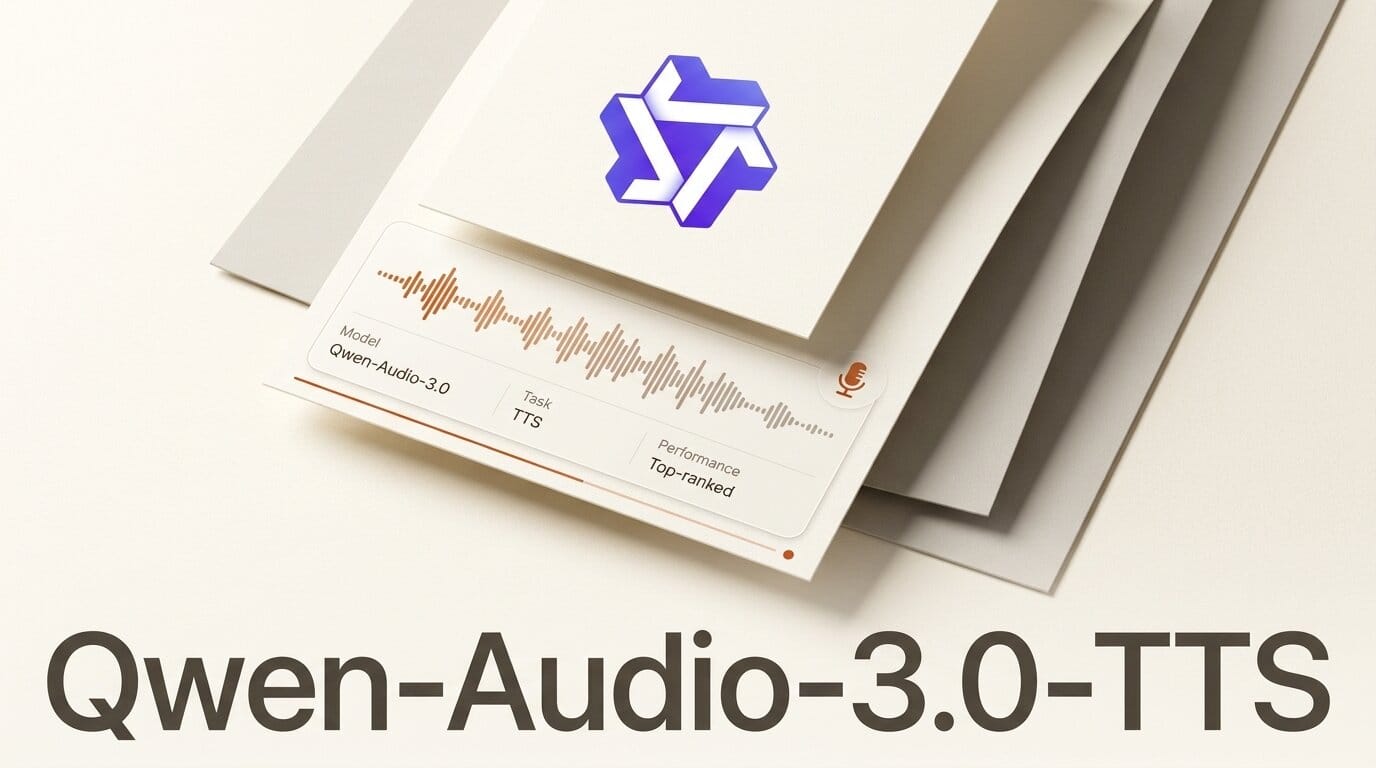
Alibaba's Tongyi Lab has released Qwen-Audio-3.0-TTS, a hosted text-to-speech model that debuted in July 2026 and immediately claimed the top spot on the independent Artificial Analysis Text-to-Speech leaderboard. The Plus tier posts an average speaker similarity of 82.75 percent across 16 languages and, according to Alibaba, outranks both ElevenLabs v3 and Gemini 3.1 TTS in blind Speech Arena testing. For creators building voiceovers, dubbing pipelines, audiobooks, and real-time voice agents, this is the first credible challenge to ElevenLabs from a major cloud provider in months.
What Qwen-Audio-3.0-TTS Actually Ships
The release comes in two tiers served through Alibaba Cloud Model Studio. The Flash version targets real-time interaction with a first-packet latency of roughly 300 milliseconds, which is fast enough for conversational voice agents and live captioning. The Plus version trades a little speed for higher naturalness and voice similarity, making it the choice for produced content like narration and dubbing.
Both tiers cover 16 languages, seven of them newly added: Japanese, Korean, German, Spanish, French, Italian, Russian, Arabic, Indonesian, Portuguese, Thai, Vietnamese, Malay, and Tagalog, alongside Chinese and English. On top of that, the model handles 20 Chinese dialect regions with zero-shot voice cloning, a depth of regional coverage that Western TTS providers rarely match. Coverage details were confirmed by MarkTechPost in its launch coverage.

How It Compares to ElevenLabs and Gemini
The headline claim is competitive ranking. Alibaba says the Plus tier sits first on the Artificial Analysis Text-to-Speech leaderboard, ahead of the models most creators reach for today. The table below summarizes where Qwen-Audio-3.0-TTS lands against ElevenLabs v3 and Google's Gemini 3.1 TTS on the dimensions that matter for production work.
| Capability | Qwen-Audio-3.0-TTS Plus | ElevenLabs v3 | Gemini 3.1 TTS |
|---|---|---|---|
| Speech Arena ranking | First | Behind Qwen Plus | Behind Qwen Plus |
| Languages | 16 plus 20 Chinese dialects | Dozens | Multiple |
| Real-time latency | ~300ms (Flash tier) | Low-latency mode | Streaming |
| Zero-shot voice cloning | Yes, cross-lingual | Yes | Limited |
| Emotional control | Six emotions plus 86 inline tags | Yes | Yes |
| Access | Hosted API | Hosted API | Hosted API |
The practical takeaway: Qwen-Audio-3.0-TTS is not an open-weight download. It is an API-first service, so the comparison is service against service, not a local model you self-host. Creators who need on-device or offline generation should look at Alibaba's separate open-weight line instead.
Inside the Tech: Tokenizer, Tags, and Voice Cloning
Under the hood, the model uses a 12.5 Hz low-frame-rate speech tokenizer that cuts inference latency while preserving content and speaker identity. Alibaba trained it with a five-stage progressive paradigm that combines a language model with a flow model, then finishes audio with a 48 kHz vocoder for super-resolution output.
The most creator-relevant feature is control. Beyond natural-language style instructions, the model exposes 86 fine-grained inline tags that let you adjust delivery at the phrase or even single-word level. You can shift emotion across happy, angry, sad, fearful, surprised, and disgusted, and it can synthesize one-pass long-form audio up to three minutes without stitching. Voice cloning is zero-shot and cross-lingual, so a reference clip in English can drive Japanese or Spanish output while keeping the original timbre, even when the reference recording is noisy or reverberant.
What This Enables for Creators
The combination of low latency, deep language coverage, and word-level control opens workflows that were awkward or expensive before:
- Multilingual dubbing from one voice. Record a single reference clip, then generate the same narrator across all 16 languages with consistent timbre, cutting the cost of hiring separate voice talent per market.
- Real-time voice agents. The Flash tier's 300ms first-packet latency is low enough for interactive assistants, live streams, and game NPCs that respond without a noticeable pause.
- Long-form narration. Three-minute one-pass synthesis means fewer joins and less manual cleanup for audiobooks, explainer videos, and podcasts.
- Emotionally directed reads. Inline tags let you script a laugh, a whisper, or a rising emphasis on one word instead of re-recording the whole line.

How to Try It Today
Qwen-Audio-3.0-TTS is available now through Alibaba Cloud Model Studio. Because it is hosted, you access it with an API key rather than downloading weights. A typical first pass looks like this:
- Create an Alibaba Cloud account and enable Model Studio, then generate an API key.
- Pick your tier: Flash for interactive or streaming use, Plus for produced content.
- Send text with an optional reference audio clip for voice cloning and any inline tags for delivery control.
- Stream the response for live use, or save the full clip for editing.
If you specifically need a model you can run locally, note that this 3.0 release is distinct from the open-weight Qwen3-TTS line published earlier in 2026 under Apache-2.0, which remains available on GitHub and HuggingFace. The latency and first-place benchmark numbers reported by AIBase apply to the hosted 3.0 service, not the open weights.
Frequently Asked Questions
Is Qwen-Audio-3.0-TTS open source?
No. The 3.0 release is a hosted, API-only service on Alibaba Cloud Model Studio. The open-weight option is the separate Qwen3-TTS line released earlier in 2026 under an Apache-2.0 license.
How many languages does it support?
Sixteen languages, seven of them new in this release, plus zero-shot voice cloning across 20 Chinese dialect regions.
What is the difference between the Flash and Plus tiers?
Flash is optimized for real-time use with about 300 milliseconds of first-packet latency. Plus prioritizes naturalness and speaker similarity for produced content and is the tier that ranks first on the leaderboard.
Can it clone a voice from a short clip?
Yes. Voice cloning is zero-shot and cross-lingual, and Alibaba says it works even with noisy or reverberant reference audio while preserving the speaker's timbre in other languages.
How does it compare to ElevenLabs?
Alibaba reports the Plus tier ranks first on the Artificial Analysis Text-to-Speech leaderboard, ahead of ElevenLabs v3 and Gemini 3.1 TTS. Independent creators should benchmark on their own voices and languages before switching production pipelines.
Can I generate long audio in one pass?
Yes. The model supports one-pass long-form synthesis up to three minutes, reducing the need to stitch shorter segments together.