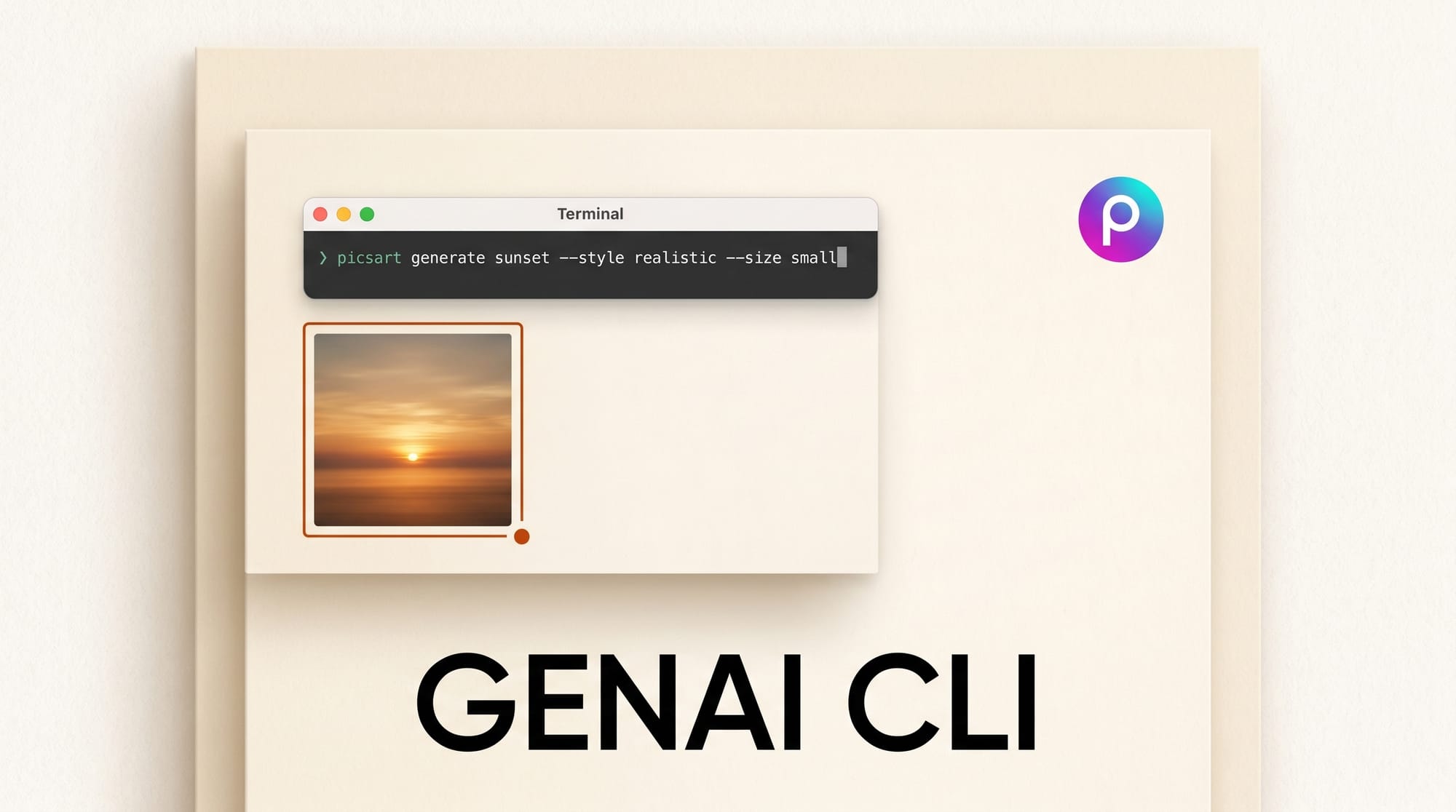
Picsart launched its GenAI CLI on April 28, 2026, bringing image, video, and audio generation directly into the terminal with one install. The command-line tool gives creators, marketers, and developers programmatic access to 130+ leading AI models across all three media types, with native Model Context Protocol support that wires the same catalog into Claude Code, Cursor, and Windsurf without per-provider API glue.
The launch matters less for what Picsart shipped, and more for what it confirms about where the creative AI stack is heading. Generation is becoming a callable surface, not an app. The terminal is now a viable creative workspace for anyone who already lives in one, and agents can drive the same surface through MCP without a human ever opening a browser.
Background
Picsart spent the last decade as a mobile-first photo and video editor with a creator audience measured in hundreds of millions of monthly users. The company began rebuilding itself as an AI infrastructure provider through 2024 and 2025, opening its Creative APIs to enterprise customers and adding partner models from Black Forest Labs, OpenAI, Anthropic, Google, ElevenLabs, Runway, and Kling at a steady cadence. The GenAI CLI is the natural extension of that work: instead of asking developers to integrate the Picsart REST API, Picsart hands them a binary that already wraps the catalog.

That distribution choice lands in a moment when MCP has become the default plumbing for agent-to-tool wiring. The protocol was open-sourced by Anthropic in late 2024 and is now supported natively in Claude Code, in Cursor, and in Windsurf. By shipping the CLI with an MCP server in the same package, Picsart skips the usual second-product release schedule and lets the CLI install double as the agent installation.
Deep Analysis
The aggregation play: one auth, 130 models
The strongest argument for the CLI is not generation quality or speed. It is the integration tax it removes. A working creative pipeline today routinely calls Flux for stills, a Sora or Kling endpoint for video, ElevenLabs for voice, and a separate audio model for music or SFX. Each provider ships its own SDK, billing, key rotation, error semantics, and rate-limit behavior. A team that builds against four of those directly is maintaining four parallel integrations and four parallel credit ledgers.
The Picsart CLI collapses that to one binary, one credential, and one credit pool, with provider switching reduced to a flag. Picsart is not the first to attempt this: Replicate, fal.ai, and Together each pitch a similar consolidation. What is different here is that Picsart already operates a consumer-facing creative product on top of the same catalog, which means the company is drinking its own dogfood at scale. The model selection visible in the AI Playground is the same selection exposed at the CLI, and the latency curves Picsart users see are the latency curves the CLI inherits.
MCP turns the creative stack into agent-callable tools
The MCP server bundled with the CLI is the more important half of the launch. It means a coding agent inside Cursor 3.1 or Claude Code can request a thumbnail, generate a voiceover, or render a 5-second clip as a tool call inside the same plan it is using to write code, edit configs, or open a pull request. The agent does not need to know which underlying model handled the call. It does not need a Picsart account beyond the one configured during install. The generation becomes a function with arguments, returning a URL or a file path the agent can read.
That changes the economics of automated content production. A nightly build that previously emitted only software artifacts can now also emit branded images for a release page, a 30-second product walkthrough, and a narrated changelog audio file, all without a human in the loop on the creative side. Combined with the agent-team patterns shipping in Poolside Laguna and Claude Code's parallel agent windows, the CLI puts creative generation on the same plane as compile, lint, and test.
The strategic risk: Picsart becomes a margin-thin reseller
The aggregation business has a known problem. The provider whose model gets called still needs to be paid, and the aggregator's margin is the spread between its retail credit price and the wholesale rate it negotiates with each lab. When the underlying providers are fast-moving labs that ship new flagship models every six to eight weeks, the aggregator is in a permanent renegotiation loop. If a customer's pipeline is locked to the model rather than to the aggregator, the aggregator's switching cost approaches zero on the day a competing aggregator catches up.
Picsart's hedge is the consumer brand and the AI Playground revenue, both of which generate margin the pure-API aggregators do not have. The question for 2026 is whether the CLI lands enough developer mindshare to become the default creative MCP surface inside Claude Code and Cursor. If it does, the catalog and credits compound into a moat. If it does not, the CLI is a thin layer over commodity generation and the consumer business has to keep funding it.
How this fits the week's other releases
The CLI does not launch in a vacuum. The same week saw Anthropic ship the Claude Creative Work connector suite, which exposes Figma, Adobe, and Blender as MCP tools to Claude. ComfyUI v0.20.1 bundled SUPIR upscaling, RIFE interpolation, FILM frame generation, and SAM 3.1 segmentation into a single release, hardening ComfyUI's claim as the open-source agent target. Three independent releases, three different angles on the same thesis: creative work is no longer trapped behind a GUI, and agent-callable surfaces are the unit of distribution.
Picsart's bet is that creators who already learned git, npm, or a build system will adopt the CLI faster than they adopt yet another browser tab. Anthropic's bet is that the agent itself becomes the front end. ComfyUI's bet is that the open-source node graph survives as the production target. All three can be right at once, and the GenAI CLI is positioned to interoperate with the other two through MCP rather than compete.
Impact on Creators
For solo creators who already write scripts or run build tools, the CLI is a clear productivity win. A campaign that used to mean opening four browser tabs becomes a shell loop with model flags. A YouTube channel pipeline can drop a generation step into a Makefile or a GitHub Action and ship thumbnails, voiceovers, and short clips on every push. The friction Picsart removes is real and immediate.
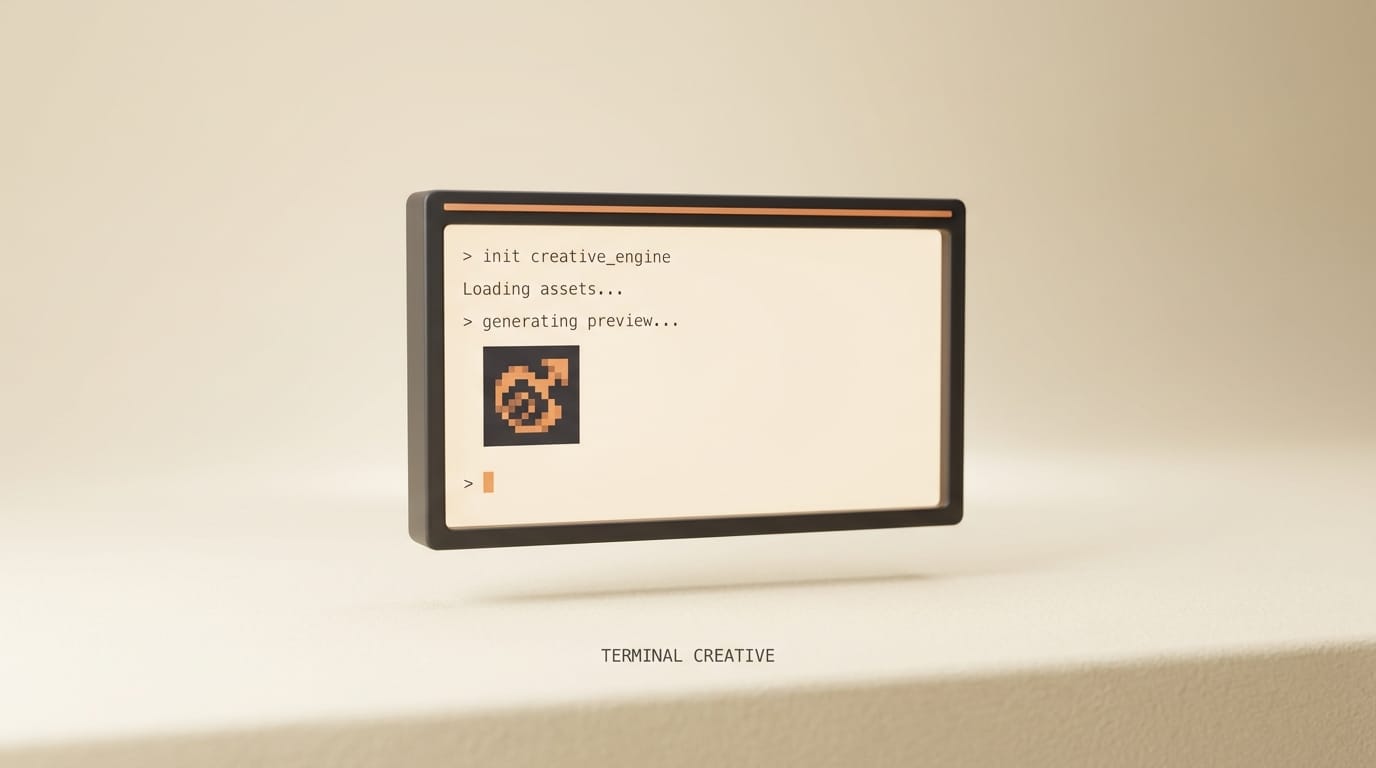
For creators who do not script, the CLI is irrelevant. The audience that benefits is the developer-adjacent creator: indie game devs, technical YouTubers, motion-graphics shops, marketing agencies with engineering staff. Picsart's existing AI Playground continues to serve everyone else, and the CLI is positioned as the surface a power user graduates to once the GUI workflow becomes a bottleneck.
The MCP integration changes the calculus for studios. A small team running Cursor or Claude Code can now wire creative generation into the same agent that writes their code, the same way it might call a database tool or a deployment script. That is the difference between adding AI to a workflow and rebuilding the workflow around the agent. Studios that make the second move will move faster than studios that treat the CLI as an additional tab.
Key Takeaways
- Picsart shipped a single binary that wraps 130+ image, video, and audio models with one credential and one credit pool, removing the per-provider integration tax for production pipelines.
- The bundled MCP server makes every model in the catalog callable from Claude Code, Cursor, and Windsurf, putting creative generation on the same plane as the agent's code and config tools.
- This is the third launch in seven days that pushes creative work onto agent-callable surfaces, alongside Claude Creative Work connectors and the ComfyUI v0.20.1 bundle release.
- Picsart's competitive risk is margin compression as flagship models churn; the bet is that CLI mindshare inside developer tools becomes a moat the pure-API aggregators cannot match.
- Adoption will skew toward developer-adjacent creators first; the AI Playground remains the entry point for the broader Picsart audience.
What to Watch
The first signal is whether MCP servers from Adobe, Runway, and Black Forest Labs ship in the next 90 days. If they do, the CLI becomes one of several aggregator-flavored MCP entry points and Picsart's distribution advantage narrows. If they do not, Picsart is the only end-to-end creative MCP server in production through Q3 2026, and that gap will compound.
The second signal is pricing. Picsart's per-generation credit model assumes the catalog stays roughly priced as it is today. If Sora-2, Veo 4, or a Flux successor ships at materially different cost, Picsart has to either eat the spread or pass it through, and either choice tells customers something about the durability of the bundle.
The third signal is the ecosystem reaction inside Claude Code and Cursor. If the CLI's MCP server starts appearing in template configs, starter kits, and tutorial videos within the agent IDEs, Picsart will have crossed from optional add-on to default infrastructure. If it stays a niche power-user tool, the launch will be remembered as a well-engineered product that did not change the distribution map.