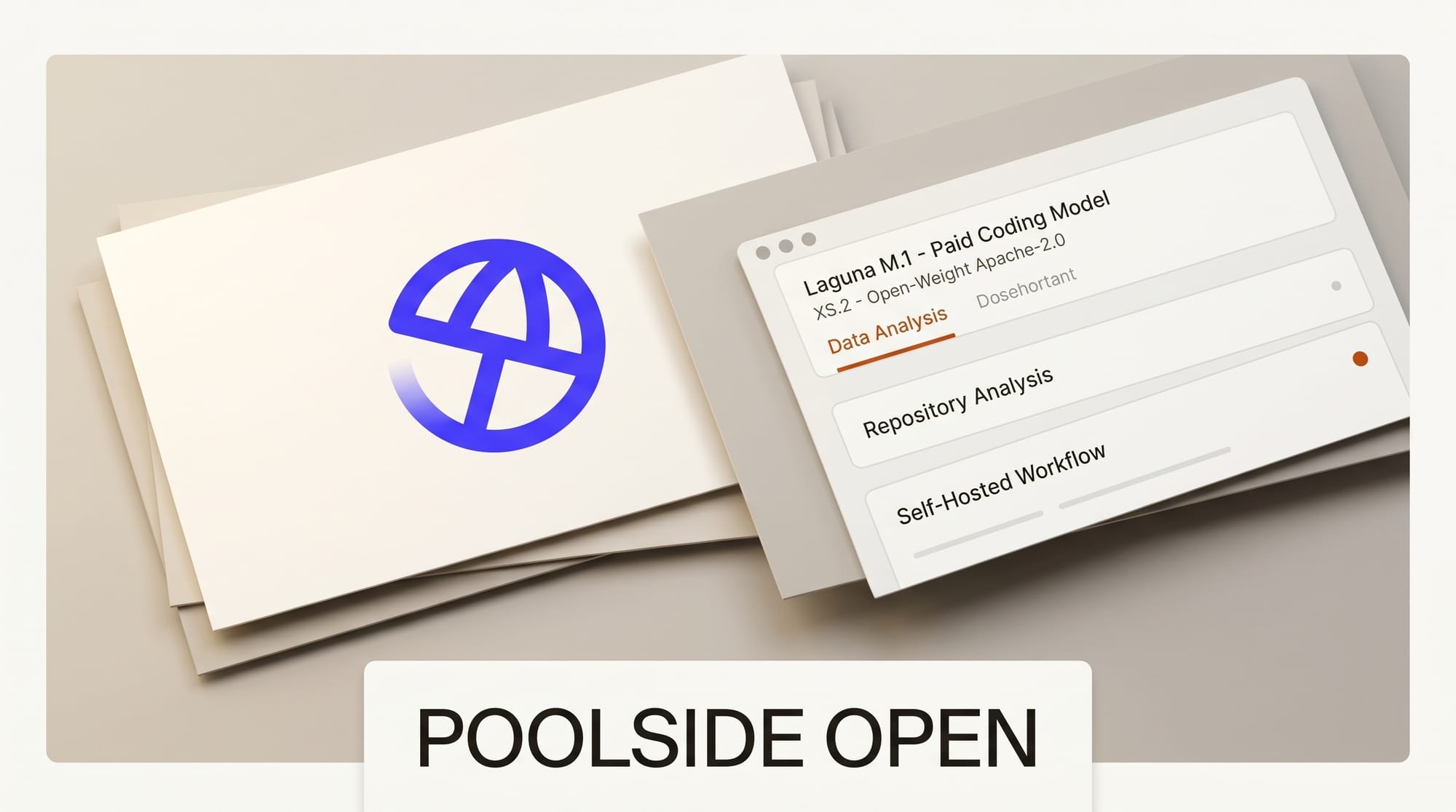
Poolside released the first two models in its Laguna family on April 28: a 225B-parameter flagship called M.1 and an open-weight 33B model called XS.2 under Apache 2.0. Both are pitched at agentic, long-horizon coding work, and both ship alongside Pool, the agent runtime Poolside uses internally for training and evaluation.
What Happened
Laguna M.1 is a 225B-parameter mixture-of-experts model with 23B active parameters, trained on 30 trillion tokens across 6,144 NVIDIA Hopper GPUs. It scores 46.9% on SWE-bench Pro and 40.7% on Terminal-Bench 2.0. Laguna XS.2 is a much smaller MoE at 33B total / 3B active, also trained on 30T tokens, hitting 44.5% on SWE-bench Pro and 30.1% on Terminal-Bench 2.0. The notable detail: XS.2's score on SWE-bench Pro is within two points of the flagship while running at roughly an eighth the active parameter budget.
Why It Matters
Open-weight coding models from a frontier lab are still rare. DeepSeek V4 remains the most cited example, and Qwen has its own line, but Apache 2.0 from a Western coding-focused lab is a different signal. It means XS.2 can be embedded in commercial agent products without licensing friction, downloaded via Ollama for local inference, or routed through OpenRouter for hosted use. For builders shipping coding agents, that combination of weights, runtime, and benchmarks is the closest thing to a complete stack the open-source side has produced this quarter.
Key Details
Both models lean on a few architectural bets that Poolside flagged in the technical writeup. The training mix includes 4.4T+ synthetic tokens, generated and balanced through an in-house framework called AutoMixer. Poolside also emphasizes code execution as a first-class capability over traditional tool-calling interfaces, on the theory that agents that can actually run their work scale better on long-horizon tasks. Pool, the runtime they used internally, is now available as a research preview, alongside an early product called Shimmer that hints at where the company wants developer experience to go.
Laguna M.1 finished pre-training at the end of 2025 and serves as the foundation for the rest of the family. Both models are free to use through Poolside's API and OpenRouter for a limited time, with enterprise access available via models@poolside.ai for higher rate limits.
What to Do Next
If you build coding agents or run local inference for development workflows, pull XS.2 from Ollama and benchmark it against your current open-weight baseline. If you operate at scale, M.1 is worth a head-to-head against your existing closed-weight provider on long-horizon tasks where Terminal-Bench scores translate to real cost savings. For broader context on where these models sit in the wider tooling stack, see our 2026 AI coding tools guide.