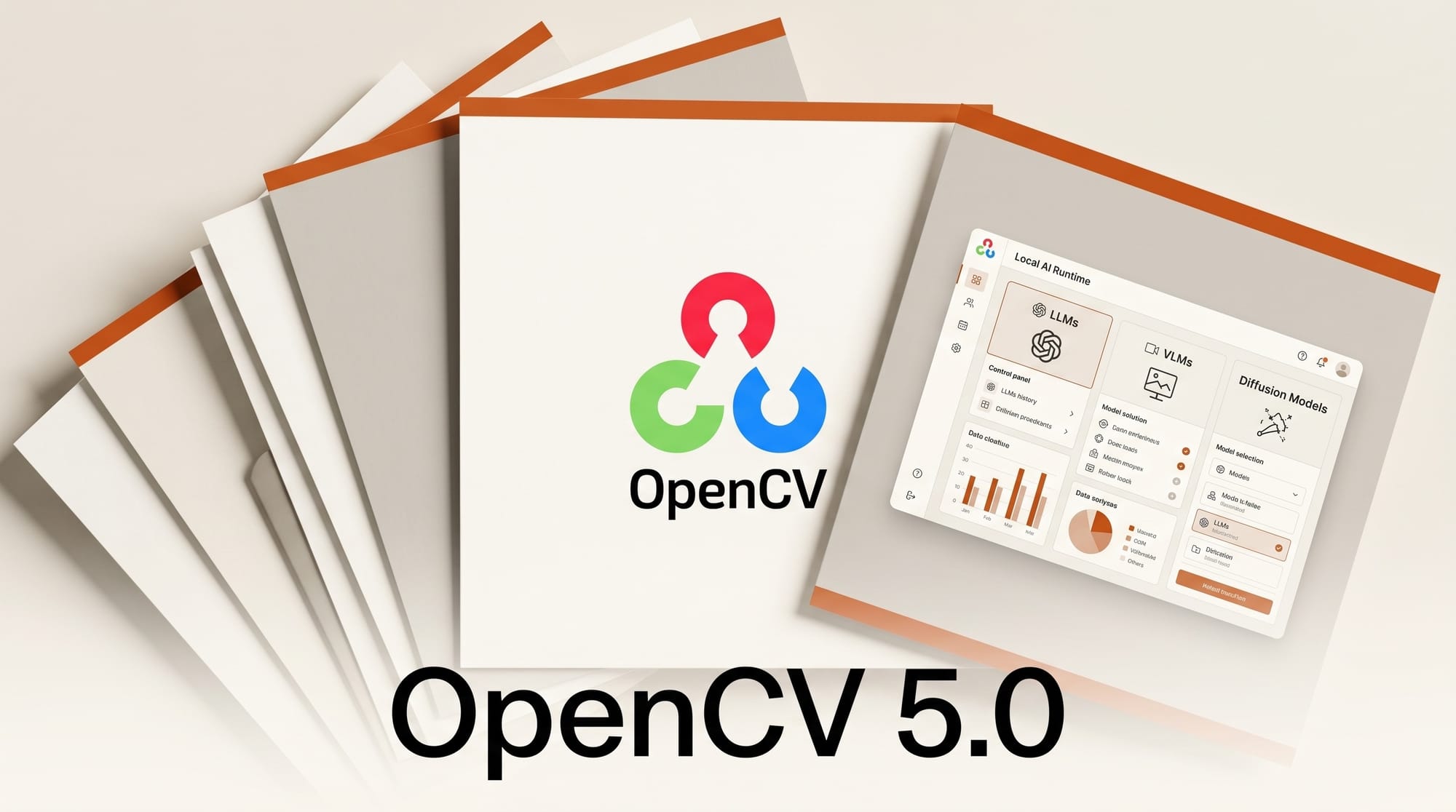
OpenCV 5.0 is the first major version of the world's most-used computer vision library in years, and it quietly reframes what that library is for. The headline is not a new filter or a faster resize. It is that OpenCV now runs large language models, vision-language models, diffusion, and inpainting natively, alongside a rebuilt 3D toolkit, turning a single dependency into a local runtime for an entire creative pipeline.
For creators building image, video, and 3D tools, that collapses a stack that used to need three or four separate runtimes into one library you already know. Here is what shipped, and why it changes the calculus for anyone building local, offline-first creative software.
Background
OpenCV has been the plumbing under creative and vision software since 2000: capture, resize, color conversion, contour detection, camera calibration. For most of the last decade, the moment a project needed a neural network, developers reached past OpenCV to PyTorch, ONNX Runtime, or a cloud API, and used OpenCV only for the pixel work around the edges.
That split is what OpenCV 5.0 attacks. Released as a pip package on June 8, 2026, and timed to the CVPR 2026 conference in Denver, version 5 is the first major bump since the 4.x line and the largest architectural change the project has shipped in years. Coverage from Phoronix and heise both lead with the same framing: OpenCV is no longer just an image-processing library, it is becoming a model runtime.
Deep Analysis
From a Layer Stack to a Computation Graph
The core change is a complete rewrite of the DNN module. The old engine ran a model as a fixed sequence of layers. The new one builds a typed operation graph with proper shape inference, constant folding, and operator fusion, including attention and MatMul fusions with a FlashAttention-style implementation. It also handles If and Loop subgraphs and symbolic, dynamic shapes that the 4.x engine could not express.
The practical payoff is coverage. OpenCV 5's ONNX operator support jumped from roughly 22 percent in the 4.x days to over 80 percent, which is the difference between "most modern models fail to load" and "most modern models just run." The full source sits on the 5.x branch on GitHub.
Generative AI Now Runs Inside the Library
Because the engine can finally express modern architectures, OpenCV 5 ships the models on top of it. It can run language and vision-language models directly inside the DNN module, including Qwen 2.5, Gemma 3, PaliGemma, and the open GPT-2 and GPT-style decoder families. To make that real, the library now includes a native tokenizer and a KV-cache for autoregressive decoding, the two pieces that classical CV libraries always lacked.
For visual work, the most immediately useful addition is object removal with LaMa inpainting, running entirely inside the new DNN engine in a single forward pass, plus support for diffusion models. That means a cleanup or generation step can run through the same library handling your capture, crop, and color, rather than a second runtime bolted on beside it.

The 3D Toolkit Creators Actually Needed
The refactor that matters most for 3D and spatial creators is the split of the old calib3d module into focused 3d, calib, and stereo modules with real capability behind them. OpenCV 5 adds multi-camera calibration through calibrateMultiview, point cloud and mesh I/O via loadPointCloud, savePointCloud, loadMesh, and saveMesh with OBJ and PLY support, and dense RGB-D fusion with TSDF, HashTSDF, and ColorTSDF volumes. Robust estimation now runs through a modern USAC framework by default.
For anyone building photogrammetry, depth-capture, or Gaussian-splat pipelines, that is a meaningful upgrade: the capture-to-mesh path that used to require stitching OpenCV to separate reconstruction tools is now closer to a single library, with standard OBJ and PLY exports that drop straight into Blender or a web viewer.
Local, Offline, and Tuned to the Hardware
All of this is built to run on the device in front of you. OpenCV 5 introduces a hardware acceleration layer with vendor-tuned paths for Intel IPP, Arm KleidiCV, Qualcomm FastCV, and RISC-V Vector, so the same code targets a workstation, a phone, or an edge board, as CNX Software details in its hardware breakdown. New first-class FP16 (cv::hfloat) and BF16 (cv::bfloat) types, plus bool and 64-bit integers, line the math up with how modern models actually run, and the core math workloads are reported up to twice as fast.
The cost of entry is modest housekeeping: C++17 is now the minimum recommended standard, and the Python bindings move to NumPy 2.x with cleaner keyword arguments. Most 4.x scripts still run, but the calib3d split and the new data types can surface edge cases, so a test pass against the official documentation is wise before production.
Impact on Creators
The reason this matters beyond the developer crowd is distribution. Shipping a fully local creative tool used to mean bundling a vision library and a separate model runtime, then keeping both in sync across platforms. With OpenCV 5, a background remover, an object-removal brush, an on-device image tagger, or a depth-capture app can lean on one dependency for both the pixel work and the model inference. That makes offline, privacy-friendly, no-subscription tools genuinely easier to build and to keep small.
It also lowers the floor for the kind of local-first workflows we have tracked elsewhere. The same instinct that makes running local models on your own hardware appealing applies here: a VLM that tags or describes a shot, a LaMa pass that removes a logo, or a TSDF fusion that turns a phone video into a mesh, all running without a round trip to a server. For pipelines already built around node tools like ComfyUI and local background removal, OpenCV 5 is a strong candidate for the glue that holds the classical and AI steps together.
Key Takeaways
1. OpenCV 5.0 turns the most common vision library into a local model runtime, running LLMs, VLMs, diffusion, and LaMa inpainting inside a rebuilt graph-based DNN engine.
2. ONNX operator coverage jumped from about 22 percent to over 80 percent, so the modern models that used to fail to load now run directly.
3. The new 3D toolkit, with multi-camera calibration, TSDF RGB-D fusion, and OBJ and PLY mesh export, makes capture-to-mesh pipelines far simpler for photogrammetry and splat creators.
4. A hardware acceleration layer for Intel, Arm, Qualcomm, and RISC-V, plus native FP16 and BF16, makes fully offline, on-device creative tools easier to ship.
What to Watch
The open question is performance parity. OpenCV 5 can now load a Qwen 2.5 or Gemma 3 model, but whether its DNN engine matches dedicated runtimes like ONNX Runtime or llama.cpp on tokens per second, especially on consumer hardware, will decide how many builders actually move inference into OpenCV rather than just loading classical models there. Watch the early benchmarks against those runtimes, and watch which creative apps adopt the in-library LaMa and diffusion paths first.
The deeper signal is consolidation. When a foundational, permissively licensed library absorbs generative inference and 3D reconstruction into its core, the pressure shifts onto the standalone tools that did only one of those jobs. If OpenCV 5's model support holds up under load, the next year of local creative software may be built on a much shorter list of dependencies than the one we have today.