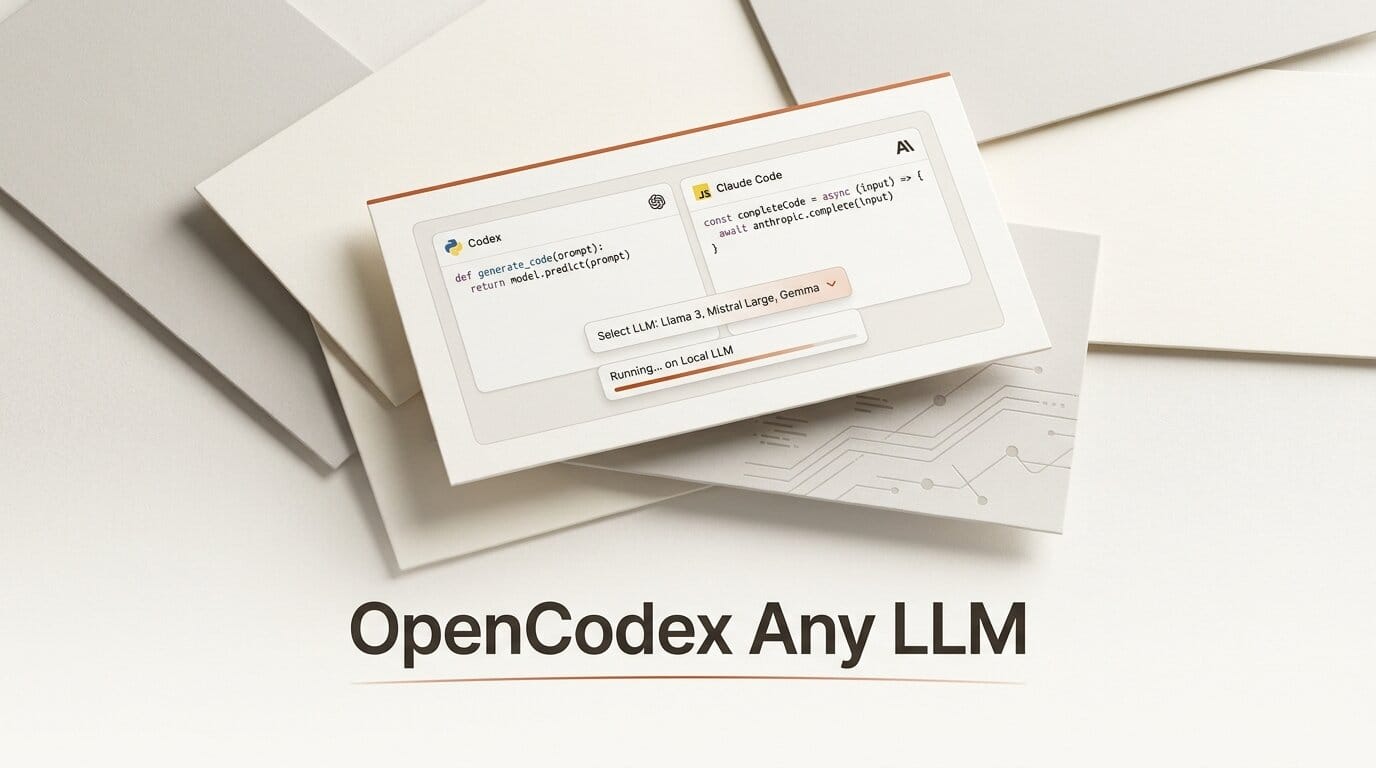
OpenCodex is a local proxy that lets OpenAI Codex CLI, App, and SDK, along with Claude Code, run on almost any large language model instead of only the vendor default. Published on npm as @bitkyc08/opencodex, the project sits at 3,500 stars and shipped release 2.7.33 on July 22, 2026, one of 134 tagged releases. Once installed, it exposes a single endpoint that translates the Codex Responses API into calls for Anthropic Claude, Google Gemini, xAI Grok, DeepSeek, Kimi, or a local model running through Ollama, so you keep the coding agent you already know and swap the brain behind it.
For builders who live inside a terminal coding agent all day, this closes the biggest gap in the current tooling: your agent and your model were welded together. OpenCodex separates them.
What OpenCodex Actually Does
Codex CLI and Claude Code are both excellent agents, but each is wired to one provider's models. If you wanted Codex to reason with Claude Opus, or wanted Claude Code to fall back to a cheap local model for boilerplate, you were stuck. OpenCodex acts as a translation layer that runs on your machine at localhost:10100. Your agent points at that address, and the proxy converts each request into the target provider's native protocol.
The routing syntax is deliberately simple. You reference a model as provider/model-id, for example anthropic/claude-opus-4-8, google/gemini-3-pro, or ollama/llama3. Drop the prefix and OpenCodex sends the request to your default provider or matches by name pattern. The project documentation lists more than 40 built-in providers across five protocol adapters, including Azure OpenAI, Groq, Together, Fireworks, Cerebras, Mistral, NVIDIA NIM, and any OpenAI-compatible endpoint you point it at.
Why It Matters for Builders
The practical win is cost and control. A single coding session can burn through a frontier model's premium tokens on tasks that a mid-tier or local model would handle for a fraction of the price. With OpenCodex you decide which model gets which job, per request, without leaving your agent. You can send architecture and debugging to Claude Opus, route repetitive edits to DeepSeek or a self-hosted model, and never touch a config file mid-session.
It also removes vendor lock-in from your daily workflow. If a provider has an outage, raises prices, or ships a weaker model, you change one prefix instead of migrating tools. For anyone building on top of these agents, that portability is the difference between a workflow you own and one you rent.

OpenCodex vs Manual Provider Swaps vs In-Agent Routing
OpenCodex is not the only way to change which model your coding tool uses, but the alternatives each give up something. The table compares the three common approaches for a solo developer.
| Approach | Model choice | Switch cost | Works with Codex and Claude Code |
|---|---|---|---|
| OpenCodex proxy | 40-plus providers, per request | Change one prefix | Yes, both |
| Manual env or config swap | Whatever the agent officially supports | Edit config, restart session | Limited, per tool |
| In-agent auto routing (for example Cursor Router) | A curated set the vendor picks | Automatic, no control | No, tied to one editor |
The trade is explicit control versus automation. Tools that route automatically to cut cost are convenient, and we covered one in our Cursor Router breakdown. OpenCodex takes the opposite stance: you keep the wheel, and the payoff is that the same setup works across Codex and Claude Code rather than a single editor.
How to Route Any Model Through Codex or Claude Code
Getting a second provider running behind your agent takes about five minutes. The steps below assume you already have Codex CLI or Claude Code installed.
- Install the proxy globally:
npm install -g @bitkyc08/opencodex. - Initialize the local config with
ocx init, which scaffolds the provider store on your machine. - Open the dashboard with
ocx guiand add a provider by pasting an API key, or connect through OAuth for Anthropic, xAI, or Kimi so no key is stored in plain text. - Start the proxy with
ocx start. It listens onlocalhost:10100. - Point Codex CLI or Claude Code at that endpoint, then call a model with the
provider/model-idsyntax, such asanthropic/claude-opus-4-8.
For a fully local setup, install Ollama, pull a model, and reference it as ollama/llama3. Requests then never leave your machine, which matters for private codebases. Aggregator keys work the same way: an OpenRouter key unlocks dozens of models behind a single credential.

Account Pooling and Quota Failover
One feature separates OpenCodex from a plain relay: ChatGPT account pooling. If you run multiple ChatGPT plans, the proxy keeps existing Codex threads pinned to one account through session affinity, while new sessions auto-pick a lower-usage account from the pool. It reads quota across the 5-hour, weekly, and 30-day windows, does a built-in quota lookup, and fails over automatically when a provider returns a 429 rate-limit error.
For heavy users who routinely hit usage caps mid-afternoon, that failover is the feature that keeps a session alive instead of stalling. The whole project is MIT licensed, so teams can audit exactly how credentials and routing are handled before trusting it with production keys.

What This Enables
With OpenCodex in place, your coding agent becomes a front end you keep and a model layer you tune. A realistic day looks like this: Claude Opus for the hard architectural pass at the start, a fast mid-tier model for the long middle stretch of edits and tests, and a local model for anything touching a private repo you would rather not send to a cloud API. You never change tools, only prefixes. That single change turns two single-vendor agents into a provider-agnostic workbench, and it is the kind of orchestration control that used to require writing your own wrapper.
What to Do Next
Install the package, run ocx init and ocx start, and wire one alternate provider into the agent you already use daily. Start with a model you are curious about but have not been able to try inside your terminal agent, then measure the cost difference over a week. If you run several coding agents at once, pair this with a parallel-session setup like the one in our Hang4r parallel-agents guide so each window can target a different model. Track new adapters on the releases page, which is updating almost daily.
Frequently Asked Questions
Is OpenCodex free to use?
Yes. The proxy itself is open source under the MIT license and installs free from npm. You still pay each model provider directly for the tokens you use, or run local models through Ollama at no per-token cost.
Does it work with both Codex and Claude Code?
Yes. OpenCodex targets OpenAI Codex CLI, App, and SDK, and also supports Claude Code with model discovery. The same proxy endpoint serves both, so you configure providers once and reuse them across agents.
Do I need an API key for every provider?
No. You add keys only for the providers you want. OpenCodex also supports OAuth for Anthropic, xAI, and Kimi, and local models through Ollama, vLLM, or LM Studio need no cloud key at all.
Will my code get sent to a third party?
Only to the provider you explicitly route to. The proxy runs locally on your machine at localhost:10100. If you route to a local model through Ollama, requests never leave your computer, which is the safest option for private repositories.
How is this different from an auto-routing tool?
Auto-routing tools pick the model for you to save money, from a set the vendor curates. OpenCodex gives you manual, per-request control across 40-plus providers and works across multiple agents rather than a single editor. It favors control and portability over hands-off automation.
What is account pooling for?
If you have more than one ChatGPT plan, pooling spreads sessions across accounts based on remaining quota and fails over on rate limits, so you hit usage caps far less often during long coding days.