Six months after launching to the top of the App Store, OpenAI pulled the plug on Sora. The company announced on March 24 that it will discontinue its AI video generation app, API, and ChatGPT video features entirely. Disney simultaneously dissolved its planned $1 billion investment in OpenAI. The shutdown signals a fundamental shift in how the most influential AI company on earth allocates its resources, and it reshapes the competitive landscape for every creator working with AI video.
For the broader landscape, see our complete guide to AI video generation in 2026.
Background
OpenAI first previewed Sora in February 2024 with demo videos that stunned the AI community. The first public version shipped in December 2024 for ChatGPT Plus and Pro subscribers. Then came Sora 2 in September 2025 as a standalone iOS app. It hit number one on the US App Store within 48 hours, racking up 164,000 downloads in its first two days and one million in its first five.
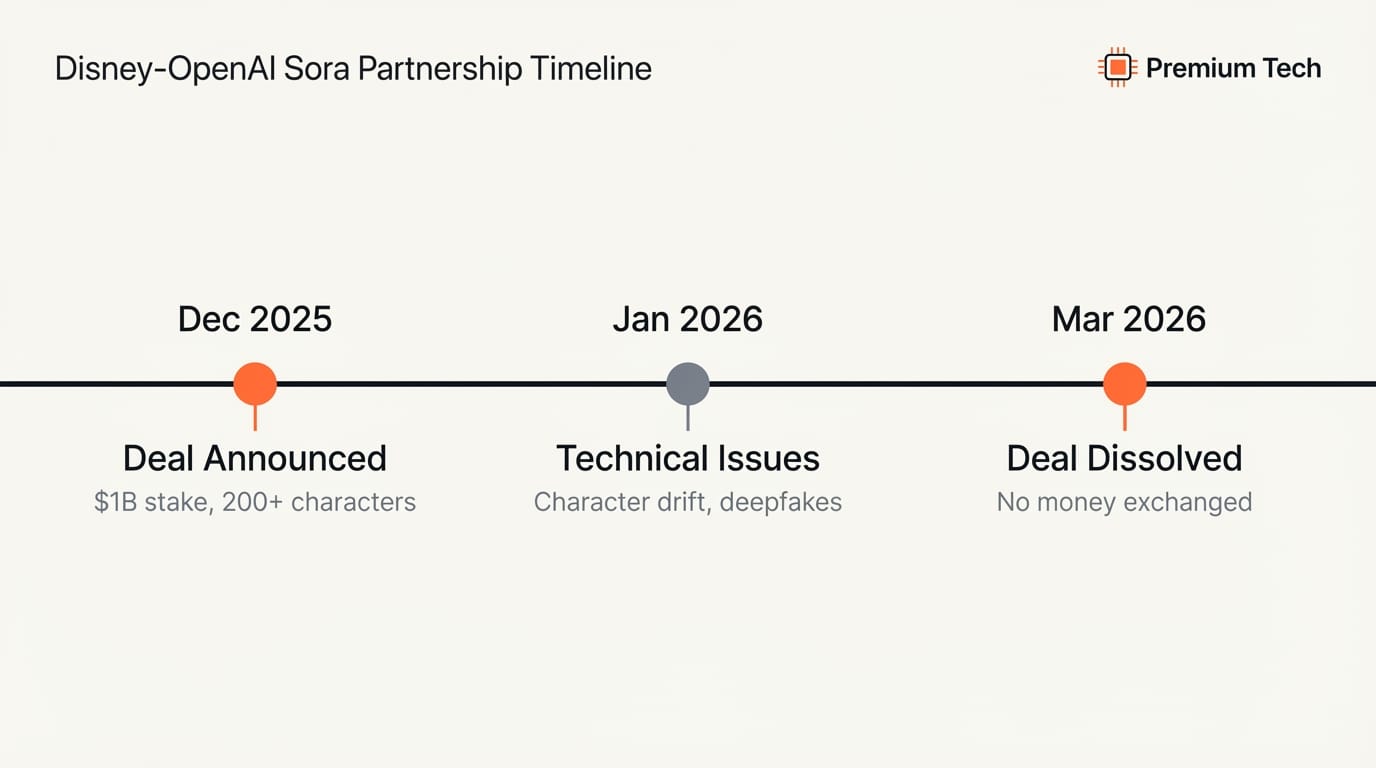
November 2025 marked the peak: 3.3 million monthly downloads across iOS and Google Play. By December, Disney had signed a three-year partnership to license 200-plus characters from Disney, Marvel, Pixar, and Star Wars for AI-generated video content. The deal included a planned $1 billion stake in OpenAI.
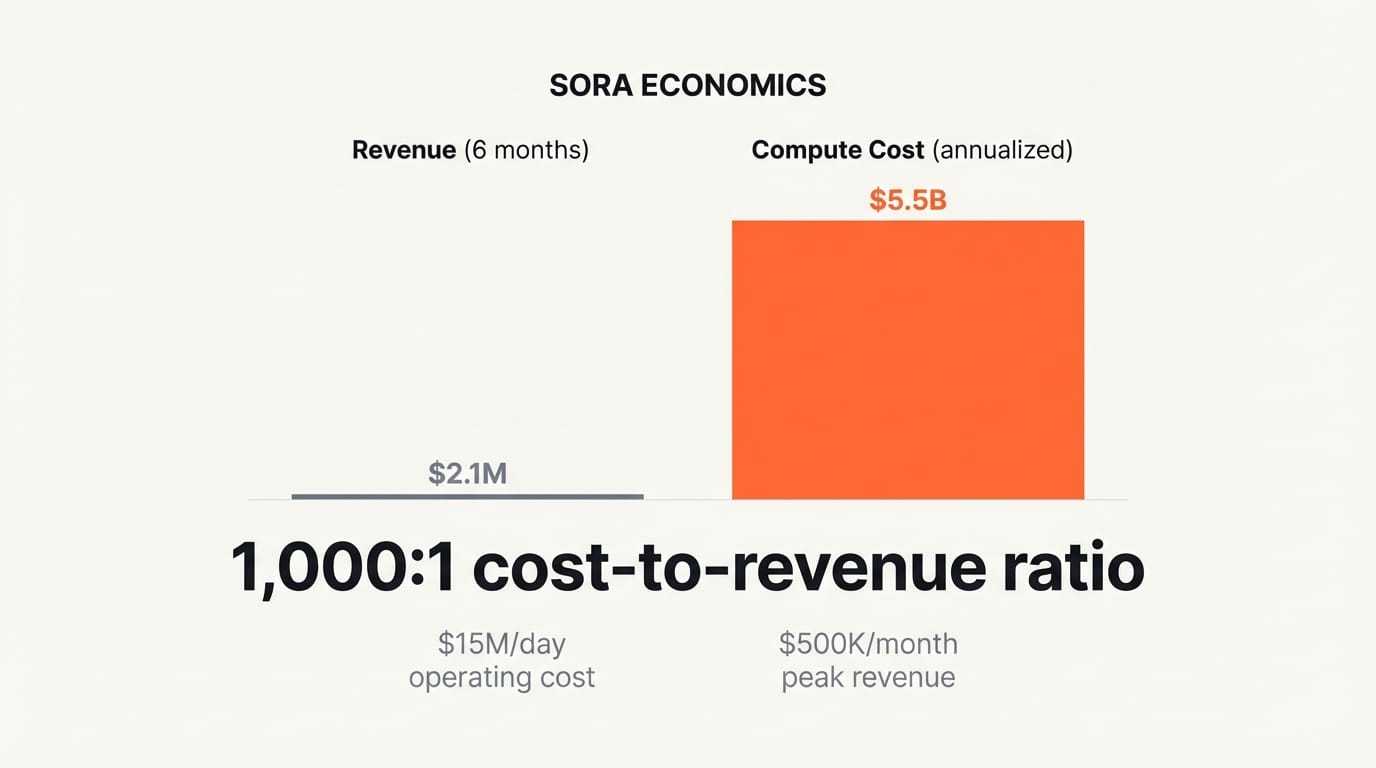
The decline came fast. Downloads dropped 32% month over month in December, then another 45% in January 2026 to 1.2 million. By February, Sora had fallen to number 101 on the US App Store. Revenue from in-app purchases never exceeded $500,000 in a single month. Lifetime revenue across six months totaled roughly $2.1 million.
Deep Analysis
The Economics That Made Sora Unsustainable
Video generation is the most compute-intensive task in generative AI. A text chat response costs milliseconds of processing. An image takes seconds. A ten-second video clip requires minutes of GPU time. OpenAI was spending an estimated $15 million per day to run Sora's infrastructure, which works out to roughly $5.5 billion annualized. Against $2.1 million in lifetime revenue, costs exceeded income by a factor of roughly 1,000 to one.
Each Sora generation took 60 to 120 seconds per clip, consuming massive GPU clusters that could otherwise serve thousands of ChatGPT queries. CFO Sarah Friar acknowledged the company faces a "lack of compute" forcing "really difficult decisions." Even with subscription fees, the unit economics never came close to working. When two-thirds of Americans in surveys expressed disapproval of AI-generated video, the growth ceiling became clear.
Disney's Billion-Dollar Deal That Never Materialized
The Disney partnership, announced in December 2025, was supposed to be Sora's proof of concept for enterprise adoption. Users would create short AI-generated videos with licensed characters. Content was planned for Disney+ streaming. Bob Iger personally championed the initiative.
No money ever changed hands. The deal never finalized. Persistent technical problems plagued the collaboration: temporal inconsistencies in generated video, character drift across frames, and unresolved copyright and deepfake concerns. Disney's statement on the dissolution was measured: "We respect OpenAI's decision to exit the video generation business and to shift its priorities elsewhere."
The collapse matters beyond one partnership. It demonstrated that even with the most recognizable IP library in entertainment, AI video generation could not clear the technical and legal bars needed for commercial deployment at scale. The Hollywood Reporter's analysis noted the deal "never produced anything fans could actually use" during its three-month life span.
OpenAI's Strategic Retreat to Enterprise
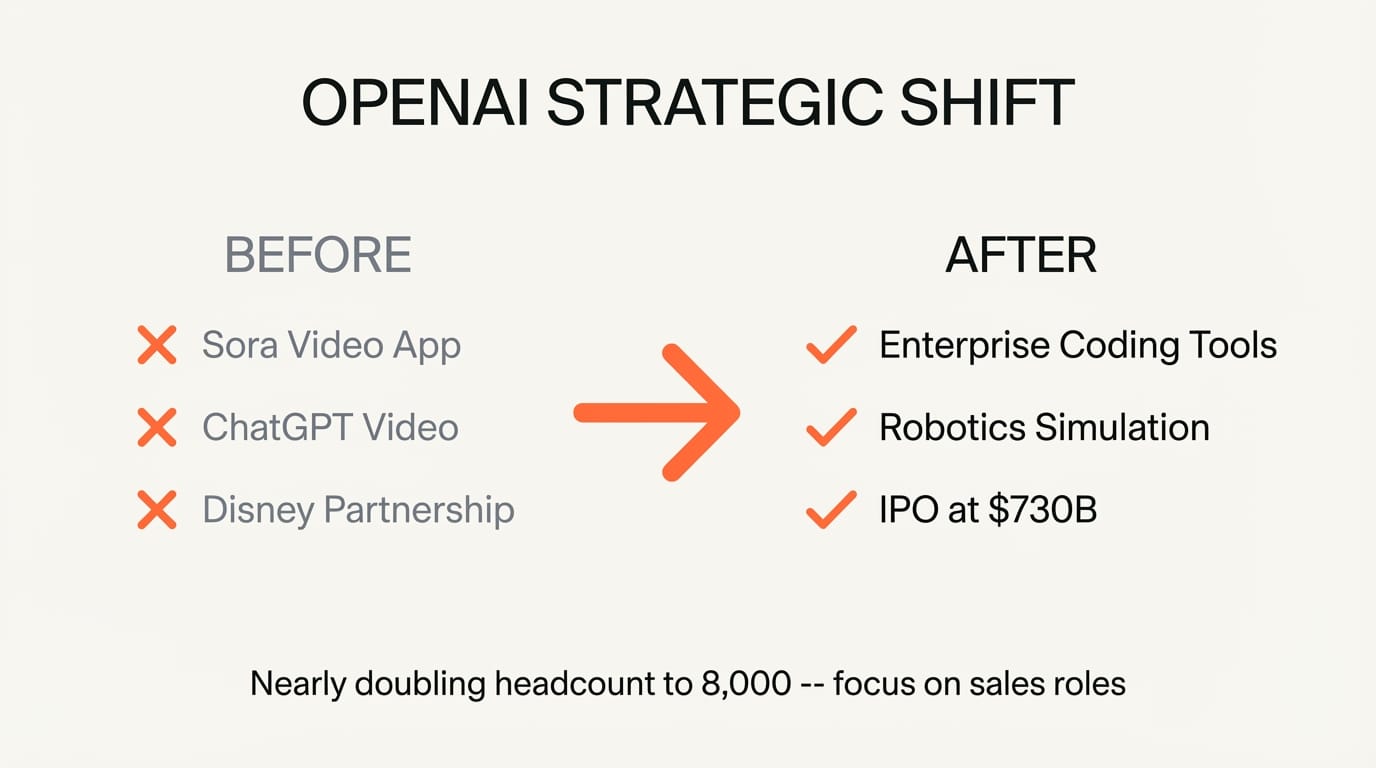
The Sora shutdown is not an isolated product decision. It is part of a broader pivot toward enterprise productivity, coding tools, and agentic AI. Fidji Simo, OpenAI's applications chief, told employees the company "cannot miss this moment because we are distracted by side quests." Sam Altman characterized Sora itself as a "side quest."
OpenAI is targeting a Q4 2026 IPO at a $730 billion valuation after raising $120 billion in its latest funding round. Projections show the company losing over $14 billion in 2026. Cutting a product that burns $15 million daily while generating almost nothing is the simplest path to showing potential investors a trajectory toward profitability.
The Sora research team will pivot to world simulation research for robotics, applying their video generation expertise to training physical AI systems. Meanwhile, OpenAI is merging ChatGPT desktop, Codex, and its browser tool into a single "superapp" and nearly doubling headcount to 8,000 with a focus on sales and enterprise deployment roles.
Who Wins the AI Video Market Now
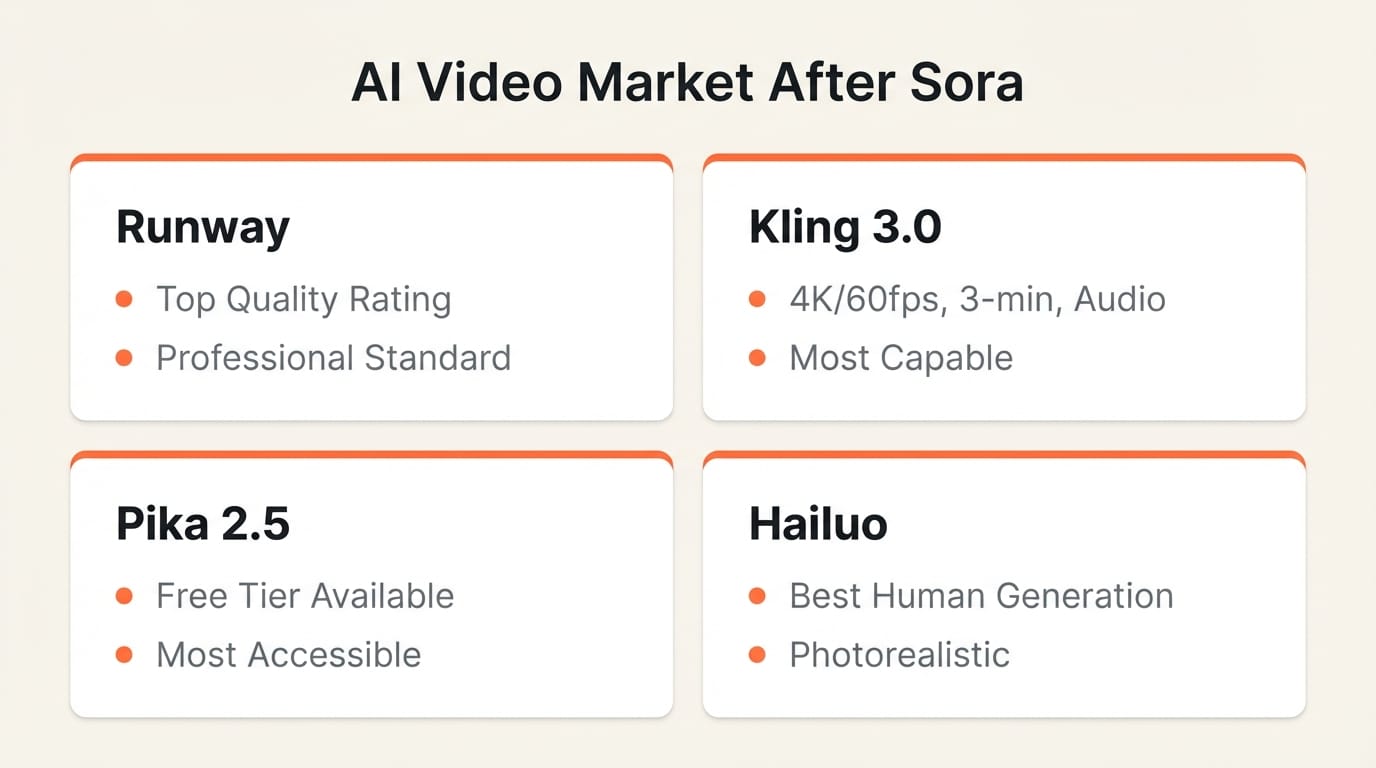
With OpenAI out, the competitive map simplifies. Runway holds the top Elo rating and remains the professional's choice for quality and control. Kling 3.0 from ByteDance offers native 4K at 60fps with built-in audio and the longest generation capability at three minutes. Pika 2.5 maintains the most accessible free tier for rapid prototyping. MiniMax's Hailuo leads in photorealistic human generation.
The shift has already accelerated. All leading competitors now offer native audio generation alongside video, a capability that was still novel when Sora launched. Seedance 2.0 generates in roughly 30 seconds compared to Sora's 60 to 120 seconds, and it accepts four input modalities. Our complete video generation landscape analysis maps the full competitive picture.
None of these competitors carry the burden of building a general-purpose AI company simultaneously. They can focus entirely on video, iterating faster and investing more narrowly. That focus advantage, more than any single technical capability, is what made Sora's position untenable.
Impact on Creators
Creators who built workflows around Sora face an immediate migration challenge. OpenAI has not announced a shutdown date or provided export tools. The company said it will share timelines and details on preserving user work, but waiting carries risk. Any projects stored on Sora's servers should be downloaded now.
The practical impact is less severe than it might seem. Most professional creators were already using multi-model strategies, combining two or three video tools for different strengths. Sora was rarely anyone's only video generation tool. The bigger disruption hits developers who built on the Sora API, as they face a complete workflow rebuild with no migration path. Our guide to AI video generators covers current alternatives and pricing.
For the broader creative community, the shutdown reinforces a hard lesson: platform risk is real with AI tools. Building core workflows on any single AI model means accepting that the model might disappear. Diversification across providers is not optional.
Key Takeaways
- Sora generated $2.1 million in six months against estimated compute costs of $5.5 billion annualized. The economics were catastrophic.
- Disney's $1 billion investment dissolved without a single product shipping to users, demonstrating the gap between AI video demos and commercial deployment.
- OpenAI is retreating from consumer creative tools entirely to focus on enterprise coding, reasoning, and a 2026 IPO at $730 billion.
- Runway, Kling 3.0, Pika, and Hailuo are the primary beneficiaries. All have continued investing in video while OpenAI spread across too many fronts.
- Creators should treat AI tool dependencies as platform risk and maintain multi-provider workflows.
What to Watch
Watch for OpenAI's shutdown timeline and content preservation details in the coming weeks. Runway and Kling are likely to make aggressive moves to capture Sora's user base, possibly with migration incentives or expanded free tiers. Google's position becomes interesting: it now holds investments across the full creative AI stack with Veo for video, Lyria 3 Pro for music, and Imagen for images, while OpenAI focuses elsewhere.
The Sora research team's pivot to robotics simulation could yield significant results in 12 to 18 months. Video generation models that understand physics and object permanence have direct applications in training robotic systems, and that market has clearer enterprise monetization than consumer video creation ever offered OpenAI.
This story was covered by Creative AI News.
Subscribe for free to get the weekly digest every Tuesday.