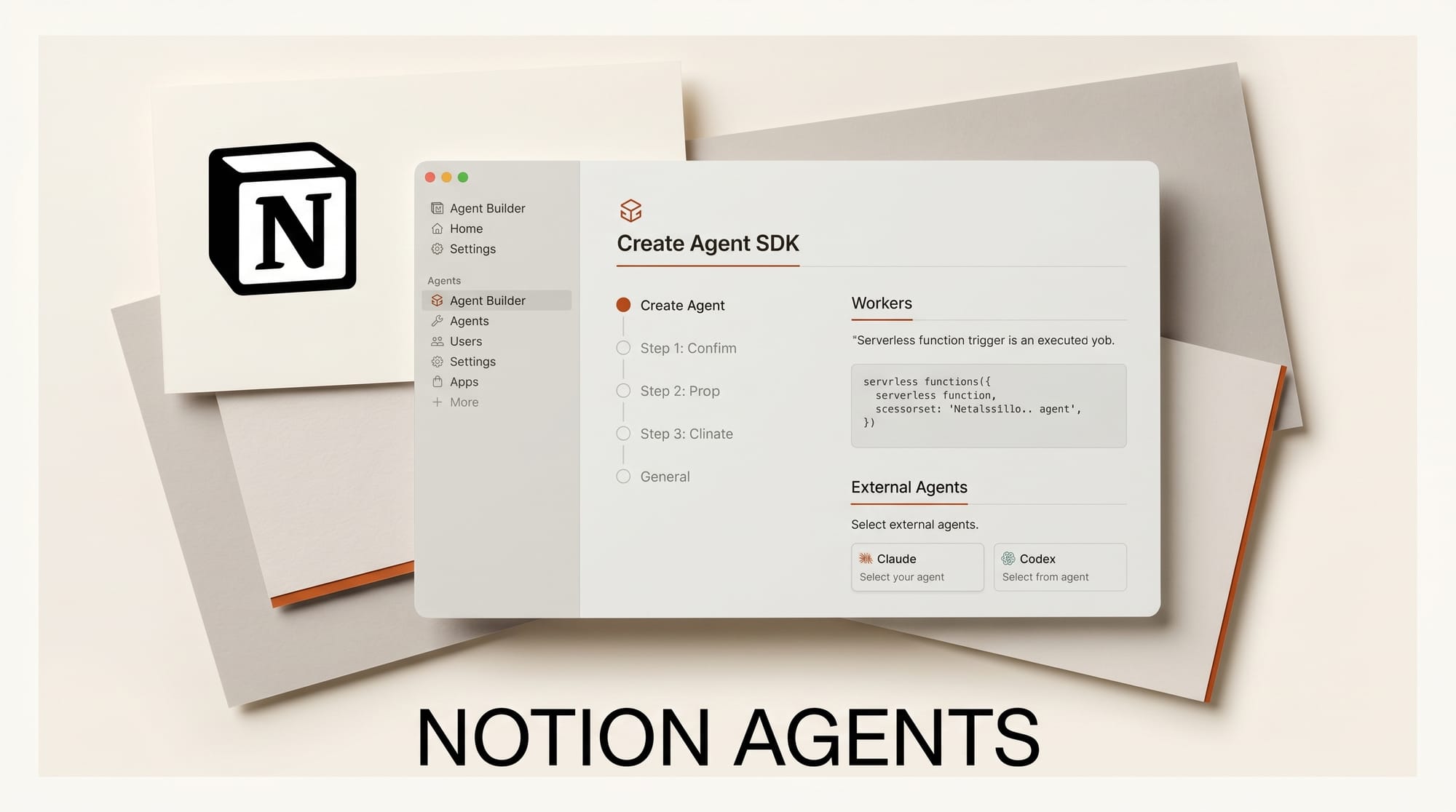
On May 13, 2026, Notion held its first Dev Day and launched a full developer platform: Notion Workers, an External Agents API, an Agent SDK, and a command-line interface. All four components landed together, transforming Notion from a structured document tool into a programmable workspace where Claude, Codex, and custom agents can read, write, and act on your data.
At launch, supported partner agents include Claude (Anthropic), Codex (OpenAI), and Decagon. The Notion MCP server received a simultaneous update that makes database operations 91 percent more token-efficient -- a direct improvement for anyone already running AI agents against their Notion workspace.
What Happened at Notion Dev Day 2026
Notion announced four interconnected products on May 13:
- Notion Workers: A hosted serverless runtime for custom code, deployed via the Notion CLI, running in a secure sandbox.
- External Agents API (Alpha): Lets third-party agents like Claude and Codex operate inside Notion directly -- routing tasks, reading databases, writing pages.
- Agent SDK (Alpha): Embeds Notion's own AI agents in external tools -- CRM dashboards, Microsoft Teams, Discord, analytics platforms.
- Notion CLI: A command-line tool for programmatic workspace interaction, authentication, Workers deployment, and building integrations.
The announcements were made at a livestreamed product event and confirmed in TechCrunch's coverage the same day.
Notion Workers: Custom Code Without Managing Servers
Workers is the infrastructure layer that makes everything else possible. You write JavaScript, deploy it via the Notion CLI, and it runs in a sandboxed environment hosted by Notion -- no Docker, no VMs, no cloud configuration.
Three specific capabilities run on Workers:
- Database sync: Pull data from any external source with an API -- Salesforce, Strava, Zendesk, Spotify, or a custom internal system -- and sync it into a Notion database on a schedule or via webhook trigger.
- Custom agent tools: Extend what AI agents can do inside your workspace. A Worker can call external APIs, transform data, or run logic that no built-in Notion feature supports.
- Webhook handling: Receive events from external services and trigger Notion actions in response.
Workers are free during the current beta. Billing switches to Notion's credit system on August 11, 2026.
The PlanetScale engineering team offered a concrete example at the event: a Worker that runs nightly, finds uneditable PDFs in Google Drive, converts them, and writes the results as fully editable Notion pages. That is the kind of workflow that previously required a custom server, a cron job, and API credentials scattered across multiple services.
For a detailed technical walkthrough of Workers architecture and deployment, Matthias Frank's Dev Day guide covers the full setup with code examples.
External Agents API: Claude and Codex Inside Your Workspace
The External Agents API is in alpha and is the piece most directly relevant to creators running AI-assisted workflows. It allows Claude, Codex, and Decagon to act as orchestrated agents inside Notion -- not just reading pages, but routing tasks, creating content, and triggering workflows.
The practical use case Notion demonstrated: a support ticket lands in a Notion database, the External Agents API routes it to the appropriate coding agent (say, Codex for a bug report, or Claude for a policy question), the agent resolves it, and the result writes back into Notion. No manual hand-off. No copy-paste between tools.
For creators, this means your Notion workspace can become the coordination layer for multi-agent work. Research goes in, Claude processes it, outputs return to Notion for review -- all without leaving the tool you already use for project management.
The External Agents API is currently in alpha with a waitlist. The API is read-write: agents can create pages, update databases, and trigger Workers, not just read data.

Agent SDK: Notion Agents Embedded in Your Other Tools
The Agent SDK inverts the External Agents API direction. Instead of bringing outside agents into Notion, it lets you embed Notion's own AI agents in tools outside the workspace.
Announced use cases include:
- A "deal report" button in your CRM that pulls structured context from a Notion database and generates a formatted summary
- A Teams or Discord bot that answers repeated questions using verified knowledge from your Notion workspace
- A dashboard in Amplitude or Hex that surfaces customer context stored in Notion pages
For design studios, content teams, and agencies, the Agent SDK means the structured knowledge you maintain in Notion -- brand guidelines, client briefs, asset libraries, process docs -- becomes queryable by the agents and tools your team already uses daily.
The Agent SDK is in waitlist alpha. Access requests can be submitted through the Notion developer portal.
Notion CLI and Markdown API
Two developer tools completed the Dev Day release.
The Notion CLI handles authentication, reading and writing workspace data programmatically, and building and deploying Workers. Install it from ntn.dev with:
curl -fsSL https://ntn.dev | bashThe CLI is available on all Notion plans. It is the required interface for deploying Workers and the recommended tool for scripting any Notion data operation. Full API reference and developer documentation is at developers.notion.com.
The Markdown API is a new read-write interface that lets agents and scripts interact with Notion pages as plain Markdown rather than Notion's proprietary block format. This is significant for AI agent workflows: most language models work with Markdown natively, so the Markdown API eliminates a translation layer that previously added friction and token cost.
The Notion MCP server was also updated. Database operations are now 91 percent more token-efficient, which directly reduces cost and latency for any agent using Notion as a data source.

What This Enables for Creators
The four products together address a gap that content creators, designers, and small production teams hit when they try to build AI-assisted workflows: most AI agents live in separate tools, and the results have to be manually moved into the places where work actually happens.
Notion is where many creative teams manage briefs, track projects, store reference material, and log decisions. When Claude can read a brief, generate a draft, and write the output directly into a linked Notion page -- and when a Worker can sync the latest client feedback from a form into the project database without manual entry -- the coordination overhead drops substantially.
The 91 percent token efficiency improvement on MCP is also a cost signal. For teams already running Claude or Codex against their Notion workspace, this update cuts the API cost of every database operation by roughly 10x in token consumption. If you run those queries at scale (daily briefs, batch processing, automated reporting), the savings are real.
For creators who want to connect Claude workflows to multiple tools at once, the Claude Code Agent View guide covers how to run parallel AI coding and research sessions -- a pattern that pairs directly with Notion as the output destination via the External Agents API.
What to Do Next
If you use Notion for project management or knowledge management and want to integrate AI agents:
- Install the Notion CLI now -- it is available on all plans. Install with
curl -fsSL https://ntn.dev | bashand authenticate against your workspace. - Review the May 13 release notes at notion.com/releases/2026-05-13 for the full feature list and documentation links.
- Join the waitlists for the External Agents API and Agent SDK if either fits your workflow. Both are in alpha with limited access.
- Test the MCP update if you are already running Claude or Codex against Notion data. The token efficiency improvement takes effect immediately -- no configuration needed.
- Plan a Workers use case before August 11 billing starts. Free access runs through the summer, which is the ideal window to build and test a sync or webhook integration without cost pressure.
Frequently Asked Questions
What is the difference between the External Agents API and the Agent SDK?
The External Agents API brings outside agents (Claude, Codex, Decagon) into Notion -- they can act on your Notion data as a destination. The Agent SDK does the reverse: it embeds Notion's own AI agents in external tools (CRM, Teams, Discord) so they can answer questions and surface Notion data as a source. Both are in alpha with waitlist access.
Does the Notion CLI require a paid Notion plan?
No. The Notion CLI is available on all Notion plans, including the free tier. Workers deployment also uses the CLI, though Workers themselves will move to a credit-based pricing model on August 11, 2026. Credit consumption during the beta period is free.
How does the Markdown API differ from the existing Notion API?
The existing Notion API uses Notion's block format, which requires converting to and from the block structure when working with AI agents. The Markdown API reads and writes pages as standard Markdown, which eliminates that conversion step. For AI agent workflows, this reduces the prompt overhead and makes it easier to pipe Notion content directly into Claude or Codex without preprocessing.
What did Notion improve in the MCP server update?
The Notion MCP server update added Meeting Notes and block comment support, and it made database operations 91 percent more token-efficient. For Claude or Codex agents reading large Notion databases through MCP, this means the same operation now costs roughly one-tenth the token count it previously required.
Can I use Notion Workers without knowing JavaScript?
Workers currently require JavaScript. The runtime is a sandboxed Node-compatible environment deployed via the Notion CLI. If you are not a developer, the most practical path is to wait for partner agent integrations (Claude, Codex) through the External Agents API, which will expose Notion's capabilities without custom code.
When will the External Agents API and Agent SDK leave alpha?
Notion has not announced a general availability timeline for either. Both launched in alpha on May 13, 2026, with access via waitlist. Given that Workers moves to credit billing on August 11, a reasonable inference is that the agent products will follow a similar summer-to-fall availability progression, but this is not confirmed.