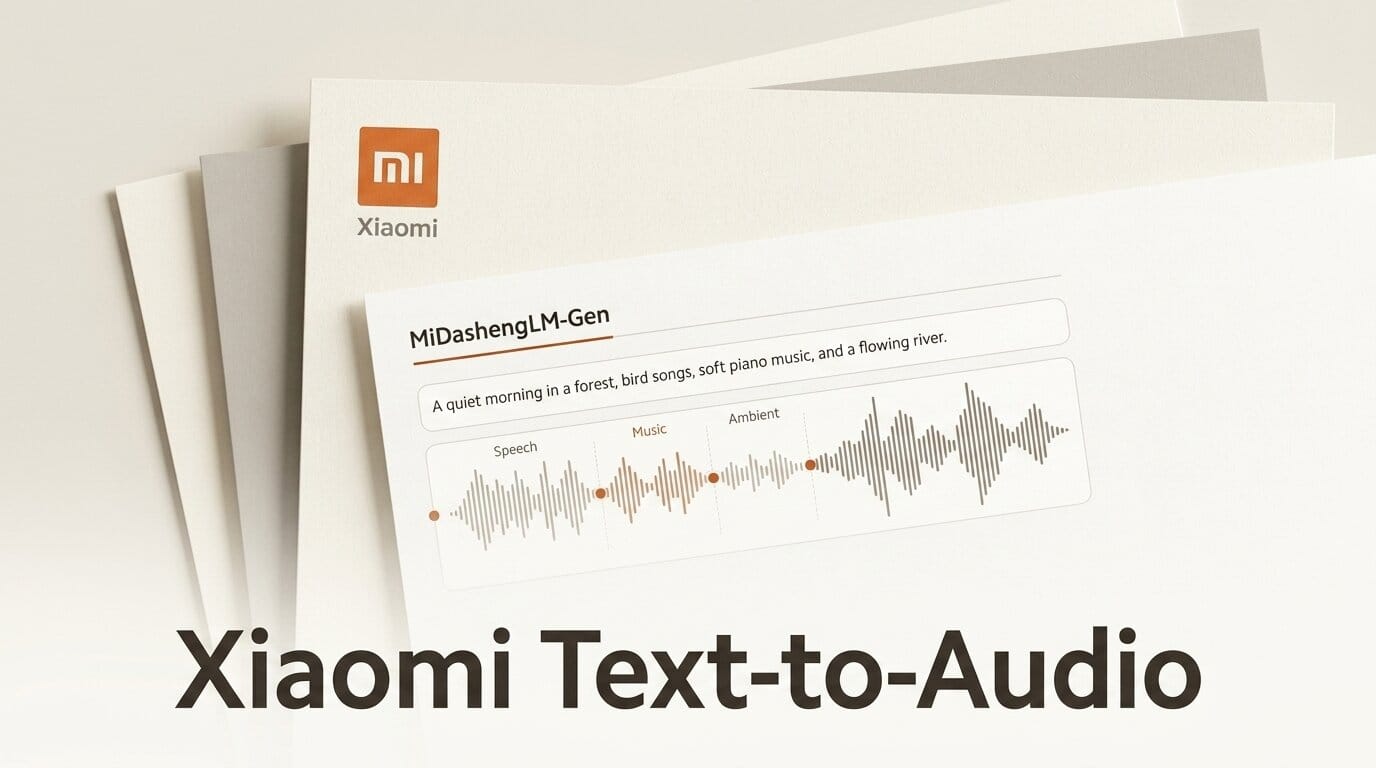
Xiaomi released MiDashengLM-Gen on August 12, 2026, an open-weights 3B-parameter model that generates a full audio scene, speech, music, and sound effects together, from a single text prompt. It ships under the permissive Apache 2.0 license with code, checkpoints, and a live demo, and its technical report claims a first: one end-to-end trained model for general text-to-audio, rather than a pipeline of frozen, separately built components. On the English Seed-TTS benchmark it cuts word error rate from 12.15 percent for prior unified models down to 2.79 percent, closing most of the gap to dedicated text-to-speech systems at 1.24 percent.
For creators who assemble voiceover, background music, and ambient sound in separate tools and stitch them in a timeline, that consolidation is the headline. Below is what the model actually does, how it works, the numbers that back it up, and how to run it today.
What MiDashengLM-Gen Actually Does
MiDashengLM-Gen takes a text description and produces a single 16 kHz mono audio clip that can contain layered speech, music, and environmental sound at once. Instead of generating a voice track in one system and a music bed in another, you describe the scene, a narrator speaking over soft piano in a rainy street, and the model renders all of it in one autoregressive pass of variable length. It is built by the Xiaomi MiLM Plus team, the same group behind the earlier MiDashengLM-7B audio-understanding model, and this Gen variant flips that lineage from listening to producing.
How One Model Replaces a Whole Audio Stack
The practical shift is consolidation. A typical creator audio workflow today chains a text-to-speech engine, a text-to-music generator, and a sound-effects library, then mixes them by hand. MiDashengLM-Gen collapses those steps into one prompt-to-clip call. The table below compares the approaches.
| Approach | Speech | Music | Sound effects | License | Runs locally |
|---|---|---|---|---|---|
| MiDashengLM-Gen (3B) | Yes | Yes | Yes | Apache 2.0 | Yes |
| Prior unified models | Yes (12.15% WER) | Limited | Limited | Varies | Sometimes |
| Dedicated TTS system | Yes (1.24% WER) | No | No | Often closed | Varies |
| Multi-tool pipeline | Separate tool | Separate tool | Separate library | Mixed | Depends |
The trade-off is clear: a single open model handles all three audio types where a dedicated TTS engine still wins on raw pronunciation accuracy. For scene-level work rather than clean isolated narration, one model that stays coherent across voice, music, and effects is the more useful primitive.
There is a workflow dividend too. When one model owns the whole scene, timing between a spoken line and the music swell behind it is decided during generation, not patched together in a digital audio workstation afterward. That removes a class of manual alignment work, and because the description is text, versioning a soundbed becomes editing a sentence rather than re-rendering and re-mixing three files.
The Architecture: An LLM That Speaks in Sound
Under the hood, MiDashengLM-Gen couples a pretrained large language model with per-token conditional flow matching. The language backbone is a fully fine-tuned Qwen3-1.7B, and the flow-matching head turns each predicted token into a slice of waveform. Because the LLM drives generation autoregressively, output length is variable and the model can keep speech, music, and effects synchronized within the same sequence rather than aligning three separate outputs after the fact. The report frames this as a genuinely end-to-end trained system, not frozen encoders bolted together, which is what lets one network cover the whole audio scene.

The Benchmark Numbers That Matter
Speech intelligibility is where unified audio models have historically fallen apart, so that is the number to watch. On the Seed-TTS English evaluation, MiDashengLM-Gen posts a 2.79 percent word error rate. That is down from 12.15 percent for previous unified models, roughly a four-times reduction, and it lands within striking distance of purpose-built TTS at 1.24 percent. The authors report that the improvement extends to multilingual settings with competitive word error rates, and that on the MECAT benchmark the model holds competitive mixed-audio generation quality while gaining that intelligibility. In plain terms: earlier all-in-one models produced garbled speech; this one produces speech you can actually understand while still layering in music and effects.
What This Enables for Creators
For a video editor, podcaster, or game developer, the value is fewer tools and tighter iteration. You can draft a full soundbed, a line of narration over a music cue with an ambient backdrop, from one prompt, audition it, and revise the description instead of re-mixing three exports. Because the weights are open under Apache 2.0 and the model is only 3B parameters, it runs locally, which matters for cost, privacy, and batch generation of many variations. This is the same open-weights, run-it-yourself pattern reshaping other creative categories, from local video generation to open flagship LLMs.
The honest caveat: at 2.79 percent WER it is not yet a drop-in replacement for a dedicated TTS engine when you need pristine, isolated narration. Treat it as a scene generator and rapid-draft tool, not a final broadcast voice track, and use it where the whole mixed bed is the deliverable.
How to Try MiDashengLM-Gen Today
- Open the demo page to hear generated samples before installing anything.
- Set up a Python environment and install the dependencies:
pip install torch torchaudio "transformers>=4.51" einops safetensors soundfile tqdm numpy x-transformers - Load the model in a few lines:
AutoModel.from_pretrained("mispeech/midashenglm-gen", trust_remote_code=True) - Call
model.generate()with structured multi-view caption tokens that describe the speech, music, and sound-effect layers of your scene. - Read the setup notes and examples in the GitHub repository, then save the 16 kHz output and drop it into your editing timeline.
Everything you need, code, checkpoints, and the demo, is public, so the fastest path is to clone the repo and generate a few scenes against your own prompts.
Frequently Asked Questions
Is MiDashengLM-Gen free to use commercially?
Yes. It is released under the Apache 2.0 license, which permits commercial use, modification, and redistribution with attribution. Confirm the exact terms in the model card before shipping a product on top of it.
Can it generate speech, music, and sound effects at the same time?
Yes. That is the core design. It renders a mixed audio scene combining speech, music, sound effects, and environmental acoustics in a single autoregressive pass rather than in separate tracks.
How good is the speech quality compared to a real TTS system?
It reaches 2.79 percent word error rate on the English Seed-TTS benchmark, far better than prior unified models at 12.15 percent but still behind dedicated text-to-speech at 1.24 percent. It is strong for scene generation, not yet a replacement for a specialized narration engine.
What hardware do I need to run it?
It is a 3B-parameter model built on Qwen3-1.7B, small enough to run locally on a single modern GPU. Exact memory needs depend on your setup, so check the repository requirements.
Who built it and when was it released?
It was built by the Xiaomi MiLM Plus team and released on August 12, 2026, alongside an arXiv technical report, open weights on Hugging Face, and a public demo.
What languages does it support?
The report states the model extends to multilingual settings with competitive multilingual word error rates, though the headline benchmark figures are reported on English.