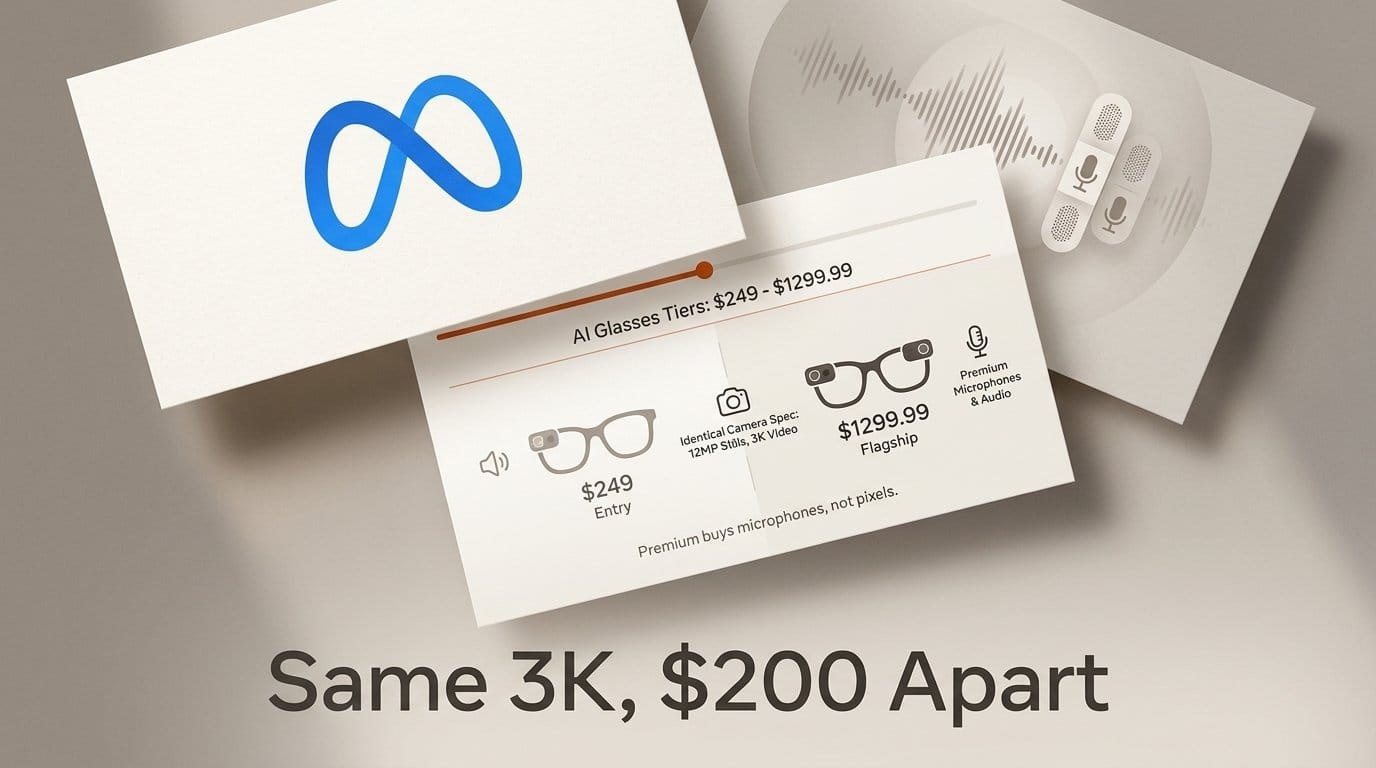
Meta opened Connect 2026 on September 23 with six pairs of glasses spanning $249 to $1,299.99, and the pair it put on stage first cannot take a photograph. The Ray-Ban Meta Audio is camera-free by design at $349. The new flagship, Ray-Ban Meta (Gen 3), costs $449 and is available today.
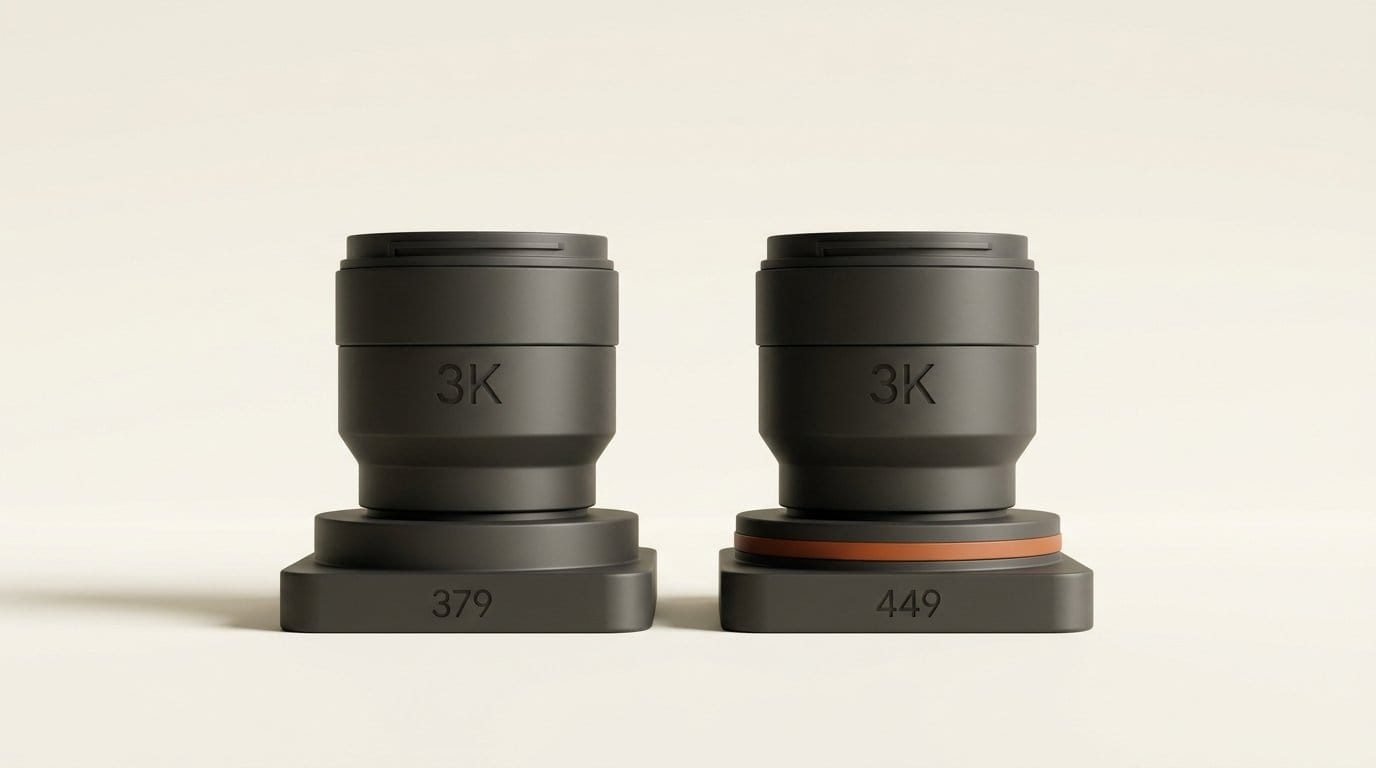
Read the spec sheets side by side and a pattern shows up that none of the keynote framing points at: every camera-equipped pair in the lineup captures the same thing. The $249 Meta Adventurer and the $449 Ray-Ban Meta (Gen 3) both shoot 12 MP stills and 3K video. So does the Gen 2 that Meta shipped in September 2025 for $379. The camera has not moved in a year. What Meta charges more for in 2026 is microphones.
That matters if you were planning to buy glasses as a capture device rather than as an assistant. The resolution question is settled across the whole range, which means the decision collapses into battery, audio, and frames. Below is the lineup with every number Meta published, then the three places where the money actually changes what you get.
What Meta shipped at Connect 2026
Six products, four of them orderable this week. Prices are Meta's published starting prices in USD.
| Product | Price | Camera | Video | Battery | Available |
|---|---|---|---|---|---|
| Meta Adventurer | $249 | 12 MP ultra-wide, 100-degree FOV | 3K at 30 fps, 1080p at 60 fps | 8+ hours | Pre-order now, ships Oct 23 |
| Ray-Ban Meta Audio | $349 | None | None | 12 hours, 48 more from case | Pre-order now, ships Oct 13 |
| Meta Adventurer / Capri LISA Edition | $399 | 12 MP | 3K | 8+ hours | Announced Sept 23 |
| Ray-Ban Meta (Gen 3) | $449 | 12 MP | 3K Ultra HD | 9 hours | Available today |
| Meta Ray-Ban Display | $799 | Yes, plus in-lens display | Dolby Atmos spatial capture | Not published | US now, EU Oct 13 |
| Meta VR Glasses | $1,299.99 | Passthrough only | No capture | 3 hours playback | Spring 2027 |
The Gen 3 arrives in Aviator, Wayfarer, and a new Zena cat-eye frame across 27 color and lens combinations. The Audio ships in Clubmaster and Burbank across 23. Meta also added Singapore, South Korea, Mexico, and the UAE as launch markets today, with Brazil, Turkey, Poland, Portugal, Israel, South Africa, Indonesia, Thailand, Hong Kong, New Zealand, Malaysia, and the Philippines listed as coming soon.
The camera has not changed since September 2025
This is the claim worth checking, because it is the one that decides whether an upgrade is rational. Meta's own Gen 2 announcement from September 17, 2025 described "3K Ultra HD video capture" with "ultrawide HDR, up to 60 frames per second, and more than twice as many pixels as the previous generation," at a starting price of $379. Today's Gen 3 page describes a "12 MP camera and 3K Ultra HD video recording."
Same sensor resolution, same video resolution, $70 more. That is an 18.5% price increase on the flagship line for a camera that captures identically. The documented gains are elsewhere: battery goes from eight hours to nine, a 12.5% improvement, and the microphone array is rebuilt.
The comparison that should actually worry Meta is internal. The Adventurer at $249 carries a 12 MP ultra-wide with a 100-degree field of view, records 3K at 30 fps and 1080p at 60 fps, and runs 8+ hours. The Gen 3 at $449 is 80.3% more expensive, or $200 in cash, for the same two headline numbers. Meta's entry line has also gotten cheaper: the Meta Glasses line launched in June at $299, so the $249 Adventurer is a 16.7% cut on the cheapest way into a 12 MP, 3K pair of Meta glasses.
For anyone who bought Gen 2 in the last twelve months specifically to shoot POV footage, there is no pixel argument for replacing it.
The real upgrade is the microphones
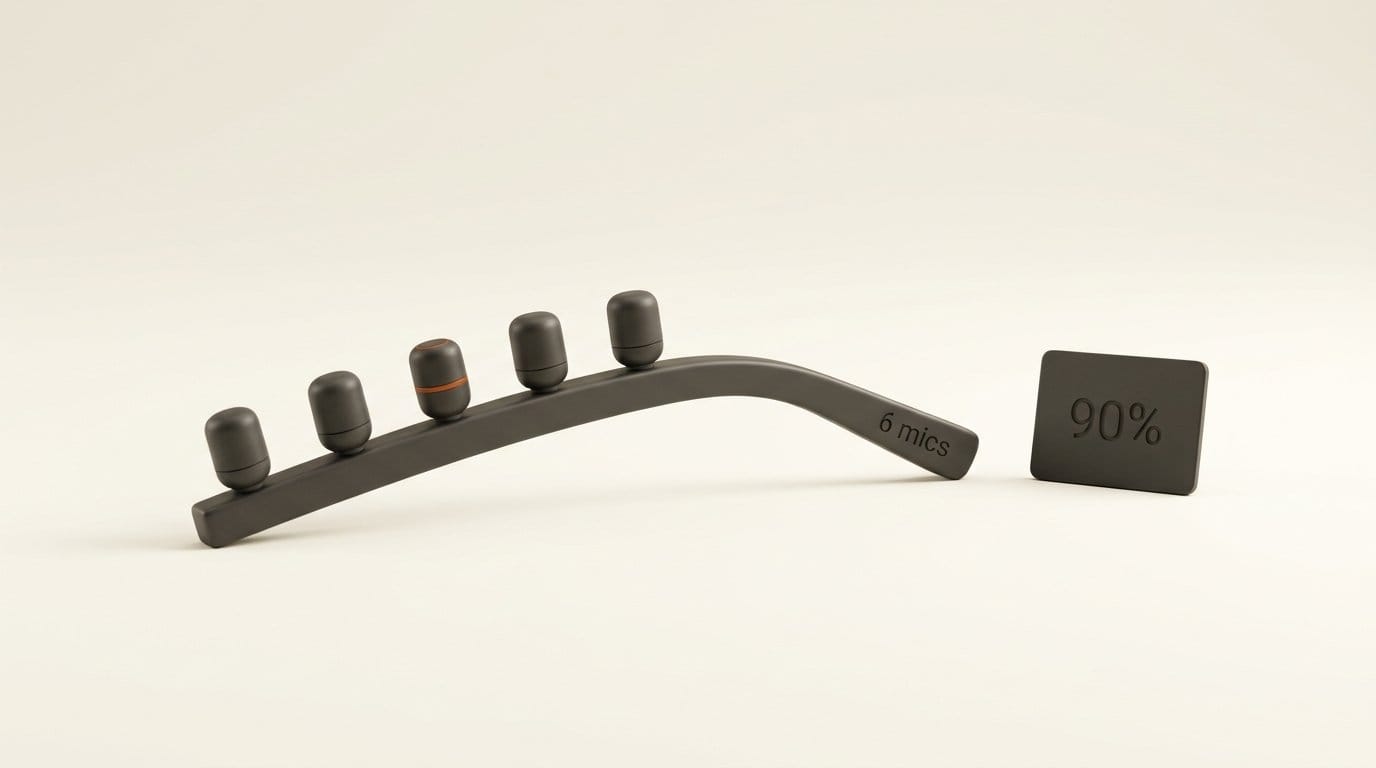
Meta's Gen 3 headline spec is a six-microphone array that the company says "cuts more than 90% of background noise." Gen 2 shipped with an unspecified multi-mic array and wind noise reduction. Going from a vague array to a stated six capsules with a published rejection figure is the only place in this launch where a capture number moved in a direction a creator can use.
The bigger audio claim is not shipped yet. Meta writes that "later this year," its AI glasses "will be the first consumer devices that enable users to capture and experience videos in Dolby Atmos with 360-degree spatial sound." That is a forward-looking statement, not a feature you can record with on September 23. It also sits awkwardly next to the Ray-Ban Display update, which lists Dolby Atmos video capture with spatial surround, "recorded natively," among features rolling out now. Two Meta posts published the same day describe the same capability with different timing, so treat Atmos capture as confirmed on Display and promised on the rest of the line.
If it lands as described, it is a genuine first and the most useful thing here. Glasses are a mediocre video camera and a very good microphone position: mounted at head height, pointed wherever you are looking, hands free. Location sound, room ambience, walking interviews, and on-site reference audio are all jobs where a 3K image is beside the point and clean multi-capsule audio is the entire deliverable. Meta's wearables are quietly becoming an audio tool with a camera attached, which is a different product from the one the marketing describes.
The $349 pair that records nothing
Ray-Ban Meta Audio is Meta's first audio-only glasses: 43 grams, up to 12 hours on a charge, up to 48 more from the case for 60 hours total, music and calls and speech translation and Muse access, and no camera at all. Meta is explicit that this is deliberate, and TechCrunch framed it as the camera-free option for people who want the assistant without the lens.
It is also $100 more than the Adventurer, which has a 12 MP camera. Inside one lineup announced on one day, the cheaper product captures 3K video and the more expensive one captures nothing. That is defensible as a privacy and battery trade, and the 12 hours is 33.3% longer than the Gen 3's nine, but it inverts the usual assumption that paying more buys more capability. Anyone shopping the price list without reading the spec column will get this wrong.
Camera-free is a real category, not a Meta invention. Google's audio-first glasses took the same position, as we covered in our Android XR audio glasses analysis, and the reasoning is the same: no lens means no recording indicator, no social friction, and a much smaller battery draw.
Where the expensive tiers put the money
Meta Ray-Ban Display is $799 in the US, £749 in the UK, $1,149 CAD, and €899 in the EU, with US orders open and EU pre-orders shipping October 13. Its September update adds cycling and public transit directions in the US and Canada, walking navigation that references visual landmarks instead of street names, calendar management, mirrored phone notifications, an Explore app for glasses-native experiences, and a photorealistic hologram of your face for WhatsApp calls in US Early Access this fall. The hologram infers expression from voice tone. Display is also where Dolby Atmos capture is described as shipping rather than coming.
Meta VR Glasses is the outlier, and worth naming clearly because its price will attract attention it does not deserve from creators. At $1,299.99 and shipping Spring 2027, it is a 5K Infinite Display at 37 pixels per degree, about 100 grams, a Snapdragon Reality Elite processor, three hours of continuous high-resolution playback, and 45W fast charging. Meta's announcement describes watching 3D movies, live sports, gaming, a private workspace, and receiving holograms. It does not mention recording, 3D capture, authoring tools, or a developer SDK. It is a display, not a camera, and nothing in the launch material suggests you will make anything with it. If you want head-mounted capture that feeds a 3D pipeline, that remains a dedicated spatial capture rig problem.
Muse, Meta's agent, spans the range. Connect added live video chat, real-time voice with selectable custom voices, an email address per agent, and retail actions with partners including Walmart, Best Buy, Gap, Sephora, and Wayfair. Meta also teased Muse Charm, a pendant with a small display, speakers, mics, and a fingerprint sensor, due later in 2026 with no price. Engadget's roundup has the full hardware list. The agent side of Muse has been moving faster than the optics, which we traced in our look at Muse Glimmer 30B.
What to buy, and what to skip
The spec convergence makes this unusually simple. Three rules cover most creative use.
- Buying glasses to shoot: take the $249 Adventurer. It records the same 12 MP and 3K as the $449 flagship. Put the $200 you saved toward a lavalier, which will improve your footage more than anything in this launch.
- Buying glasses to record sound: the Gen 3 is the only defensible upgrade, and only if you work in wind, traffic, or crowds where the six-mic array and the stated 90% noise rejection earn their keep. If Atmos capture matters to your pipeline, wait for it to ship rather than buying on the promise.
- Already own Gen 2: do nothing. You have the same camera. One extra hour of battery and a better mic array is not $449.
The wider read is that Meta has stopped competing on capture resolution and started competing on frames, price points, and the assistant. Six tiers, one sensor spec. For creators that is good news, because it means the cheap pair is no longer the compromised pair, and the interesting frontier moved to audio, where glasses were always going to be better than they are at video.
Frequently asked questions
Is the Ray-Ban Meta Gen 3 camera better than the Gen 2?
Not on resolution. Meta described Gen 2 as 3K Ultra HD with ultrawide HDR at up to 60 fps in September 2025, and describes Gen 3 as a 12 MP camera with 3K Ultra HD recording in September 2026. The documented Gen 3 improvements are a nine-hour battery instead of eight and a six-microphone array. Meta has not published a sensor change.
What is the cheapest Meta glasses pair that records 3K video?
The Meta Adventurer at $249, with pre-orders open now and shipping October 23. It has a 12 MP ultra-wide camera with a 100-degree field of view and records 3K at 30 fps or 1080p at 60 fps. That is $200 less than the Ray-Ban Meta (Gen 3) for the same headline resolution.
Does the $349 Ray-Ban Meta Audio have a camera?
No. It is Meta's first audio-only glasses and has no camera, so it cannot take photos or record video. It weighs 43 grams, runs up to 12 hours on a charge with up to 48 more from the case, and handles music, calls, speech translation, and Muse. It ships October 13 and costs $100 more than the camera-equipped Adventurer.
Can you record Dolby Atmos spatial audio on Meta glasses today?
Only on Meta Ray-Ban Display, where Meta lists Dolby Atmos video capture with native spatial surround among features rolling out now. For the broader AI glasses line, Meta says "later this year" that its glasses will be the first consumer devices to capture video in Dolby Atmos with 360-degree spatial sound. Treat it as unshipped on the Audio, Adventurer, and Gen 3 until Meta says otherwise.
Can you create content with Meta VR Glasses?
Nothing in the launch material says so. The $1,299.99 headset, due Spring 2027, is described for watching 3D movies and live sports, gaming, a private workspace, and receiving holograms. Meta's announcement does not mention recording, 3D capture, authoring tools, or a developer SDK. It is a 5K playback device at 37 pixels per degree with three hours of battery.
Should you upgrade from Ray-Ban Meta Gen 2?
For video, no. The camera specification is unchanged and you would pay $449 for one extra hour of battery and a better microphone array. The upgrade is worth considering only if you record dialogue or ambience in noisy environments, where the six-mic array and Meta's claim of more than 90% background noise reduction change what is usable in post.