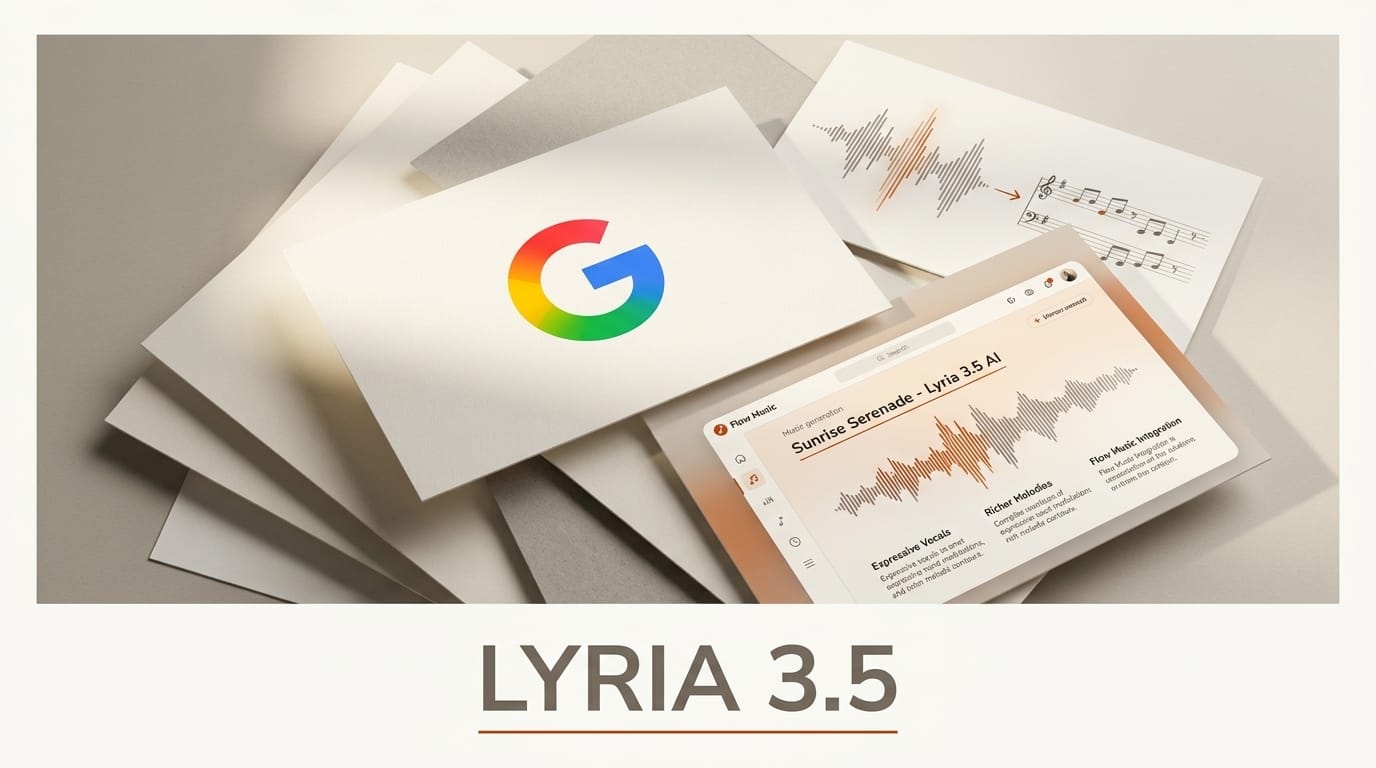
Google DeepMind released Lyria 3.5 on July 29, 2026, rolling the new music generation model into Flow Music the same day. The update goes after the four things creators complain about most in AI song tools: melodic structure, lyric adherence, vocal expression, and control over tempo and duration. It lands roughly four months after Lyria 3 Pro, which shipped March 25, 2026, and it keeps Google's two signature choices intact: training on licensed data and stamping every output with a SynthID watermark.
If you have used Suno, Udio, or ElevenLabs Music, Lyria 3.5 is not a reinvention. It is a targeted quality pass on the parts of a generated song that usually give the game away: robotic vocals, lyrics that ignore your prompt, and melodies that wander. Here is exactly what changed, how it stacks up against the competition, and how to get a usable track out of it in Flow Music.
What Google Shipped in Lyria 3.5
The announcement on the Google DeepMind blog frames Lyria 3.5 around four upgrades rather than a single headline feature. Google did not publish new benchmark scores or track-length numbers, so the improvements are described qualitatively, but each maps to a concrete pain point.
- Musicality: richer, more complex melodic structures that Google says "sound more natural," aimed at reducing the aimless, loop-like feel of earlier AI songs.
- Lyrics: better adherence to your prompt and stronger structural awareness, so a request for a verse-chorus-bridge shape is more likely to come back with one.
- Vocals: more realistic and emotionally nuanced singing with improved pronunciation, the single most common tell of machine-made music.
- Creative control: easier management of tempo and duration, giving you more say over the arrangement instead of accepting whatever the model returns.
Every clip still carries a SynthID watermark, Google's imperceptible signal for identifying AI-generated audio. That matters for creators who need to disclose AI use or want provenance baked into their files.
Lyria 3.5 vs Lyria 3 Pro vs Suno v5.5
The clearest way to place Lyria 3.5 is against Google's own prior model and against Suno, the current consumer benchmark. The table below uses only disclosed facts; where Google did not publish a number, it is marked as not disclosed.
| Capability | Lyria 3.5 | Lyria 3 Pro | Suno v5.5 |
|---|---|---|---|
| Vocals | More expressive, improved pronunciation | Natural flow, high fidelity | Studio-grade, voice cloning |
| Lyric adherence | Improved prompt and structure following | Full song-structure awareness | Strong, prompt-driven |
| Stem export | No | No | Yes, up to 12 stems |
| Max track length | Not disclosed | Up to 3 minutes | Up to 8 minutes |
| Training data | Licensed only | Licensed only | Faced label lawsuits |
| Watermark | SynthID on every output | SynthID on every output | Not the default |
| Where to use | Flow Music | Flow, Vids | suno.com |
The pattern is consistent with Google's positioning all year. Lyria trades raw flexibility for two things creators increasingly care about: a clean licensing story and built-in provenance. Udio and ElevenLabs Music compete on length and control, but both sit outside Google's licensed-data guarantee. If your work will be commercially distributed or fed into a platform that scrutinizes training provenance, that column carries real weight.

The Four Upgrades That Matter for Creators
Read past the marketing and the four improvements sort into two camps: output quality and creative control.
Vocals and pronunciation are the biggest practical win. Earlier AI vocals slur consonants and flatten emotion, which forces creators to either bury the vocal in the mix or bounce the track to another tool. More accurate pronunciation and expressive phrasing mean a Lyria 3.5 vocal is more likely to survive as a lead rather than a texture.
Lyric adherence reduces the number of regenerations. When a model respects the section structure you asked for, you spend less time rerolling and more time refining. Combined with the musicality upgrade, choruses are more likely to actually land as choruses.
Tempo and duration control is the quieter change with outsized workflow impact. Being able to steer arrangement length lets you match a track to a specific video cut or podcast segment instead of trimming after the fact.
How to Make a Track with Lyria 3.5 in Flow Music
Lyria 3.5 is available now inside Flow Music, part of Google's Flow creative suite. A first usable draft takes a few minutes.
- Open Flow Music and start a new song. Lyria 3.5 is the active model as of the July 29 rollout, so no version switch is required.
- Write a structured prompt. Name the genre, mood, tempo feel, and section shape (for example: "mid-tempo indie folk, warm female vocal, verse, chorus, bridge"). The lyric-adherence upgrade rewards specificity.
- Set tempo and duration using the new controls before you generate, so the arrangement is built to your target length rather than trimmed afterward.
- Generate and audition the vocal first. Pronunciation and expression are where 3.5 improved most, so judge the lead vocal before the instrumentation.
- Iterate on the prompt, not the seed. Adjust the section description or mood words to fix structure problems instead of blindly regenerating.
- Export your track. Remember there is no stem separation, so mix decisions are baked in. If you need isolated stems, plan to layer with a stem-capable tool.
What This Enables
For working creators, Lyria 3.5 makes AI music viable in more places it previously fell short. A YouTube creator can score a specific cut with a track built to length. A podcaster can generate an intro sting with a vocal that does not sound artificial. An indie developer can prototype a game's theme with licensed-data peace of mind before commissioning a composer.
The licensed-data foundation is the strategic differentiator. Creators who were nervous about training-provenance lawsuits hanging over Suno and Udio get a model they can point clients to. Pair that with SynthID provenance and Lyria 3.5 fits cleanly into workflows where disclosure and rights clearance are non-negotiable. For teams already building AI-assisted audio pipelines, it slots alongside voice tools like Fish Audio S2.1 Pro for narration and dialogue.

Lyria 3.5 Expands to the Gemini App, the API, and Vids
Six weeks after the Flow Music rollout, Google widened distribution sharply. In a September 4, 2026 announcement, Lyria 3.5 became available in the Gemini app to all users globally on web and mobile, and also landed in the Gemini API, Google AI Studio, and Google Vids, alongside its existing home in Flow Music. That turns a model most creators had to seek out inside a dedicated music surface into one sitting in the assistant they already have open.
The in-app experience Google describes is built for speed rather than depth: pick a genre, choose a vocal or instrumental style, start from a supplied template, and select a short or longer track. Google frames the use cases as custom backing tracks, brand jingles, and personalized ringtones, which is a fair description of the ceiling. This is drafting and scoring for short-form work, not a replacement for the more deliberate composition pass in Flow Music.
The more consequential half of the announcement is the developer surface. Lyria 3.5 is now reachable through the Gemini API music generation endpoint and can be driven interactively from AI Studio, which means generated music can be scripted into a pipeline instead of exported by hand. For anyone assembling automated video, podcast, or game-audio workflows, programmatic access to a licensed-data model with SynthID provenance is a materially different proposition from a browser tool. Its arrival in Google Vids matters for the same reason at the other end of the skill curve, putting scoring one menu away from the timeline for people who will never touch an API.
Two caveats survive the expansion. Google did not publish standalone pricing or tier gating for Lyria 3.5 in the Gemini app announcement, so the cost of the API path in particular is not something to plan a budget around yet. It also did not restate a maximum track length, so the constraints described below still stand until Google says otherwise.
Where Lyria 3.5 Still Trails
Lyria 3.5 does not close every gap. It still lacks stem separation, which keeps it a step behind Suno v5.5 for anyone who wants to remix or master in a DAW. Google also did not disclose a new maximum track length, and Lyria 3 Pro topped out at three minutes against Suno's eight. If your project needs long-form composition or granular post-production, the honest read is that Lyria is a fast, clean drafting tool rather than a full production replacement. Its strengths are provenance, licensing, and vocal quality, not flexibility.
Frequently Asked Questions
Is Lyria 3.5 free to use?
Google has not published standalone pricing for Lyria 3.5 in either the July 29, 2026 Flow Music launch post or the September 4, 2026 Gemini app announcement. Access follows whatever plan governs the surface you use it on, whether that is Flow Music, the Gemini app, or the Gemini API, so check the current terms in the product before committing to a paid workflow.
How is Lyria 3.5 different from Lyria 3 Pro?
Lyria 3.5 is a quality-focused update to the same lineage, improving musicality, lyric adherence, vocal expression, and tempo and duration control. Google did not describe it as a new flagship tier, so treat it as an incremental but meaningful upgrade over the March 2026 Lyria 3 Pro release.
Can I use Lyria 3.5 tracks commercially?
Lyria is trained on licensed data and every output carries a SynthID watermark, which is designed to make commercial use more defensible than models that faced label lawsuits. Confirm the specific usage rights in Flow Music's terms before distributing, since licensing terms can differ from training-data claims.
Does Lyria 3.5 support stem export?
No. Stem separation was absent in Lyria 3 Pro and the 3.5 announcement did not add it. Creators who need isolated vocal, drum, or instrument stems for mixing should plan to use a stem-capable tool such as Suno alongside it.
Where do I access Lyria 3.5?
In five places as of September 4, 2026: the Gemini app on web and mobile, available to all users globally; the Gemini API; Google AI Studio; Google Vids; and Flow Music, Google's browser-based music surface within the broader Flow creative suite, where the model first became the active option on July 29, 2026.