Two startups now ship diffusion large language models you can call from an existing agent loop today: Inception's Mercury 2.5 Preview and Celeris's Celeris-1 Magnus. Both generate and refine many tokens in parallel instead of one after another, and both claim the same prize: agents that feel responsive without dropping to a weaker model. Mercury 2.5 clocks up to 1,107 tokens per second, Celeris-1 Magnus claims over 500, and each exposes an OpenAI-compatible endpoint so you can swap a base URL and measure the difference. Diffusion LLMs have crossed from research curiosity into a real category for builders, and this comparison lays out where each one wins.
Background
Most frontier models decode one token at a time. Each new token depends on the one before it, which sets a hard floor on how fast a response can arrive no matter how much hardware you throw at it. That sequential floor is the single biggest source of latency in agents that make many short tool calls in a row, and it is why a multi-step agent can feel sluggish even on fast infrastructure.
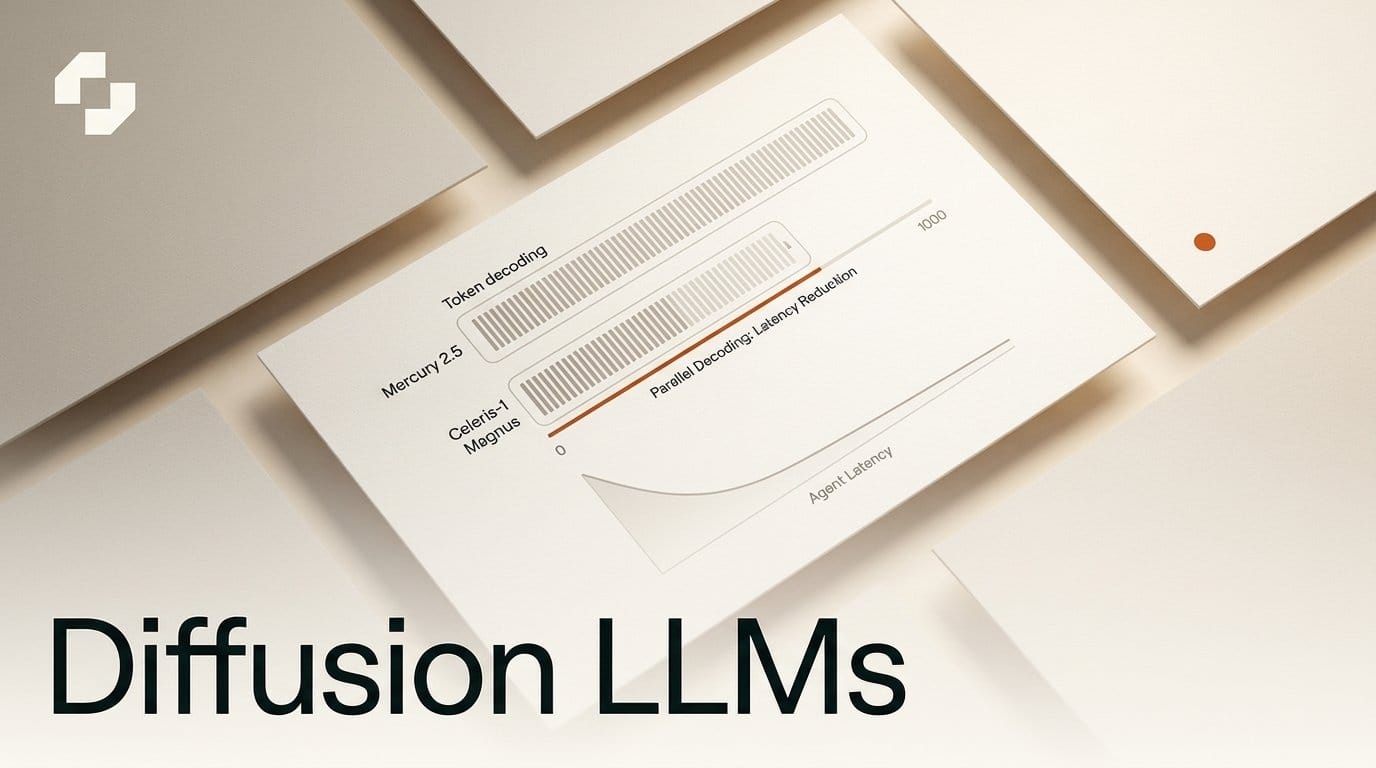
A diffusion LLM sidesteps that floor. Instead of extending a sequence token by token, it refines a whole block of tokens at once, in parallel, the same conceptual move that image diffusion models make with pixels. The payoff is throughput: for the same intelligence tier, a diffusion model can return an answer in a fraction of the wall-clock time. That is the lever both Mercury 2.5 and Celeris-1 Magnus pull, and the reason two independent teams shipping the approach in the same window matters more than either launch alone.

Deep Analysis
The category is young enough that the two shipping options differ in ways that matter for a real deployment. Here is how they compare, and how to read the benchmarks each vendor publishes.
Why parallel decoding beats the sequential-token floor
The trade builders have weighed for years is speed versus intelligence: pick a smaller model and hope it holds up on your task. Diffusion decoding changes the question. Because it attacks the sequential-token floor directly rather than shrinking the model, the trade becomes speed at a similar intelligence for a fraction of the token cost. That distinction is the whole pitch. Inception positions Mercury 2.5's quality against cost-optimized frontier models like Claude Haiku 4.5 and Gemini 3.5 Flash-Lite, per its launch writeup, and reports a roughly 10-point intelligence jump over Mercury 2 while keeping the speed. The payoff concentrates on multi-step tool loops, not single short completions, which is exactly where agents spend their time.
Mercury 2.5 versus Celeris-1 Magnus: the numbers
The two models target the same job from different starting points. Mercury 2.5 is a purpose-built diffusion model from Inception; Celeris-1 Magnus is a hybrid diffusion model derived from the open Qwen3.8-27B. The table below lays out the published specs.
| Spec | Mercury 2.5 Preview | Celeris-1 Magnus |
|---|---|---|
| Architecture | Diffusion LLM | Hybrid diffusion, from Qwen3.8-27B |
| Claimed speed | Up to 1,107 tokens/sec | Over 500 tokens/sec |
| Context window | 260,000 tokens | 131,072 tokens |
| Pricing | $0.04 in / $0.15 out per M | Per token, billed at the console |
| Access | OpenRouter, exclusive during preview | OpenAI-compatible API, keys live now |
| Extras | Tunable reasoning, schema-aligned JSON | Optional thinking flag for accuracy |
Mercury 2.5 leads on raw throughput, context length, and published pricing, and it exposes tunable reasoning levels plus schema-aligned JSON output so structured workflows drop in without extra scaffolding. Inception is also running 80 percent off through September 7, which makes the preview cheap to trial. Celeris-1 Magnus counters with an openly derived base and an optional thinking flag that trades a few seconds for higher accuracy, useful when a task needs a correctness boost on demand.
Reading vendor benchmarks with skepticism
Both companies publish their own numbers, and both should be treated as hypotheses. Celeris reports that on the tau-cubed banking benchmark, Celeris-1 Magnus hits 41.2 percent task completion at a 55-second median, against GPT-5.6-sol at 38.1 percent and 79 seconds. That is a meaningful edge if it survives independent testing, but it is vendor-published: the model is now indexed on Artificial Analysis for third-party tracking, and outlets like explainx's breakdown flag that the figures are worth reproducing on your own stack. The right move with any diffusion-LLM claim is to reproduce the benchmark on your workload, because the speed advantage is architectural and real while the quality-parity claim is the part that varies most by task.
When to swap an agent to a diffusion LLM
Both vendors point to the same three jobs where speed compounds: search and research agents that fire many short calls, voice pipelines that need sub-second turns, and coding subagents that fan out edits across a repo. The safe way to adopt one is incremental. Add the model to a non-critical path first, a draft generator, an autocomplete helper, or one subagent in an existing pipeline, keep your prompts, and measure end-to-end task latency against your current model. Because both endpoints are OpenAI-compatible, the swap is a base URL and a key, so the experiment costs an afternoon, not a rewrite.

Impact on Creators
For creators building agentic tools, diffusion LLMs turn latency from a fixed cost into a tunable one. A storyboard agent that calls a model a dozen times, a voice assistant that has to answer before the pause gets awkward, or a batch captioning job over hundreds of assets all feel different when the underlying model returns in a fraction of the time. The cost angle compounds the speed one: Mercury 2.5's cost-optimized pricing sits in the bracket you would otherwise weigh against open coding models, and continues the steady drop in API prices that keeps resetting the default model choice. For anyone who has been picking a smaller model just to stay responsive, this is a way to keep the intelligence and lose the wait.
Key Takeaways
Diffusion LLMs decode tokens in parallel, which sidesteps the sequential-token latency floor that slows down tool-heavy agents. Mercury 2.5 Preview leads on throughput, context, and published pricing and is live on OpenRouter; Celeris-1 Magnus counters with an openly derived base and an optional thinking flag and is callable today through an OpenAI-compatible API. Both publish their own benchmarks, so reproduce the numbers on your own workload before trusting a quality-parity claim. The speed advantage is architectural and reliable; the quality claim is the part to verify.
What to Watch
The first thing to watch is whether independent benchmarks confirm the quality-parity claims. Speed is easy to verify and hard to fake; parity with cost-optimized frontier models across diverse tasks is the contested part, and Artificial Analysis tracking will settle it over the coming weeks. The second is availability. Mercury 2.5 is OpenRouter-exclusive during the preview and Celeris is a single-vendor endpoint, so how these models reach the coding tools and agent frameworks creators already use will decide their real adoption. The third is architecture convergence: two teams shipping diffusion LLMs in one window suggests more are coming, and if a major lab ships a diffusion option next to its autoregressive line, choosing a model becomes a choice about how you want to trade speed, and that is a better problem to have than the one builders face today. Compare that against the way builders currently pick among open coding models like GLM-5.3, Qwen, and DeepSeek and the diffusion option starts to look less like a niche and more like a new column in the decision table.