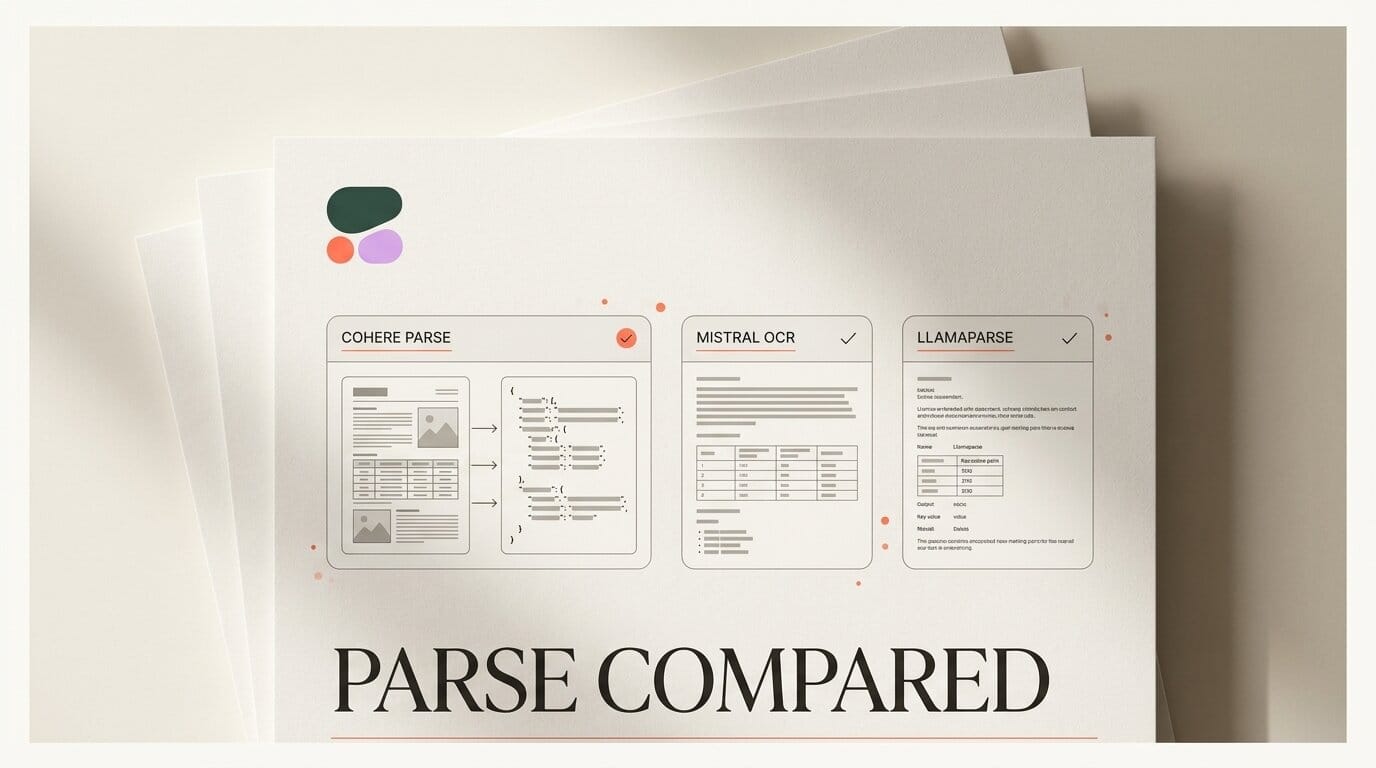
Cohere shipped Parse to general availability on August 27, 2026, a vision language model that turns PDFs, spreadsheets, scanned forms, and slide decks into clean Markdown for retrieval and agent pipelines. It lands at $1.50 per 1,000 pages and, on the independent ParseBench leaderboard, posts the top overall score against Mistral OCR, LlamaParse, AWS Textract, and Google Document AI. For anyone building a RAG stack or a document agent, document parsing just got a new default to test.
What Cohere Parse Actually Ships
Parse is a single model that reads a document the way a person does: it recognizes tables, forms, diagrams, and images, then returns structured Markdown with bounding boxes that preserve where each element sat on the page. Input formats include images, PDFs, .xlsx, .docx, and .html, and it handles nine major world languages. That output shape matters because Markdown with preserved structure is exactly what a downstream embedding model or agent wants to chunk and reason over.
It is generally available through the Cohere API, Cohere's self-hosted Model Vault, Microsoft Foundry, and AWS SageMaker, so teams can call it as a hosted endpoint or run it inside their own environment for data that cannot leave the building. Throughput is a headline number: Cohere cites 4.5 pages per second on a single accelerator and 36 pages per second on an 8xH100 node, which it reports as roughly 1.4x the speed of RedNote's dots.mocr and 2.2x that of Chandra OCR 2.
How It Compares on ParseBench
The differentiator is accuracy, and Cohere anchors its claim to ParseBench, a three-dimension benchmark that scores table extraction, content faithfulness, and semantic formatting. On the reported averages, Parse leads a crowded field, though the margin over the next tool is narrow enough that your document mix should decide the winner, not the leaderboard alone.
| Tool | ParseBench average |
|---|---|
| Cohere Parse | 79.2 |
| LlamaParse (cost effective) | 78.3 |
| Mistral OCR 4 | 74.5 |
| Databricks AI Parse | 72.4 |
| Google Document AI | 57.3 |
| AWS Textract | 53.3 |
The dimension breakdown is where the picture sharpens. Cohere reports Parse at 87.0 on table extraction and 86.6 on content faithfulness, but 64.0 on semantic formatting, its weakest axis. In plain terms, it is very strong at pulling tables and staying true to the source text, and comparatively weaker at reproducing nuanced document formatting. If your corpus is financial statements, invoices, and research tables, that profile is close to ideal. If it is heavily designed marketing collateral where layout carries meaning, test formatting fidelity carefully before you commit.
It is also worth reading these numbers with the usual caution: they are vendor-reported against a public benchmark. The gap between Parse at 79.2 and LlamaParse at 78.3 is under a point, so a head-to-head on your own documents is the only test that settles it. What the table does establish clearly is the tier: the modern vision-language parsers (Cohere, LlamaParse, Mistral OCR, Databricks) sit 15 to 25 points above the older OCR services from AWS Textract and Google Document AI.

The Pricing Math for Builders
Parse is priced at $1.50 per 1,000 pages on the Cohere API. Cohere frames the savings story against hyperscaler document services it pegs at $10 per 1,000 pages, and against its own Model Vault self-hosting option, which it says cuts cost 23% at 50% GPU utilization and up to 61% at full utilization. For a team processing about 13 million pages a month, Cohere estimates roughly $144,000 saved per year versus its own API and about $1.47 million versus a $10 per 1,000 page service.
For a solo builder or small studio, the relevant number is simpler: 1,000 pages for a dollar fifty means you can parse an entire document library into a knowledge base for the price of a coffee, and iterate on chunking without watching a meter. That is the real unlock, cheap enough that document ingestion stops being the expensive step in a RAG pipeline.
Wiring Parse Into a RAG or Agent Pipeline
Here is the concrete build, the workflow most readers will actually run this week:
1. Get a key and test on the demo. Create an API key in the Cohere dashboard, then run a few representative documents through Cohere's free Hugging Face demo to eyeball output quality before you write any code.
2. Parse to Markdown. Send your PDFs or Office files to the Parse endpoint following the Parse documentation. You get back Markdown plus bounding boxes. Keep the bounding-box metadata, it is what lets you cite the exact page and region later.
3. Chunk on structure, not character count. Because the output is real Markdown, split on headings and table boundaries rather than a fixed token window. Structure-aware chunks retrieve far better than blind 512-token slices.
4. Embed and store. Run each chunk through your embedding model and load it into your vector store with the page and bounding-box metadata attached.
5. Retrieve, then ground the answer. At query time, pull the top chunks and pass them to your generation model. Because Parse scored high on faithfulness, the retrieved text closely matches the source, which reduces the hallucination surface in the final answer.

Why It Matters for Creators and Builders
Document parsing is the unglamorous first mile of almost every serious AI build: a research assistant over your PDFs, a support agent that reads product manuals, a tool that turns contracts into structured data. Get that first mile wrong and everything downstream inherits the mess. A cheaper, more accurate parser that outputs clean Markdown means the builder spends time on the interesting part, retrieval and reasoning, instead of babysitting broken tables.
The strategic read is that parsing is commoditizing fast. Six credible tools now cluster within a few points of each other, and the price floor keeps dropping. For creators, that is good news: the ingestion layer of your project is now cheap and interchangeable, so you can pick on throughput, self-hosting needs, and your specific document mix rather than being locked to one vendor. If you already build retrieval flows, Cohere's own agentic retrieval work and visual pipeline tools like those in our Gradio workflow guide slot in directly after the parse step.
The Verdict: Which Parser to Reach For
Pick Parse if you want the current accuracy leader on tables and faithfulness, need a self-hosting path for sensitive data, and value throughput. Pick LlamaParse if you are already inside the LlamaIndex ecosystem, since it is a fraction of a point behind and integrates natively. Keep Mistral OCR on the shortlist for European data-residency and its own competitive pricing. The one clear takeaway: if you are still on Textract or Document AI for anything AI-facing, the modern VLM parsers are a meaningful accuracy upgrade and worth a weekend test.
Frequently Asked Questions
Is Cohere Parse free to use?
No, but it is inexpensive. The Cohere API charges $1.50 per 1,000 pages. Cohere also offers a free Hugging Face demo Space for evaluation and a self-hosted Model Vault option that lowers per-page cost at scale.
What file formats does Cohere Parse accept?
Images, PDFs, .xlsx, .docx, and .html. It outputs clean Markdown with bounding boxes for visual elements and supports nine major world languages.
How does Cohere Parse compare to Mistral OCR?
On Cohere's reported ParseBench averages, Parse scores 79.2 versus 74.5 for Mistral OCR 4. The gap is real but modest, and Mistral OCR remains attractive for European data residency. Test both on your own document mix.
Can I run Cohere Parse on my own infrastructure?
Yes. Beyond the hosted Cohere API, Parse is available through Model Vault for self-hosting, plus Microsoft Foundry and AWS SageMaker, so data that cannot leave your environment can still be parsed in place.
Is Cohere Parse good for building RAG pipelines?
Its Markdown output and high content-faithfulness score make it well suited to RAG. Chunk on the Markdown structure, keep the bounding-box metadata for citations, then embed and retrieve as usual.
What is Cohere Parse weakest at?
Semantic formatting, where Cohere reports a 64.0 score against 87.0 for table extraction. If your documents rely on complex visual layout to convey meaning, validate formatting fidelity before committing.