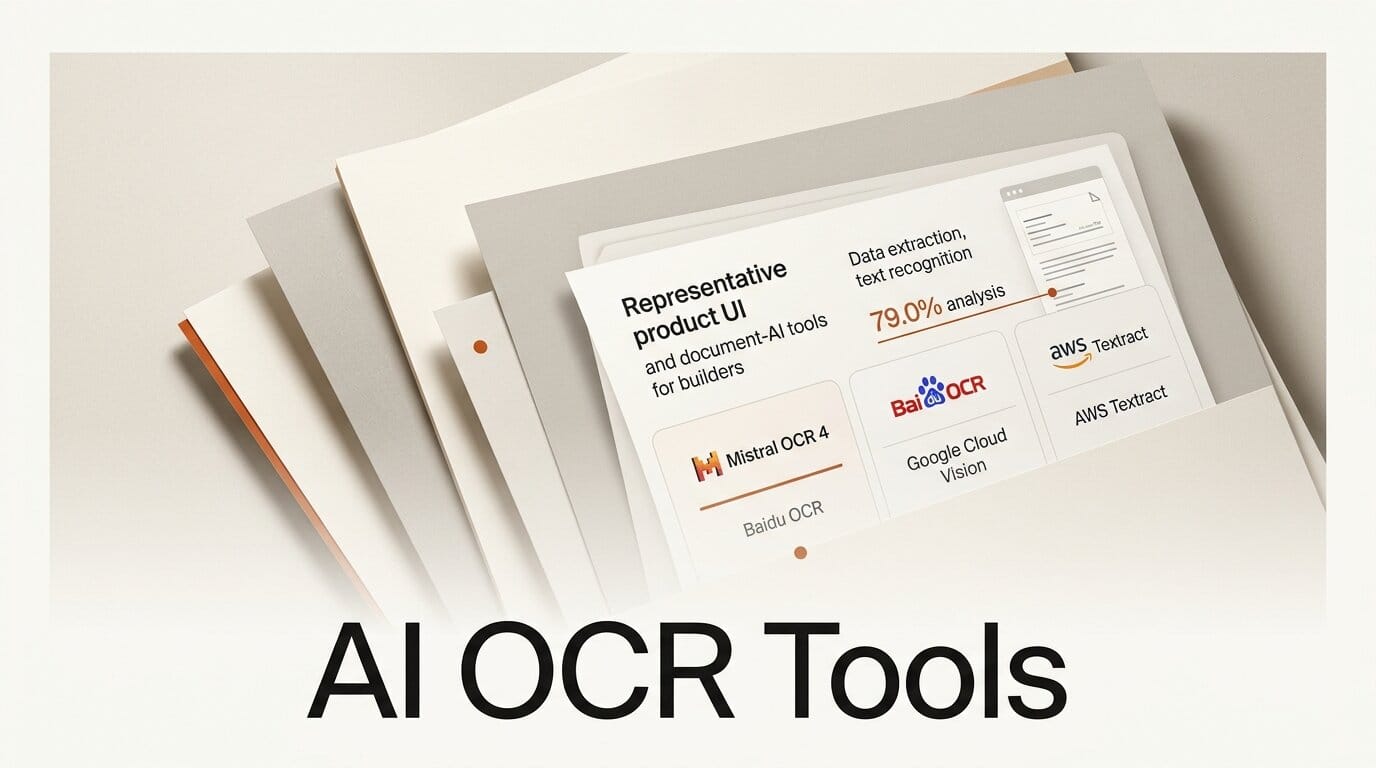
If you are building anything that reads documents, a RAG assistant over your PDFs, an invoice or contract pipeline, a research tool that ingests scanned archives, the optical character recognition layer is where most projects quietly break. In 2026 the choice comes down to five serious options: Mistral OCR 4 for the best accuracy with a self-host escape hatch, Baidu Unlimited-OCR for open, single-pass long documents, DeepSeek-OCR as the open compression baseline, Google Document AI for the widest language coverage, and AWS Textract for structured forms inside the AWS ecosystem. This comparison ranks them on accuracy, languages, self-hosting, and real cost so you can pick without burning a week on trials.
Quick Picks: Which Document AI Fits Your Build
Pick Mistral OCR 4 if you want the highest accuracy available with the option to keep documents in house. It leads on the benchmarks, returns per-word confidence scores, and ships as a single self-host container as well as a hosted API.
Pick Baidu Unlimited-OCR if you process very long documents and want open weights you can run for the price of compute. Its single-pass design turns dozens of pages into structured text without the usual slice-and-stitch pipeline.
Pick Google Document AI if your priority is language coverage. It supports more than 200 languages and is the safest pick for multilingual archives, government records, or global invoice flows.
Pick AWS Textract if you already run on AWS and your documents are forms, tables, receipts, and IDs. Its structured extraction APIs map cleanly onto downstream AWS services, even though its language list is short.

How the Five Tools Compare
Two benchmarks anchor this space. OmniDocBench measures full-page document parsing across tables, formulas, and reading order, and olmOCRBench from AllenAI tests plain-text fidelity. The newer models cluster in the low to mid 90s, but they report on different benchmark versions, so treat cross-tool scores as directional rather than a photo finish.
| Tool | Access | Languages | Self-host | Headline benchmark | Pricing model |
|---|---|---|---|---|---|
| Mistral OCR 4 | Hosted API + container | 170 | Yes | OmniDocBench 93.07, olmOCRBench 85.20 | $4 per 1,000 pages |
| Baidu Unlimited-OCR | Open weights (MIT) | Multilingual, strong CJK | Yes | OmniDocBench v1.5 93% | Self-host compute |
| DeepSeek-OCR | Open weights | Multilingual | Yes | Compression baseline | Self-host compute |
| Google Document AI | Managed cloud | 200+ | No | Mature enterprise OCR | Usage + processor hosting |
| AWS Textract | Managed cloud | 6 | No | Forms and tables extraction | Per-feature, per page |
Mistral OCR 4: the accuracy leader with a self-host door
Mistral reports that independent annotators preferred OCR 4 over every leading OCR and document-AI system it tested, with win rates averaging 72 percent, alongside scores of 93.07 on OmniDocBench and 85.20 on olmOCRBench. It supports 170 languages across 10 language groups and runs roughly four times faster per page than its predecessor. The features that matter for builders are typed-block classification (it tags titles, tables, equations, and signatures as distinct types), bounding boxes for every element, and inline confidence scores at the page and word level. Those confidence scores are the quiet superpower: you can route low-confidence fields to human review instead of letting a misread number corrupt your database. It accepts PDF, DOC, PPT, and OpenDocument files and is compact enough to deploy on a single container, so regulated teams can keep documents off external APIs while still buying the hosted API through Mistral Document AI when convenience wins.
Baidu Unlimited-OCR: open weights for documents that never end
The single hardest problem in production OCR is the document that does not fit in a context window. Unlimited-OCR is a roughly 3-billion-parameter, MIT-licensed model that transcribes dozens of pages in one forward pass. The trick, detailed in its arXiv paper, is Reference Sliding Window Attention, which holds the key-value cache at a constant size throughout decoding and lets the model handle up to a 32K window. It builds on DeepSeek-OCR's high-compression encoder and reports 93 percent on OmniDocBench v1.5, a six-point gain over that baseline. It ships in a standard base mode and a gundam mode for cropped or dense layouts, and runs through Hugging Face transformers or ModelScope, with an SGLang server path for batched requests. For anyone turning contracts or scanned archives into a local RAG index, fewer moving parts means fewer places for errors to creep in.

DeepSeek-OCR: the open baseline everyone builds on
DeepSeek-OCR matters less as a finished product and more as the open foundation the current wave stands on. Its high-compression vision encoder is what makes single-pass long-document parsing affordable, and Baidu's Unlimited-OCR explicitly extends it. If you want to fine-tune your own document model or understand how the new long-context OCR systems work under the hood, this is the repository to read first. For most teams it is a building block rather than a drop-in API, but it is the reason the open side of this market moved so fast in 2026.
Google Document AI and AWS Textract: the enterprise incumbents
The cloud incumbents trade peak accuracy for breadth and integration. Google Document AI supports more than 200 languages and offers specialized processors for invoices, contracts, and IDs, which makes it the default for genuinely global, multilingual document flows. AWS Textract is narrower on language, with text detection in English, Spanish, German, Italian, French, and Portuguese, but its forms, tables, and ID extraction APIs are battle tested and slot directly into the rest of AWS. Neither offers open weights or a self-host container, so if data residency is a hard requirement, both are out and the Mistral or Baidu paths are in.
Pricing and What You Actually Pay
Pricing in this category is deceptively layered, because the headline per-page number rarely reflects the real bill. Mistral OCR 4 is the simplest to reason about: $4 per 1,000 pages on the standard API, dropping to $2 per 1,000 on the batch API, with the full Document AI pipeline at $5 per 1,000. The open models, Baidu Unlimited-OCR and DeepSeek-OCR, carry no license fee at all under their permissive terms, so your only cost is the GPU compute to run them, which is a clear win at very high volume if you have the infrastructure to operate a model.
The cloud incumbents are where surprises hide. AWS Textract bills per feature, so plain text detection is inexpensive at roughly $1.50 per 1,000 pages, but turning on table and form analysis stacks separate charges on the same page. Google Document AI layers a per-processor hosting fee on top of usage, so an organization running several specialized processors pays a monthly floor regardless of how many pages it touches. The practical takeaway: at low volume the cloud APIs are cheapest to start, and at high volume an open self-hosted model or Mistral's batch tier usually wins.
What This Means for Creators and Builders
OCR used to be a back-office utility. In 2026 it is the front door to everything you build on top of documents, and the quality of that door decides whether your downstream app feels reliable or flaky. If you are building a research assistant, a knowledge base, or any retrieval pipeline, the structured output now coming out of these models, typed blocks, bounding boxes, and confidence scores, lets you build verification directly into the flow rather than discovering errors after they reach a user.
The strategic split is open versus hosted. Open models like Unlimited-OCR give you control, data residency, and zero per-page cost, at the price of running infrastructure. Hosted services like Mistral's API, Google Document AI, and AWS Textract give you zero operational burden and instant scale, at a recurring cost that grows with usage. The good news for builders is that the gap between the two has narrowed to the point where the decision is about your team and your data rules, not about accepting bad output.
Key Takeaways
1. Mistral OCR 4 is the accuracy leader, with a 72 percent average human-preference win rate, per-word confidence scores, and a self-host container for sensitive data.
2. Baidu Unlimited-OCR is the open pick for long documents, parsing dozens of pages in one pass under an MIT license.
3. Google Document AI wins on languages with 200-plus supported, while AWS Textract wins on structured forms inside the AWS ecosystem.
4. Confidence scores and typed output, not raw text, are what make a document pipeline trustworthy in production.
What to Watch
The clearest trend is open models closing the accuracy gap while keeping cost near zero, with Baidu's extension of DeepSeek-OCR showing how fast the open side can move. Expect the hosted providers to respond by leaning harder into the things open models cannot easily match: specialized processors, compliance certifications, and turnkey scale. Watch for confidence-aware extraction to become table stakes, since once builders rely on it for human-in-the-loop review, any tool without it looks risky by comparison. The benchmark story is the one to track most carefully, because as OmniDocBench and olmOCRBench versions multiply, the headline numbers will need an honest reading of which version and which document types were tested before you trust a leaderboard claim.
Frequently Asked Questions
Which AI OCR tool is most accurate in 2026?
Mistral OCR 4 reports the strongest results, with a 72 percent average human-preference win rate and a 93.07 score on OmniDocBench. Baidu Unlimited-OCR is close behind among open models at 93 percent on OmniDocBench v1.5, though on a different benchmark version.
What is the best open-source OCR model?
Baidu Unlimited-OCR is the strongest open option in 2026, released under the permissive MIT license and built to parse very long documents in a single pass. It extends DeepSeek-OCR, which remains the key open baseline for the compression techniques behind long-context OCR.
Can I run document OCR without sending data to a cloud API?
Yes. Baidu Unlimited-OCR and DeepSeek-OCR are open-weight models you can self-host, and Mistral OCR 4 ships as a single container for on-premise deployment. Google Document AI and AWS Textract are cloud-only.
How much does AI document OCR cost?
Mistral OCR 4 is $4 per 1,000 pages on its standard API and $2 on the batch API. AWS Textract starts near $1.50 per 1,000 pages for text and adds charges for tables and forms. Open models cost only the compute to run them.
Which OCR tool supports the most languages?
Google Document AI leads with more than 200 languages. Mistral OCR 4 supports 170 across 10 language groups, while AWS Textract is limited to six languages for text detection.