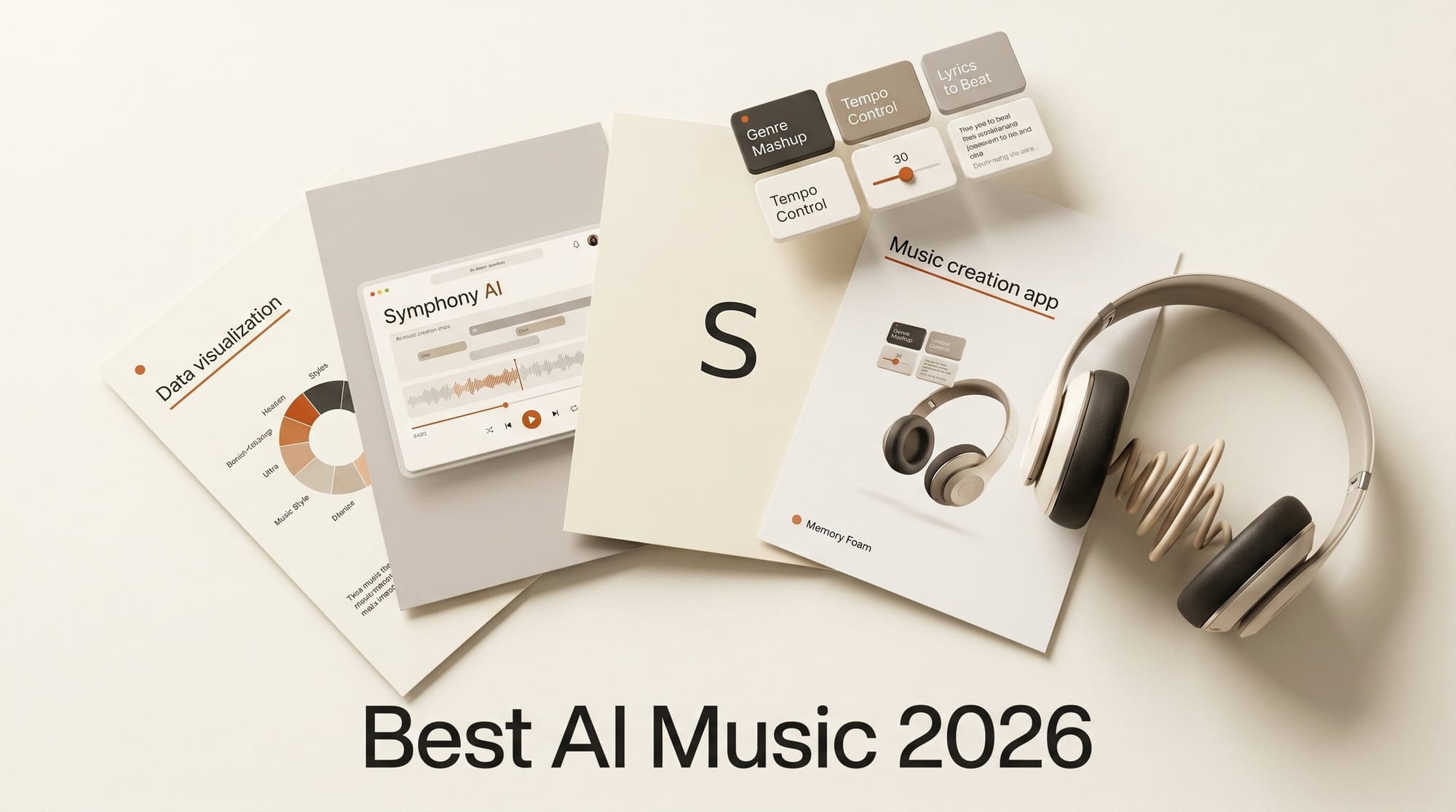
The best AI music generators in 2026 are Suno for fast, radio-ready full songs with vocals, Udio for polished instrumentals, and ElevenLabs Music for tracks that ship with clean commercial clearance. Around that core, a strong shortlist now covers every workflow a creator might have: Google Lyria for real-time and Google-ecosystem creation, Stable Audio 2.5 for enterprise-grade sound design, Mureka for budget multilingual songs, AIVA for editable film and game scores, Beatoven.ai for cheap royalty-free background music, Splice for ethically sourced generative samples, and BandLab SongStarter as the best free idea generator.
This guide compares ten tools on what they actually do, their standout feature, pricing, and the commercial-use rules that decide whether you can legally publish what you make. The AI music field moved fast this year: Suno and Udio cut label settlements, ElevenLabs launched a licensed-data model, and Google folded the former Riffusion team into DeepMind. We focus on facts you can verify and flag where licensing is still unsettled. For the wider audio picture, see our complete guide to AI music and audio in 2026.
The best AI music generators at a glance
| Tool | Best for | Standout feature | Commercial use | Starting price |
|---|---|---|---|---|
| Suno | Full songs with vocals, fast | Custom voice profiles and Song Editor | Paid plans, label litigation ongoing | Free, Pro about $10/mo |
| Udio | Polished instrumentals | Atmospheric, mix-ready output | Paid plans, UMG settlement reached | Free, Standard $10/mo |
| ElevenLabs Music | Commercially cleared tracks | Mid-track genre switching, editable | Cleared, trained on licensed data | Free, plans from $5/mo |
| Google Lyria | Real-time and Google ecosystem | Lyria RealTime interactive jamming | Varies by surface, SynthID watermark | Free in Gemini and YouTube |
| Stable Audio 2.5 | Enterprise sound design | Multi-part structure, audio-to-audio | Paid plans, fully licensed dataset | Free tier, about $0.20 per generation |
| Mureka | Budget multilingual songs | Humming and reference-track input | Royalty-free on paid plans | Free, Basic about $8/mo |
| AIVA | Film and game scores | Editable MIDI export | Paid plans, you own the MIDI | Free, Standard about 15 EUR/mo |
| Beatoven.ai | Royalty-free background music | Change mood mid-track | Perpetual royalty-free license | Free trial, paid from about $2.50/mo |
| Splice | Producers working in a DAW | Generative variations of real samples | Subscription, creators compensated | From $9.99/mo |
| BandLab SongStarter | Free idea generation | Three instant ideas per prompt | Royalty-free, no copyright ownership | Free, unlimited |
Suno
Suno is the tool most people mean when they say AI music generator, because it turns a short text prompt or your own lyrics into a complete song with vocals in under a minute. The current flagship model focuses on higher vocal realism and adds Voices, a feature that lets you build a private, identity-verified voice profile, plus a Song Editor and stem separation on paid plans. Suno's Pro plan runs about $10 a month, roughly $8 billed annually, with around 2,500 credits, and the Premier plan adds far more. Commercial rights come with the Pro and Premier tiers, but note the caveat: Suno's terms do not guarantee that copyright vests in the output, and the company has been working through major-label litigation, so treat high-stakes commercial use with caution. Best for: creators who want finished, singable songs as fast as possible.
Udio
Udio launched as Suno's closest rival and has carved out a reputation for cleaner, more mix-ready instrumentals and atmospheric beds that sit nicely under voiceover. Its paid Standard plan starts at $10 a month and removes daily limits while granting commercial rights, with a Pro tier above it for higher concurrency and priority generation. Free-tier tracks can be used but require crediting Udio, while paid subscribers drop the attribution requirement. Universal Music Group settled with Udio in late 2025 and a jointly licensed platform is reported for 2026, which makes Udio a comparatively safer bet for creators worried about training-data lawsuits. Best for: producers who care about instrumental polish and a clearer licensing path.
ElevenLabs Music
ElevenLabs Music is the audio company's entry into song generation, and its headline pitch is that the model was trained exclusively on licensed data and cleared for commercial use, a direct contrast with rivals still in court. The 2026 release introduced mid-track genre switching and editable, stem-exportable output across three products: a consumer app, a brand and agency tier, and a developer API. Pricing starts free, scales through standard ElevenLabs plans, and online and offline commercial use is permitted on self-serve plans, though film, TV, and studio games require an enterprise license. Best for: creators and developers who need commercial peace of mind and an API.
Google Lyria
Google Lyria is DeepMind's music model, producing 48kHz stereo audio with SynthID watermarking baked in so every output stays identifiable. The standout is Lyria RealTime, which lets you interactively create, control, and perform music live, and Google has spread Lyria across YouTube Shorts, the Music AI Sandbox, and the Vertex AI platform for developers. Google also acquired the former Riffusion team, now ProducerAI, in early 2026 and paired their conversational agent with the newest Lyria release. Commercial terms vary by surface, so check the rules for the specific Google product you generate in. Best for: creators in the Google and YouTube ecosystem who want real-time, interactive composition.
Stable Audio 2.5
Stable Audio 2.5 from Stability AI is built for enterprise-grade sound production, with improved musical structure that generates multi-part compositions with an intro, development, and outro, plus strong prompt adherence for mood and instrumentation. Like all Stable Audio models it is trained on a fully licensed dataset and is commercially safe, with generation priced around $0.20 each for tracks up to roughly 190 seconds. It is available on the web app, through the Stability AI API, and via partner platforms such as fal, Replicate, and ComfyUI, which makes it a favorite for sound designers and teams who want to embed generation into a pipeline. Best for: studios and sound designers who need licensed, structured audio at scale.
Mureka
Mureka is the value pick, combining composition, arrangement, and mixing into tracks up to five minutes long across roughly ten languages. Its standout is flexible input: alongside text and lyrics you can hum a melody, drop a reference track, or paste a link, and it offers stem separation, AI cover art, and custom model training. The Basic plan starts around $8 a month for up to 400 songs, with a Pro tier adding WAV and stem downloads and voice cloning, and all generated music is royalty-free with full commercial rights. Best for: budget-minded and multilingual creators who want full songs and custom voices.
AIVA
AIVA is the composer's tool, aimed at soundtracks and orchestral work rather than pop songs, with 50-plus genre and mood templates like heroic adventure and dark suspense. Unlike most generators it gives you real structural control: set BPM, duration, and movement sections, adjust instruments per part, and crucially export editable MIDI so you can finish the arrangement in your own DAW. The free plan adds a watermark and low-bitrate output, while the Standard plan at about 15 EUR a month removes the watermark, unlocks WAV and MIDI export, and grants commercial licensing, with the key benefit that you own the MIDI composition you create. Best for: film, game, and media composers who want editable scores, not just finished audio.
Beatoven.ai
Beatoven.ai is purpose-built for video and podcast background music, where the music has to support speech without competing with it. You describe a scene's mood, pick from a set of emotions and genres, set the duration, and Beatoven scores it, with a standout ability to change mood mid-track to follow scene transitions. It is one of the cheapest paid options with commercial rights, starting at a few dollars a month, and tracks come with a perpetual royalty-free license that survives even if you cancel. Best for: video editors and podcasters who want safe, affordable background scores.
Splice
Splice is not a text-to-song generator, and that is the point. Its 2026 generative tools, including Variations, Craft, and the upcoming Magic Fit, layer AI on top of a catalog of more than three million human-made samples, letting you reshape structure, key, and BPM while keeping each sound traceable to its original creator. That traceability matters: the original sample creator is compensated each time their sound seeds a variation and each time a variation is downloaded, which sidesteps the training-data ethics debate hanging over fully generative models. Splice's tools are part of a subscription from $9.99 a month with credits. Best for: producers who live in a DAW and want ethically sourced, customizable samples.
BandLab SongStarter
BandLab SongStarter is the best free way to beat a blank page, generating three unique, royalty-free musical ideas from a genre choice or a short lyric. It is completely free with unlimited uses and no credit system, spans genres from hip hop and lofi to phonk, and lets you audition different moods before launching the idea straight into BandLab's free online Studio to keep building. The trade-off is that ideas are royalty-free to use but you do not own the copyright, so it is a starting point rather than a final master. Best for: beginners and anyone who wants free, instant sparks to develop further.
How to choose an AI music generator
Start with the legal question, because it is the one that can undo your work. If you are publishing commercially, especially in advertising, film, or anything monetized at scale, favor tools that train on licensed data and say so plainly, such as ElevenLabs Music, Stable Audio, and AIVA, or those that have reached label settlements like Udio. Suno is the most capable all-rounder but still carries litigation risk, so read its terms before betting a paid campaign on it. Free idea tools like BandLab SongStarter are royalty-free to use but do not grant you a copyright, which is fine for sketches and a problem for a product you intend to own and defend.
After licensing, match the tool to the job. If you need real, singable vocals, Suno and Mureka lead on vocal quality, while Udio and Stable Audio are stronger for instrumental beds and sound design. Genre range matters too: AIVA owns cinematic and orchestral, Beatoven.ai owns mood-driven background music, and Google Lyria is the pick if you want to compose in real time or stay inside YouTube and Vertex AI. Budget creators should look at Mureka and Beatoven.ai, while developers who need an API will gravitate to ElevenLabs, Stable Audio, or Lyria. For a wider toolkit beyond music, our master resource for AI content creators in 2026 maps how these fit alongside image and video tools.
Our pick for 2026
For most creators, Suno is the winner. Nothing else turns an idea into a finished, vocal-led song this quickly, and the Song Editor, stem separation, and custom Voices give you room to refine rather than reroll. The honest caveat is licensing, so if your work is high-stakes or brand-facing, our runner-up is ElevenLabs Music, which trades a little raw flexibility for the strongest commercial clearance story in the category thanks to its licensed training data. Pick Suno to make the most music, pick ElevenLabs Music to sleep soundly about the rights.
Frequently Asked Questions
Can I sell music made with AI?
Usually yes, on a paid plan. Suno, Udio, Mureka, Stable Audio, AIVA, and Beatoven.ai all grant commercial rights on their paid tiers, and ElevenLabs Music is cleared for commercial use on self-serve plans. The nuance is ownership versus permission: a license to use a track commercially is not the same as a guaranteed, enforceable copyright, and some tools state plainly that copyright may not vest in AI output. Read the specific plan's terms before you monetize.
Is Suno or Udio better?
It depends on the output. Suno tends to win on full songs with strong, expressive vocals and is the faster path to a finished track, while Udio is often praised for cleaner instrumentals and atmospheric beds that mix well under voiceover. On licensing, Udio's settlement with Universal Music Group gives it a slightly clearer path right now. Try both free tiers on the same prompt and judge the result.
What is the best free AI music generator?
BandLab SongStarter is the best fully free option, with unlimited royalty-free idea generation and a free online studio to build in. Suno, Udio, Mureka, and ElevenLabs Music all have free tiers as well, though they limit credits or downloads and often reserve commercial rights for paid plans. For free background music for video, Beatoven.ai offers a trial, but downloads require a paid plan.
Are AI music generators legal to use commercially?
The tools themselves are legal, and many explicitly grant commercial-use licenses. The unsettled area is the training data behind some models, which is why Suno and Udio faced major-label lawsuits and why tools like ElevenLabs Music and Stable Audio market their licensed datasets as a selling point. For low-risk commercial work, prefer licensed-data tools or those that have reached label settlements.
Which AI music generator has the most realistic vocals?
Suno's latest model leads on vocal realism and expressive singing, and its custom Voices feature lets you build a verified voice profile. Mureka also delivers professional-level vocals across multiple languages. For purely instrumental or cinematic work where vocals are not the focus, Udio, Stable Audio, and AIVA are stronger choices.
Can AI music be copyrighted?
This is the open question. Several platforms grant you a commercial license without promising that copyright vests in the output, and copyright offices have generally held that purely AI-generated work without meaningful human authorship is hard to register. The safest path to ownership is heavy human editing, or tools like AIVA that export MIDI you arrange yourself, which strengthens the human-authorship claim.
What to do next
Pick two tools from this list that match your job, run the same prompt through both free tiers, and compare the results before you pay for anything. If you create music, video, or audio for a living, the smartest move is to keep up with how these tools and their licensing terms change, because they shift monthly. Subscribe to Creative AI News for weekly, creator-first breakdowns of the tools worth your time, and you will always know which generator earns a place in your workflow.