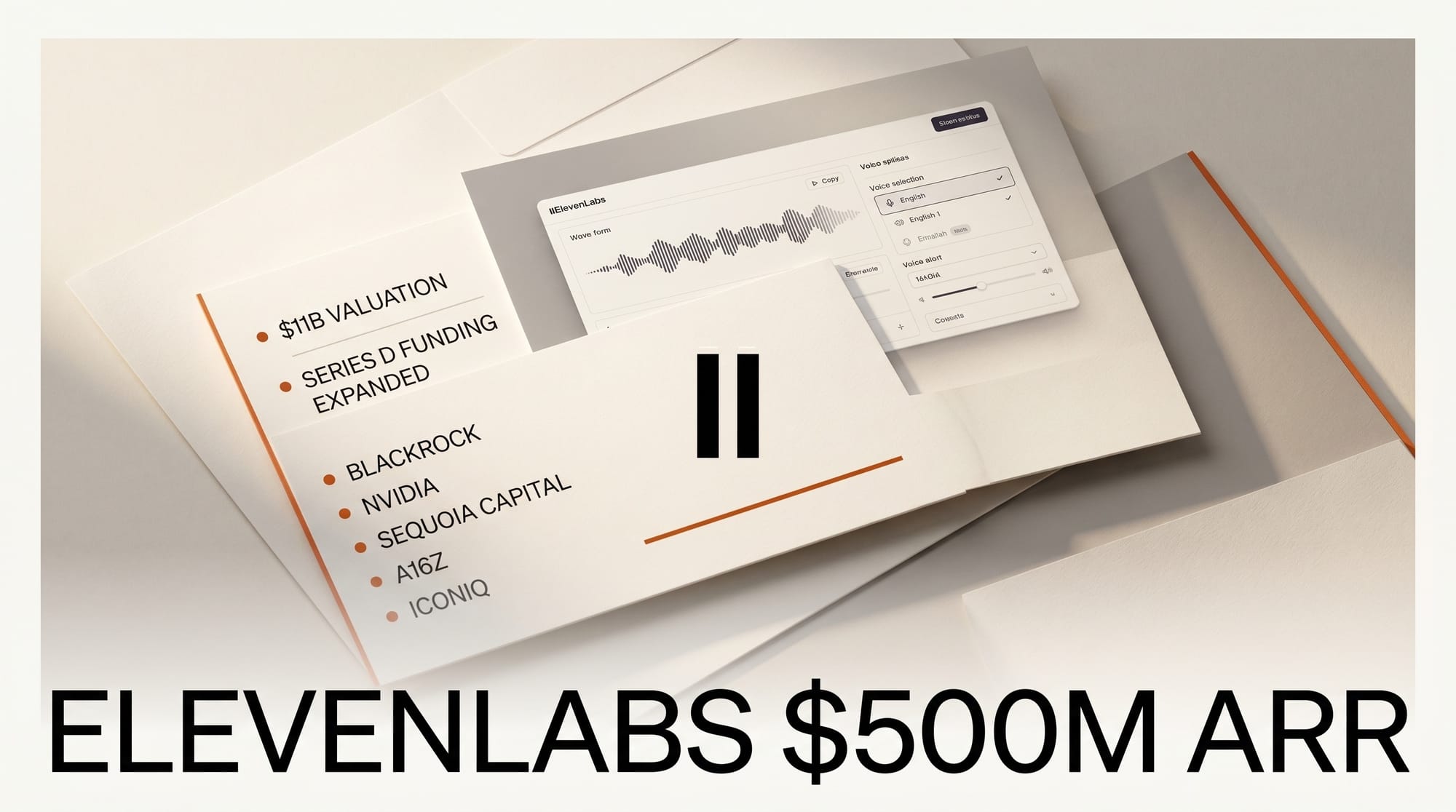
ElevenLabs crossed $500 million in annual recurring revenue on May 5, 2026, the company announced alongside an expanded investor roster for its $500 million Series D round. New investors include BlackRock, Nvidia, Jamie Foxx, and Eva Longoria, joining Sequoia Capital, a16z, and ICONIQ from the original close. The milestone puts ElevenLabs at an $11 billion valuation and makes it the most-funded independent voice AI company to date.
What the $500M ARR Number Means
ARR at this scale requires thousands of paying customers generating consistent monthly revenue. For ElevenLabs, which charges primarily through API calls and subscription tiers, $500M ARR implies roughly $41 million in monthly revenue across its user base of creators, developers, and enterprise clients.
The growth rate is notable. ElevenLabs launched its public API in late 2022. Reaching $500M ARR in roughly three years puts it on a faster trajectory than most SaaS companies at equivalent scale. For comparison, it took Figma about 6 years to cross similar ARR milestones, and Figma had a broader design market to address.
What is driving it: voice AI is now a production input for podcasters, narrators, game studios, e-learning publishers, and enterprise customer service systems. ElevenLabs sits at the intersection of all of these, and the April 30 relaunch of its ElevenMusic creator platform pushed further into the consumer creative market.
New Investors and What They Signal
BlackRock and Nvidia are the strategic additions worth watching. BlackRock, the world's largest asset manager, entering a voice AI company at Series D suggests institutional confidence in voice AI as an infrastructure-level technology. Nvidia's investment is more direct: ElevenLabs runs inference on GPU clusters, and Nvidia backing the company that helps drive demand for its hardware is a typical infrastructure play.
Jamie Foxx and Eva Longoria's involvement as investors signals a different angle: voice AI for entertainment and content creation has mainstream celebrity buy-in. Both have existing entertainment industry relationships that could translate into commercial partnerships for voice licensing, audiobook narration, and AI-assisted production.
ElevenAgents: The Platform Shift Creators Should Watch
The bigger strategic story embedded in the $500M announcement is ElevenAgents, the company's enterprise conversational voice platform. Where ElevenLabs' original product was a text-to-speech API, ElevenAgents is a full voice agent system: it handles conversation flow, integrates with business tools, and manages multi-turn dialogue without requiring developers to stitch together separate speech, language, and voice generation services.
For creators building voice-powered products, ElevenAgents shifts what is possible from standalone voice generation (clone a voice, render audio, export file) toward interactive voice experiences (voice bots, interactive narrators, voice-guided workflows). Enterprise clients including Deutsche Telekom have deployed ElevenAgents for large-scale use cases.
The implication for solo creators: the same infrastructure powering enterprise voice agents is accessible through ElevenLabs' developer API. A podcast production studio, an indie game with branching voiced dialogue, or an e-learning course with an AI tutor can all be built on the same platform that enterprises are using for customer service.
How Creators Are Using ElevenLabs Today
The five most common creator workflows on ElevenLabs:
| Use Case | Product | Creator Type |
|---|---|---|
| Audiobook narration | Text to Speech API / Reader app | Authors, publishers |
| Podcast voice cloning | Voice Cloning (Professional) | Podcasters, media companies |
| Game character voices | Text to Speech API + Voice Library | Indie game developers |
| E-learning voiceovers | Text to Speech API | Course creators, educators |
| YouTube video narration | Text to Speech (Creator tier) | Content creators, channels |
The ElevenLabs Voice Library has thousands of community-contributed voices that creators can license for commercial use. Professional Voice Cloning lets you create a private voice from a sample and use it across all content you generate. These two features together mean most narration work that previously required hiring a voice actor can now be handled inside ElevenLabs with consistent results.
ElevenLabs vs. Alternatives in 2026
| Platform | Strengths | Limitations | Best for |
|---|---|---|---|
| ElevenLabs | Voice quality, cloning, library size | Cost at scale, API complexity | Narration, character voices, enterprise |
| Inworld TTS-2 | Sub-200ms latency, voice direction | Newer library, less variety | Interactive apps, live voice agents |
| Cartesia | Speed, cost efficiency | Lower voice quality ceiling | High-volume API applications |
| OpenAI TTS | Bundled with GPT workflow | Limited voice options | Quick prototyping, GPT-native apps |
| Google Cloud TTS | Language coverage (40+ languages) | Less natural prosody | Multilingual, Google Cloud apps |
For most independent creators, ElevenLabs remains the default choice when voice quality is the priority. If you are building a real-time voice application where latency under 200ms is critical, Inworld TTS-2 is worth benchmarking. For high-volume automated pipelines where cost is the primary constraint, Cartesia is the typical alternative.
What to Do Next
ElevenLabs offers a free tier with 10,000 characters per month, enough to narrate roughly 8 minutes of audio. The Creator tier at $22/month adds commercial rights and professional voice cloning. Three things to try if you are evaluating ElevenLabs:
- Test voice quality against your actual script. Run your content through three different voices from the text-to-speech tool before committing to a subscription. The quality difference between voices is significant, and finding the right match for your content type matters more than picking a popular voice.
- Check the Voice Library for commercial licenses. Many Voice Library entries include commercial use rights. Always verify before publishing any ElevenLabs-generated audio in commercial projects, courses, or products.
- Explore ElevenAgents if you are building an interactive voice product. The enterprise page has developer access options. The conversational voice agent tooling is now production-grade.
Related: Inworld TTS-2: Sub-200ms Voice Beats ElevenLabs and Cartesia and AI Music + Audio 2026: The Complete Producer Guide.
Frequently Asked Questions
What is ElevenLabs and what does it do?
ElevenLabs is a voice AI platform that converts text to speech, clones voices from audio samples, and provides an API for building voice-powered applications. It is used by podcasters, audiobook publishers, game developers, e-learning creators, and enterprise companies building voice agents.
How much does ElevenLabs cost?
ElevenLabs offers a free tier (10,000 characters/month), a Creator tier ($22/month with commercial rights and Professional Voice Cloning), and higher tiers for larger API quotas. Enterprise pricing for ElevenAgents is negotiated directly.
What is ElevenAgents?
ElevenAgents is ElevenLabs' enterprise conversational voice platform. It handles full voice agent interactions including conversation management and multi-turn dialogue, rather than just single-pass text-to-speech generation.
How does ElevenLabs compare to Inworld TTS-2?
ElevenLabs has a larger voice library and broader language support. Inworld TTS-2 achieves sub-200ms latency and supports real-time voice direction for interactive applications. For static audio production, ElevenLabs is typically the better fit. For live voice agents, Inworld TTS-2 is worth evaluating for its latency advantage.
What does the $500M ARR milestone mean for current users?
A well-funded company is more likely to maintain service reliability and continue developing new features. The BlackRock and Nvidia investments suggest ElevenLabs will expand its GPU infrastructure, which typically benefits API response times and capacity. No pricing changes were announced alongside the milestone.
Can I use ElevenLabs voices in commercial projects?
Yes, with a paid plan that includes commercial rights (Creator tier and above). Voices from the Voice Library may have individual licensing terms. The free tier does not include commercial use rights. Always check the specific license for any Voice Library voice before publishing commercially.