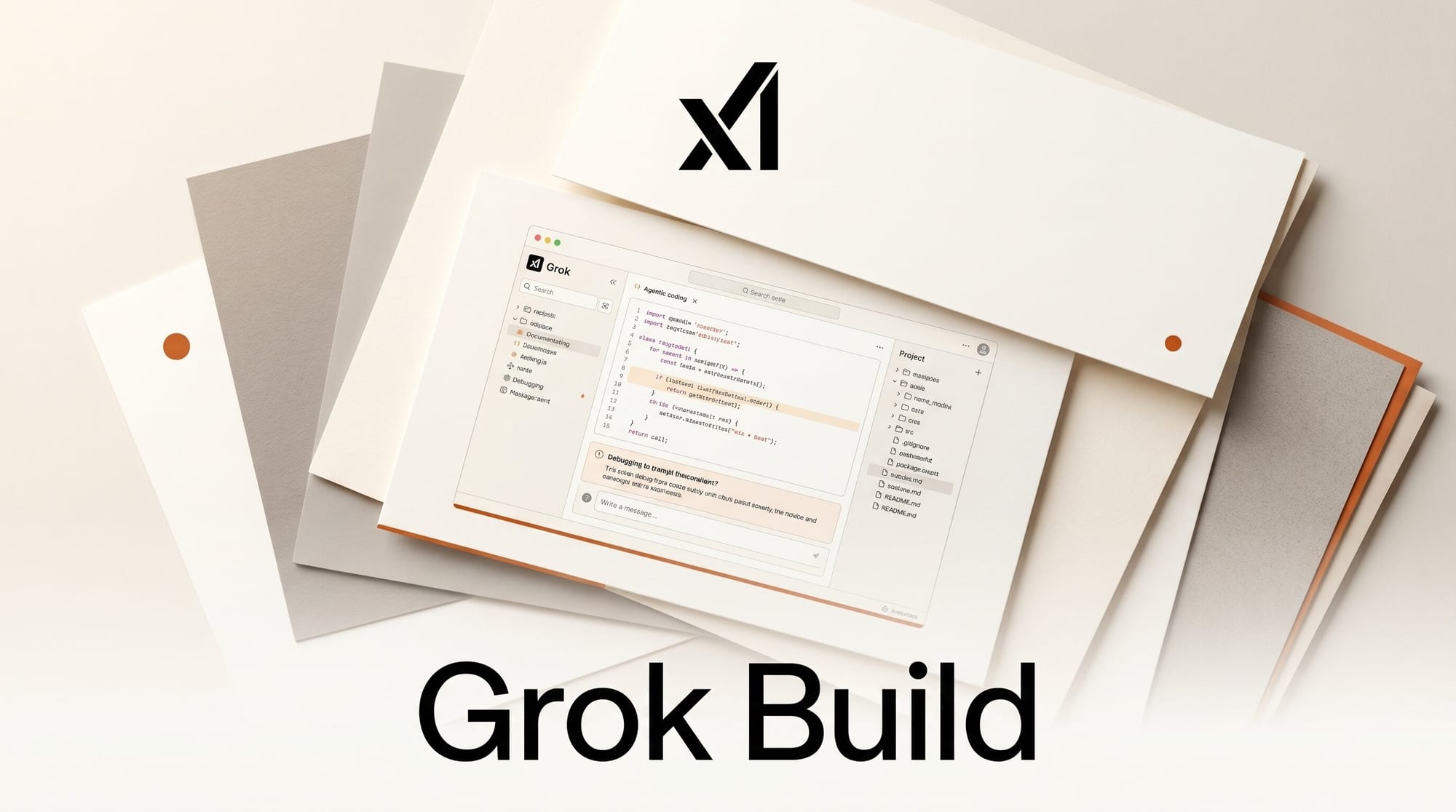
xAI released grok-build-0.1 on May 27, 2026, a coding-specialized model built specifically for agentic software-engineering workflows. The model ships with a 256,000-token context window, native function calling, image-input support, and structured JSON outputs. Pricing comes in at $1 per million input tokens and $2 per million output tokens via the xAI developer API, with cached prompts at $0.20 per million. SuperGrok and X Premium+ subscribers get model access through the Grok CLI without separate billing.
Try It: One Command to a Working Agent
The fastest path is the Grok CLI. Run curl -fsSL https://x.ai/cli/install.sh | bash on macOS or Linux to install, then log in with your SuperGrok or X Premium+ account. The CLI exposes an interactive TUI plus a headless script mode, so you can wire it into a CI job, a build pipeline, or a local agent harness without writing transport code yourself. If you prefer a coding-IDE surface, install the Kilo Code extension and pick grok-build-0.1 from the model selector. Kilo runs across VS Code, JetBrains, and CLI environments with the same model behavior.
A practical first test: point the CLI at a repo, ask it to fix a flaky integration test plus update the failing assertion, and let it iterate. Average runtime on the PinchBench agentic test suite is about 220 minutes per task at 88.9% accuracy, ranking it 4th of 50 official models tracked there.
Why It Matters
grok-build-0.1 is xAI's first model purpose-built for the agentic-coding lane (planning across files, calling tools, iterating without a human gate) rather than the chat-completion lane, per the xAI model docs. It lands in the same week that Mistral shipped Vibe with a dedicated Code Mode and VS Code extension and that Figma Make wired local code edits and PR creation into the design surface. The pricing puts xAI right between Anthropic's flagship coding tiers and DeepSeek's value tier, which moves the coding-agent floor down again.
For working developer creators, the question is no longer "can a model do agentic work" but "which one fits my budget and which IDE plays nicely with it." grok-build-0.1 is the answer for teams already paying for SuperGrok ($30/month) and an answer for everyone else priced below GPT-5.5 and Claude Opus 4.6 by a wide margin.
Key Details
Benchmarks at launch (per PinchBench): 88.9% overall (#4 of 50), 97.0% on log analysis, 96.1% on CSV analysis. The 256K context window means the model can hold a mid-size monorepo (roughly the size of a Django or Next.js app) in memory at once, which is the right size for agentic work that has to read more code than it writes. Image inputs let it accept diagram screenshots, design mockups, and error UI captures as part of an iteration loop.
The model is in early access. Function calling and structured outputs are GA at launch. Pricing-wise, $1/$2 per million tokens with a $0.20 cached-input rate makes long iteration sessions roughly 6 cents to analyze a 10,000-line codebase, per Kilo's published example. That is cheaper than running Claude Code with the same loop budget for most workloads.
What to Do Next
If you already pay for SuperGrok or X Premium+, install the Grok CLI today and benchmark grok-build-0.1 against whatever your current agentic coding stack costs you per resolved ticket. If you do not have an xAI subscription, the API pricing is competitive enough to test from a fresh account before signing up for SuperGrok. The pricing math gets interesting the moment a single SuperGrok seat replaces a per-token bill on a peer model.