Researchers Yifan Wang and Tong He published Warp-as-History on May 14, 2026, a method that adds precise camera trajectory control to frozen video generation models without retraining, new camera encoders, or test-time optimization. The code is available now on GitHub.
What Happened
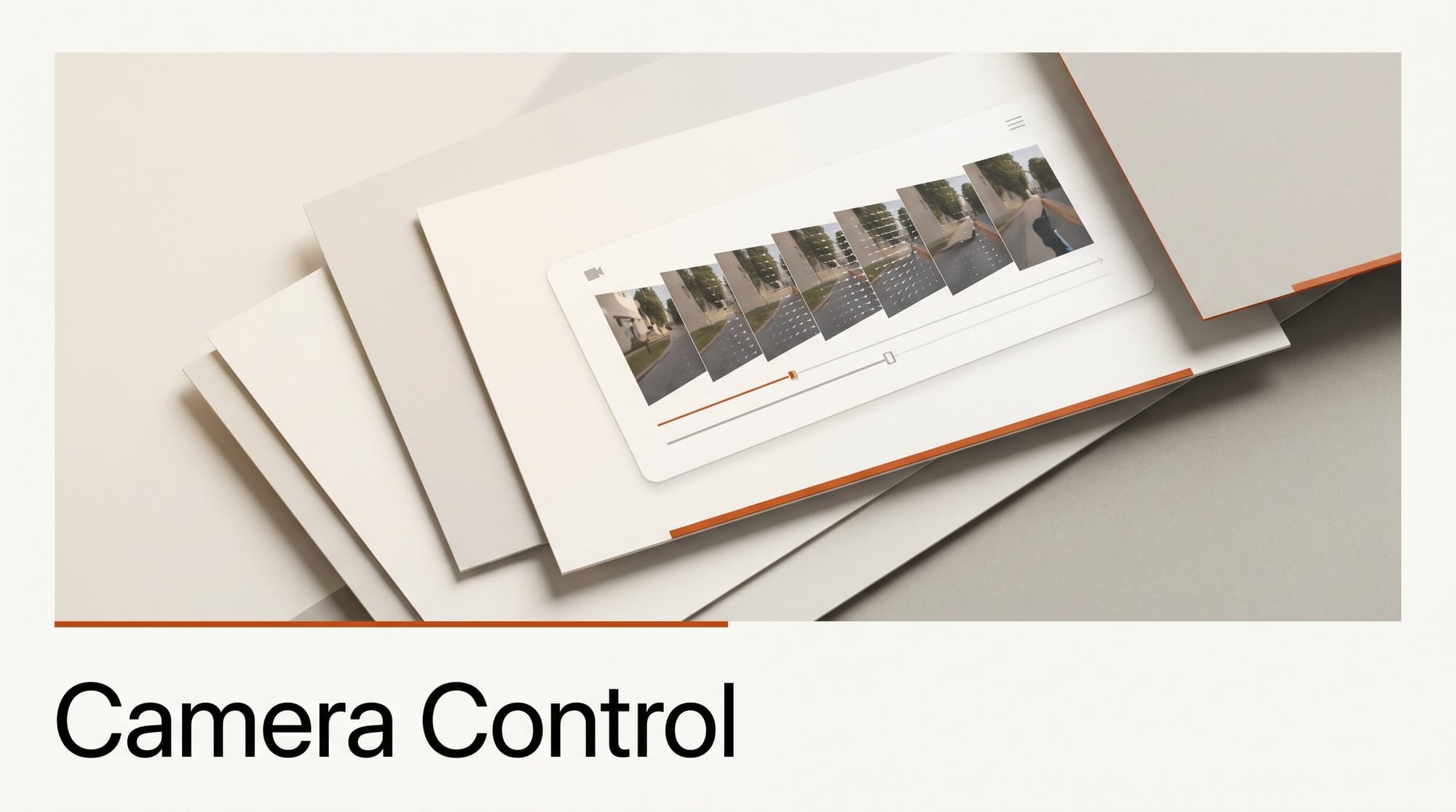
The approach converts camera movements into "camera-warped pseudo-history," a synthetic visual context the model treats as prior frames. Feeding this warped history through the model existing history-conditioning pathway causes it to follow the target camera trajectory without any architectural changes. The project page shows demos covering panning, tilting, and complex paths across varied environments.
A four-step pipeline handles the process: render available observations under the target camera trajectory, align the warp to matching target frames, remove invalid tokens from newly visible regions, and apply an optional lightweight LoRA fine-tune on a single video to stabilize behavior in unseen scenes.
Why It Matters
Camera control is one of the most frequently requested features in AI video generation. Consumer tools like Kling, Runway, and Sora offer fixed presets (zoom, orbit, pan) with limited precision. Warp-as-History demonstrates a research approach that works on existing frozen models, which means it could be adapted to these tools faster than methods that require full retraining or new architecture components.
The zero-shot capability is the key differentiator. The method works out of the box with a pretrained video model, with single-video fine-tuning as an optional improvement step that generalizes to unseen content. This lowers the barrier to adoption for tool developers.
Key Details
- Works with any pretrained video generation model, no retraining required
- Four-step pipeline: warp, align, select visible tokens, optional LoRA fine-tune
- Single-video fine-tuning generalizes to unseen scenes and camera trajectories
- Improves camera adherence, visual quality, and motion dynamics over baselines
- Full code available at GitHub for technical experimentation
Creator Outcome
This research points toward a near-term future where video creators specify precise camera paths (dolly shots, crane moves, Dutch angles) and AI generation follows them faithfully. While Warp-as-History is not yet packaged as a consumer plugin, the code is public and the approach is compatible with existing open-source video models. Technical creators using ComfyUI or custom generation pipelines can experiment with camera-controlled output today.
What to Do Next
Review the demo videos on the project page to evaluate camera adherence quality across trajectory types. The code at the project GitHub is available for technical creators who want to experiment with camera-controlled generation in their own pipelines.