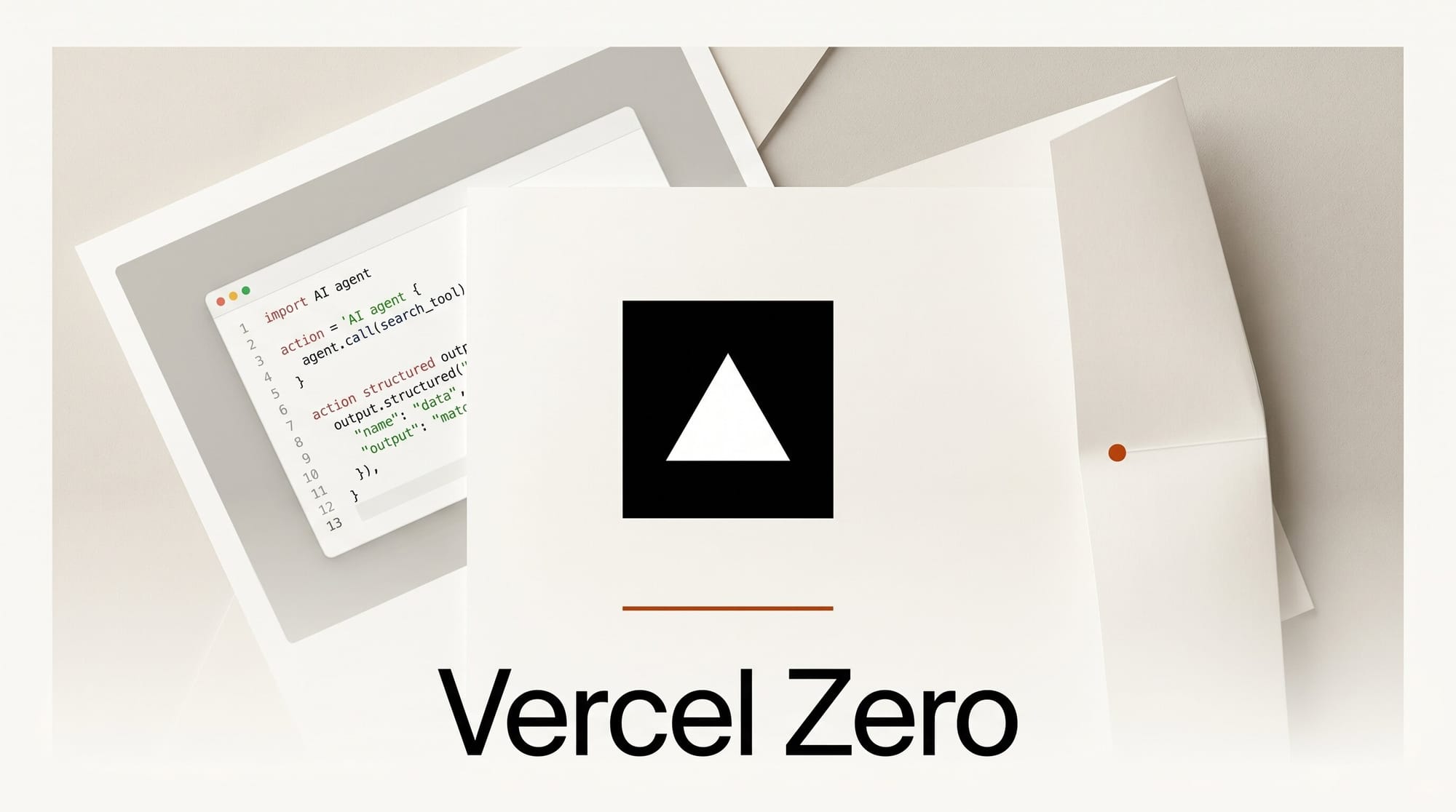
Vercel Labs just shipped Zero v0.1.3, an experimental programming language designed for AI coding agents to use instead of humans. The release landed on GitHub on May 19, with an official site and installer at zerolang.ai. It is the first serious public attempt by a top-tier infrastructure company to shape syntax, diagnostics, and standard library decisions around how coding agents actually work, not how humans read code.
What this enables for creators
If you build with Claude Code, Cursor, or Codex on a daily basis, Zero gives you a sandbox to test how those agents behave when error output is structured JSON instead of free-form compiler text. Install via one curl command, run the included samples, and watch the agent loop converge faster because diagnostics carry stable error codes a machine can act on. Even if you never ship Zero in production, the diagnostic format itself is the durable lesson, and it is the part worth borrowing into the toolchains you already run with agents like the new xAI Grok Build CLI.
Why it matters
Coding agents waste a meaningful fraction of their tokens parsing rustc, clang, and tsc error text into structured signals they can act on. The v0.1.3 release notes describe expanded agent-facing diagnostics that bypass that translation step entirely. If the approach catches on, every language with a serious agent userbase will be pressured to expose structured errors as a first-class output. Vercel's bet is that the next wave of programming languages will optimize for agents first and humans second, the same way Go once optimized for compile speed over expressiveness.
Key details
Zero v0.1.3 is pre-1.0 and explicitly labeled intentionally unstable, so do not deploy it. The standard library is deliberately broad so most programs do not start with a dependency search, a direct response to npm and cargo failure modes that have repeatedly burned coding agents. Borrow provenance tracking and conflict checking are tightened from v0.1.2, and v0.1.3 adds hosted HTTP client runtime support. The toolchain installs via a single curl from zerolang.ai. Vercel published the repository at vercel-labs/zero, already past 2.8K stars on launch day. The team explicitly warns that syntax and APIs will break across releases, so treat the current version as an exploration tool, not a foundation.
What to do next
Install Zero on a dev machine, run the getting-started samples once, then have your usual coding agent attempt a small task against Zero source. Compare how many turns it takes versus the same task in Rust or TypeScript, and inspect the JSON diagnostics output. The patterns there are the part worth lifting into your own toolchain, whether you stay on Zero or go back to Cursor Composer 2.5 or another agent runtime. Either way, the agent-first diagnostic format is the lesson the language is teaching.