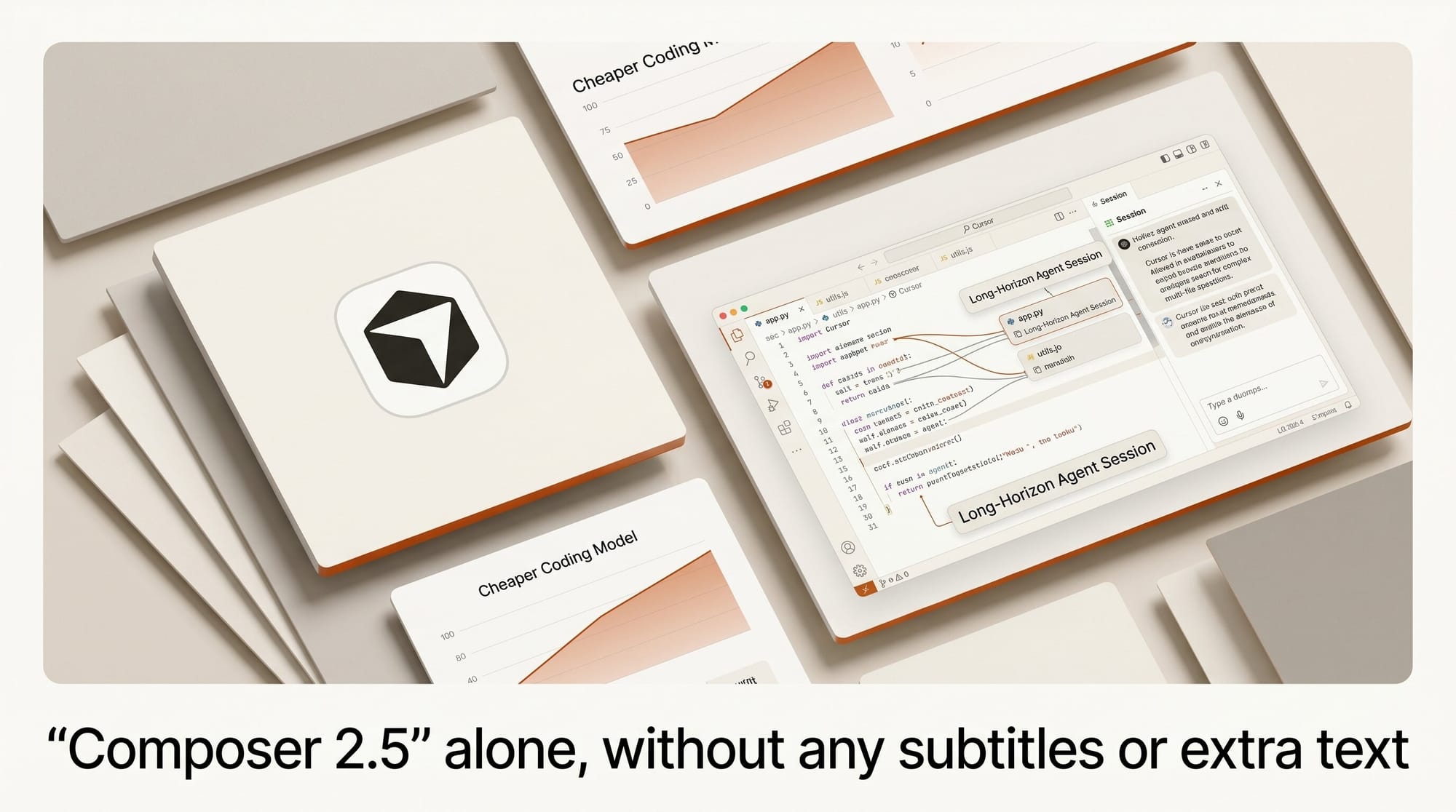
Cursor released Composer 2.5 on May 18, 2026, the second major upgrade to its in-house coding model since Composer 2 shipped in March. The headline pitch is sustained behavior over long-horizon agentic tasks plus a substantially lower price than competing fast-tier coding models, with a standard tier at $0.50 per million input tokens and $2.50 per million output tokens.
How to try it today
Open Cursor and switch the model selector to Composer 2.5. The fast variant is the default, mirroring Composer 2's rollout pattern. Cursor is doubling the usage allowance for the first week on all subscription tiers, so this is the window to load a multi-file refactor, a long-running test-suite migration, or a backend port and watch how the model handles the trajectory. The team flagged "more reliable complex instruction following" and "better sustained work on long-running tasks" as the dimensions to test against your Composer 2 baseline. Existing Cursor subscriptions cover the standard tier with no plan change required.
Why it matters
Composer 2 already cleared 73.7 on SWE-bench Multilingual and beat Claude Opus 4.6 on CursorBench when it shipped in March. Composer 2.5 raises the bar on long-horizon agentic behavior, which is where most coding agents still degrade: planning across a dozen file edits, recovering from a failed test, or holding context across a multi-hour migration. The pricing is the second story. At $0.50 per million input tokens, Composer 2.5 sits below most frontier coding-tier prices and lines up with the open-weights race that xAI's Grok Build CLI and Anthropic's Bun-to-Rust Claude Code rewrite are both trying to win.
Key details
- Release date: May 18, 2026
- Pricing (standard): $0.50 per million input tokens, $2.50 per million output tokens
- Pricing (fast variant): $3.00 per million input tokens, $15.00 per million output tokens
- First-week perk: double usage allowance for all Cursor subscribers
- Training advances: 25x more synthetic training tasks than Composer 2, targeted RL with textual feedback for localized behavior correction, dynamically created harder synthetic tasks grounded in real codebases
- Infrastructure: sharded Muon optimizer with distributed orthogonalization, dual mesh HSDP for efficient MoE weight handling (full methodology in the Composer 2 technical report, which Composer 2.5 builds on)
- Default tier: fast variant is the default in the model selector, same as Composer 2
What to do next
Run Composer 2.5 against your hardest open task this week. The double-usage window only lasts seven days, and the behavioral gains Cursor is claiming are not the kind that show up on standard benchmarks: they show up on the third hour of a refactor when most models start losing the plot. If you maintain a Cursor evaluation rubric internally, add a long-horizon test that runs at least 30 sequential file edits with cross-file references; that is the shape of task this release targets.