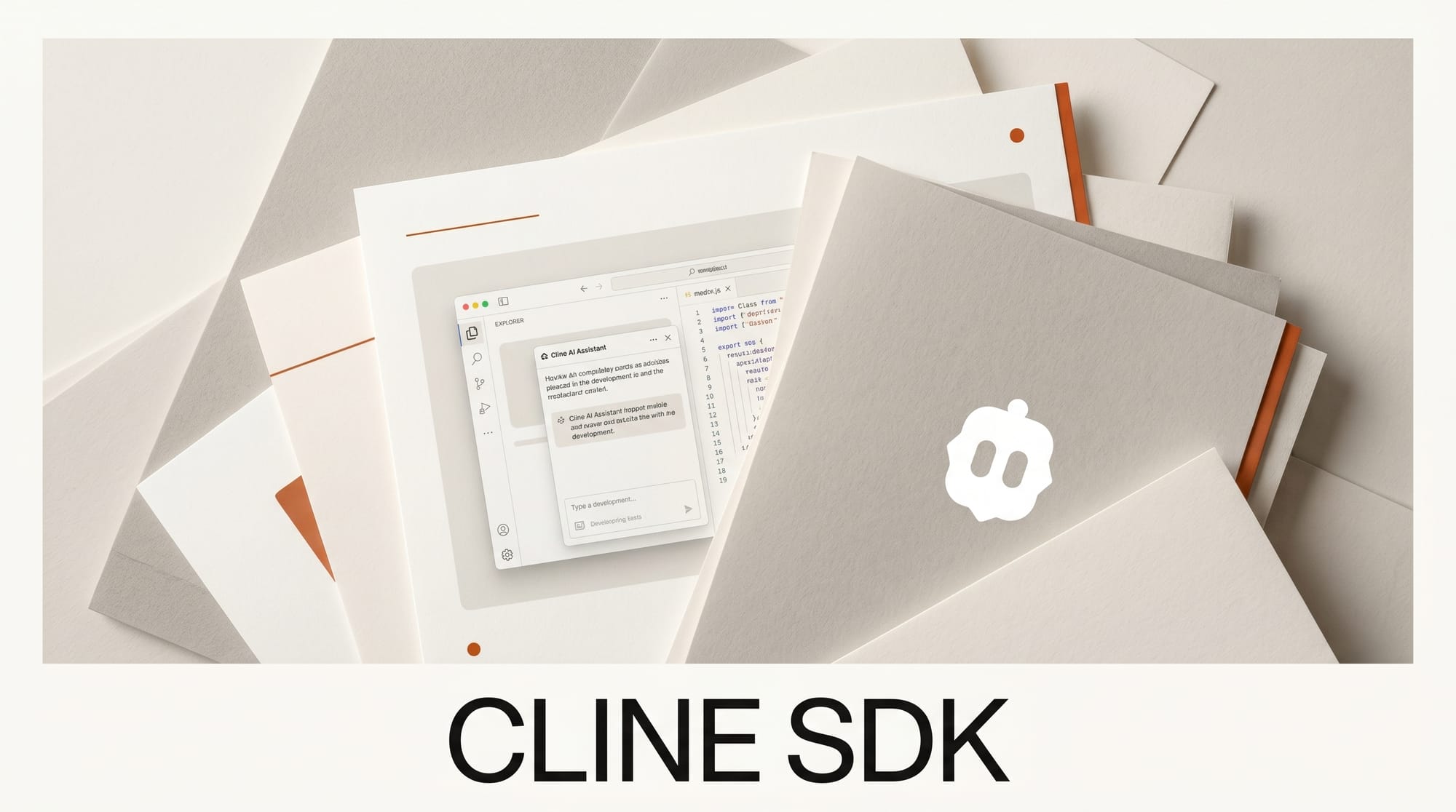
On May 13, 2026, Cline released @cline/sdk, an open-source TypeScript SDK that lets developers embed the same agent runtime powering Cline's IDE extension and CLI directly into their own apps. The release moves Cline from a single coding tool into a runtime layer anyone can build on, with checkpoints, web fetch, MCP connectors, cron jobs, and subagents available as installable packages.
Try it: spin up an embedded agent in five minutes
If you already build with TypeScript, you can wire a working coding agent into a Node service before lunch. Install the package with npm install @cline/sdk (Node.js 22 or later is required, per the SDK docs), point it at an Anthropic, OpenAI, or Google API key, and pass it a task. The agent loop is stateless, so the runtime handles checkpoints, persistence, and tool invocation while your application owns the UI and session state. The same primitives power Cline's VS Code and JetBrains extensions, so behavior you tune in the SDK ports cleanly to those surfaces.
Why it matters
Until now, teams building bespoke coding agents had two choices: fork Cline's repo and maintain a 61.8k-star codebase, or reimplement the orchestration layer on top of raw model APIs. The SDK collapses that distance. Cline ships the same checkpoint, MCP, and subagent plumbing it uses internally as a clean dependency, and keeps the project on Apache 2.0 so commercial use stays open. For studios building production tooling on top of Cursor-style flows, that means less reinvention and a faster path from prototype to shipped agent.
Key details
The SDK is split into three layers: @cline/llms abstracts model providers (Anthropic, OpenAI, Google, AWS Bedrock, Mistral, and OpenAI-compatible endpoints), @cline/agents runs the stateless agent loop, and @cline/core handles stateful orchestration including sessions, scheduling, and durability. Packages install individually or as a stack. Cline shipped CLI v3.0.3 on the same day as the SDK launch, and benchmark coverage from TestingCatalog reports Cline CLI scoring 74.2% on Terminal Bench 2.0 with Claude Opus 4.7, ahead of Claude Code's 69.4% on the same model.
What to do next
If you maintain a developer-facing product, read the SDK quickstart and decide whether the agent loop fits your durability and tool-invocation needs better than a custom implementation. If you already build on Cline's extensions, the SDK is the upgrade path for teams that want to ship the agent inside a CLI, web app, or backend job rather than an IDE pane.