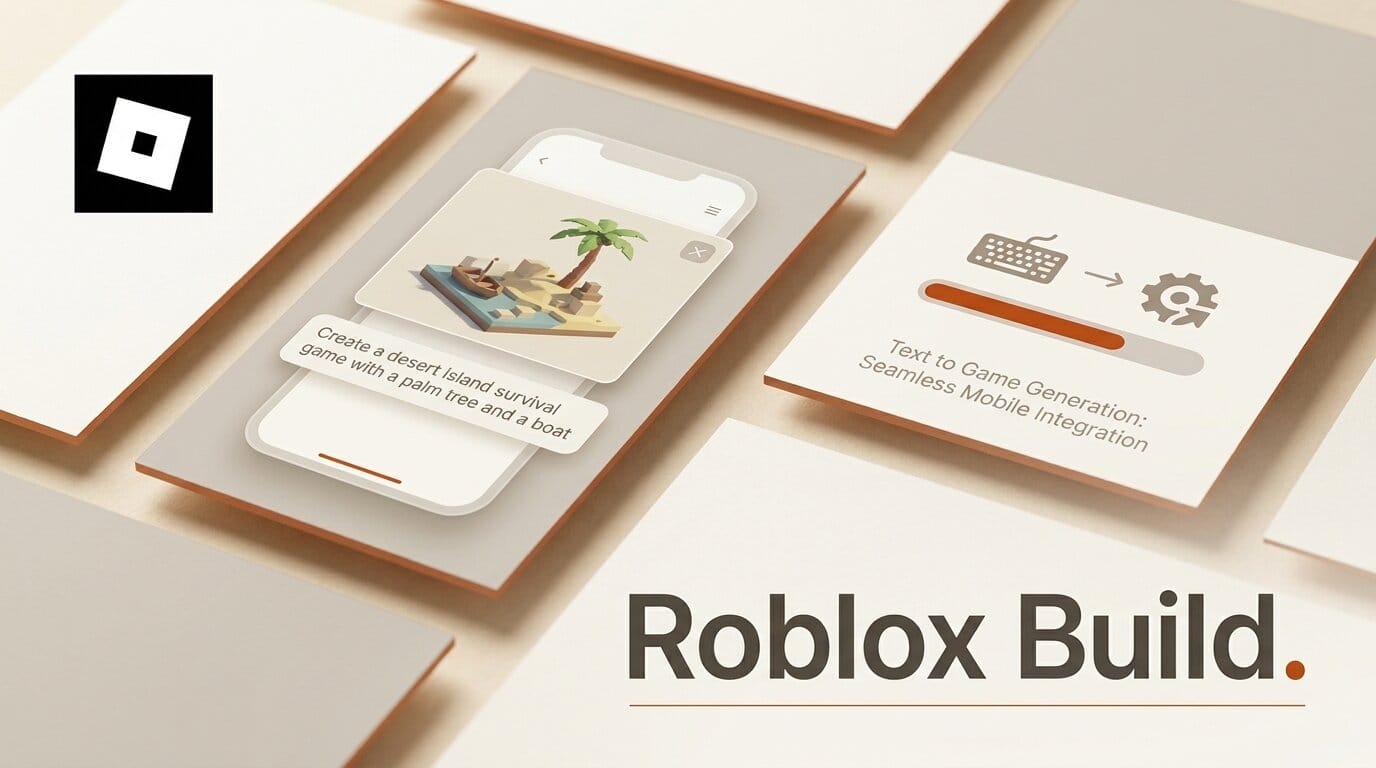
Roblox is putting game creation behind a text box. On July 16 the company announced Build, a mobile-first tool that turns a plain-language prompt into a playable game directly inside the Roblox app, with no Studio and no code. Type something like "a cozy adventure game set in a dense forest with environmental obstacles" and Build generates a starting version you can playtest, edit, and publish. Public alpha begins July 28.
What This Enables
Build collapses the gap between having an idea on your phone and shipping something playable. It handles gameplay mechanics, environment, characters, visual style, and sound in one pass, drawing on a mix of open-source and proprietary Roblox models. For creators who never learned Lua or opened Studio, that means a first prototype in minutes instead of weeks. You iterate by prompting again, then push the result into the same publishing pipeline as any hand-built experience. Alongside Build, Roblox announced Studio agents for creators who do go deeper: a playtesting agent that surfaces bugs before players hit them, an analytics agent that answers questions in plain language, and an experiment agent for retention testing.
Why It Matters for Creators
Roblox is one of the largest user-generated content platforms in the world, so a native text-to-game tool changes who gets to build there. The open question, as GamesBeat notes, is whether one-shot AI games become discoverable or drown in low-effort output. Roblox says Build games enter the same candidate pool as everything else and are ranked by its retention-based discovery system, which "doesn't include AI slop." In other words, prompting a game is easy, but earning players still depends on the experience holding attention.
Key Details
Rollout: Testing starts July 28, first as a public alpha in New Zealand, expanding to more regions over the coming months, per TechCrunch.
Access: Age-checked users 9 and older during alpha; publishing to a global audience requires age verification at 16 and up.
Pricing: A free basic tier plus paid options for power users.
Under the hood: Build leans on Roblox's generative stack, including its open-source Cube 3D foundation model for turning prompts into game-ready 3D objects, with a full scene-generation model still to come.
What to Do Next
If you already build on Roblox, watch for the Studio agents landing over the coming months and start planning which of your prototypes could benefit from AI playtesting and retention experiments. If you are new to the platform, update the mobile app and get age verification sorted so you can jump into the alpha as it widens beyond New Zealand.