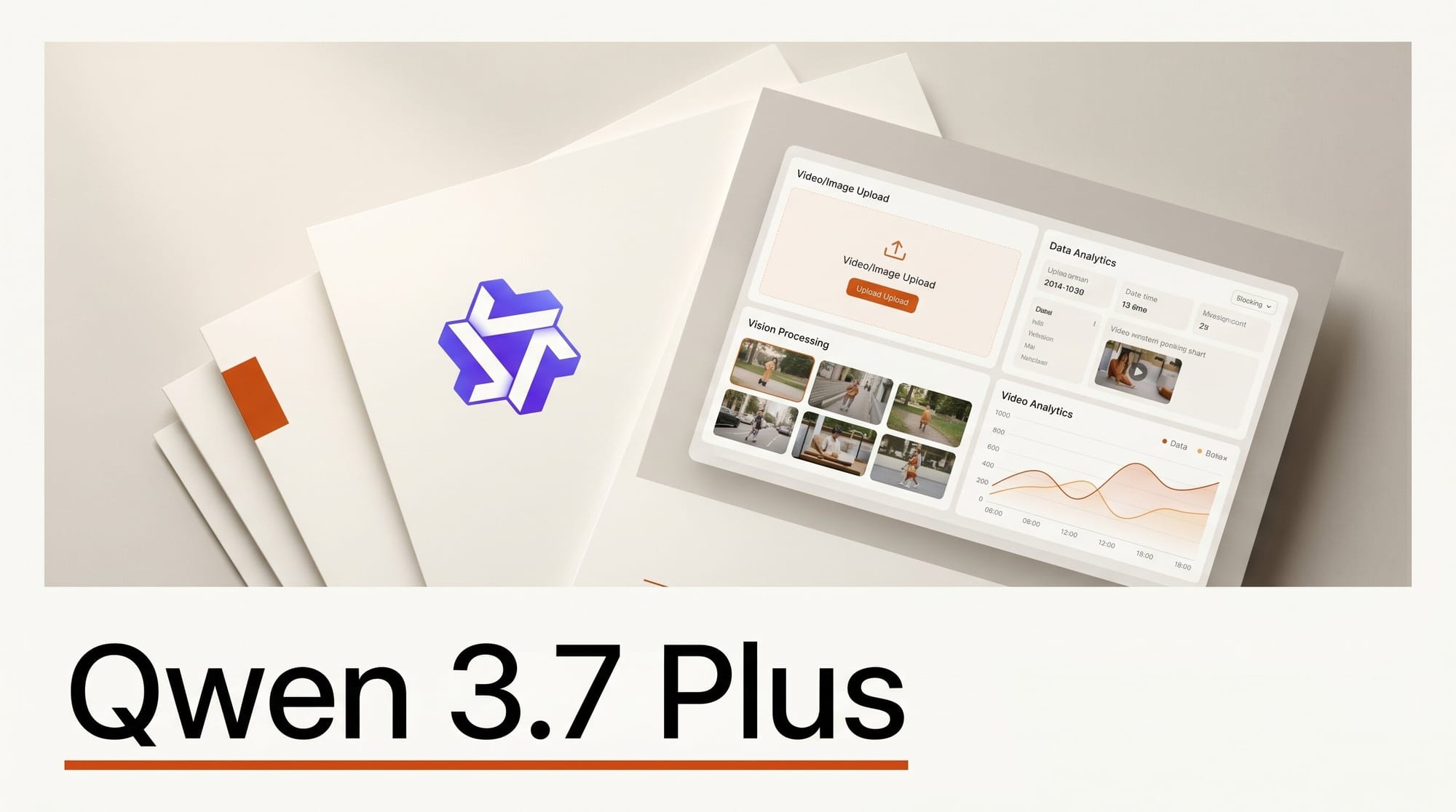
Alibaba's Qwen team launched Qwen3.7-Plus on the Bailian platform on June 2, 2026, the multimodal sibling to last month's Qwen3.7-Max. The model adds native image and video understanding to the Qwen3.7 reasoning stack, with deep reasoning, tool invocation, self-programming, verification, testing, and autonomous iteration available through a single API endpoint.
What Creators Can Try Today
Qwen3.7-Plus is accessible through Alibaba Cloud's Bailian, rebranded internationally as Model Studio. The fastest evaluation path: open the playground, paste a long PDF or a video frame sequence, and ask the model to extract structured data while citing source frames. The same prompt flow used for closed-source vision models like GPT-5.5-V or Claude Opus 4.8 transfers without modification, which makes side-by-side benchmarking on your own evaluation set straightforward.
Why It Matters
The Qwen line has been the de facto open-source frontier for non-US labs across 2026, with the open-weights Qwen3.6 family powering production deployments at every layer from single-GPU local inference to 1T-parameter cluster setups. Qwen3.7-Plus is closed-weights on Bailian today, but the historical pattern is that smaller open-weights variants follow the closed flagship within four to eight weeks. Watch the Qwen organization on Hugging Face for the open-weights releases that traditionally follow each Bailian flagship.
What the Vision and Video Stack Adds
The release extends Qwen into the agent-model category that Qwen Chat users and developers have been asking for: native vision input, video frame understanding, tool calls, and self-verification loops in one model rather than three. For document-heavy workflows, that means one API call replaces a chain of OCR plus extraction plus verification. For video workflows, it means a single model can read a frame sequence, reason about what is happening, and return structured output that drives downstream automation.
Key Details
The model adds vision and video understanding on top of the Qwen3.7-Max reasoning core released in May. Core capabilities listed at launch: image understanding, video understanding, deep reasoning, tool invocation, verification, testing, self-programming, and autonomous iteration. Availability is via the Bailian Model Studio API only at launch, with the same pricing structure as the Qwen3.7-Max tier. International developers access through Alibaba Cloud's English-language Model Studio dashboard. Coverage at MarkTechPost on the Qwen3.7-Max release documents the underlying reasoning stack Plus inherits.
What to Do Next
If your workflow involves long-form document parsing, video frame extraction, or any agentic pipeline that mixes vision and tool calls, run Qwen3.7-Plus against your evaluation suite this week. The cost-per-output-token math is the deciding factor for production: Qwen has consistently priced 30 to 60 percent under the equivalent closed-source US tier, and the same pattern likely holds here.