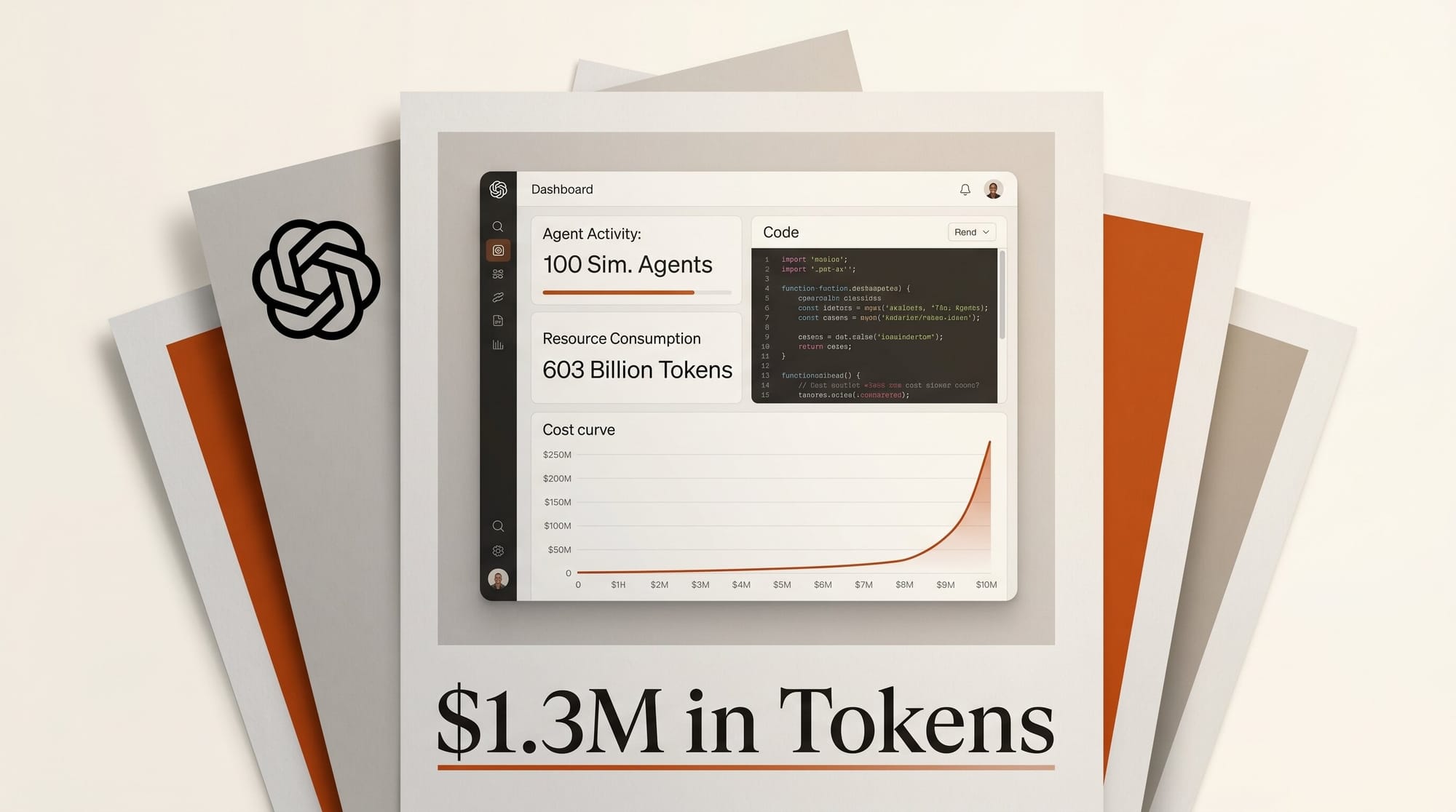
The numbers tell the story plainly: 100 AI coding agents running simultaneously, 603 billion tokens processed, 7.6 million API requests, and $1.3 million in OpenAI API costs in a single month, Tom's Hardware reports. OpenAI covered the bill.
What Happened
OpenClaw is an AI coding agent framework designed to run in parallel, with multiple agent instances working through code tasks simultaneously. According to Tom's Hardware, creator Peter Steinberger and his three-person team scaled it to 100 simultaneous agents, generating 603 billion tokens and 7.6 million API requests over the course of one month.
The $1.3 million in API costs was not charged to Steinberger directly. In February 2026, he announced he was joining OpenAI to focus on bringing agents to a wider audience, with OpenClaw transitioning to independent foundation management. The compute resources were part of that arrangement.
Why It Matters
This is the clearest public data point yet on what large-scale AI agent operation actually costs. For creators building agent pipelines, the math is stark: 100 agents, even running sequentially through daily tasks, can generate token volumes that are invisible in testing but catastrophic at scale.
The $1.3 million figure is not an outlier. It reflects what happens when you multiply even modest per-task token usage across hundreds of parallel executions. The same dynamic is showing up across cloud platforms: AWS and Google Cloud users are reporting unexpected AI bills as usage shifts from experimentation to production scale.
For creators building with leaner alternatives like lightweight open-source coding agents, the contrast is instructive: smaller, focused models with tighter context windows can dramatically reduce per-task token consumption.
Key Details
- Tool: OpenClaw, an AI coding agent framework for parallel multi-agent execution
- Scale: 100 simultaneous agents, 603 billion tokens, 7.6 million requests in one month
- Cost: $1.3 million in OpenAI API usage, covered under Steinberger's OpenAI employment arrangement
- Team: Three people
- Project status: Steinberger announced in February 2026 that OpenClaw would move to a foundation to remain open and independent
What to Do Next
If you are building with AI coding agents, set per-run token budgets before scaling. Most agent frameworks allow you to cap context window size and limit tool call chains per task. Batch API endpoints cost roughly 50% less than synchronous calls for identical workloads. Keep model selection deliberate: smaller models handle well-defined subtasks at a fraction of the cost of frontier models.
Token cost is not a reason to avoid agents. It is a reason to design them with constraints from the start rather than after your first billing cycle.