Mistral AI has launched Mistral OCR 4, the newest version of its document extraction model, claiming a 72% average human-preference win rate over rival OCR providers and processing speeds roughly four times faster per page. The model reads PDFs, Word, PowerPoint, and OpenDocument files, returning structured data instead of a flat wall of text.
What Happened
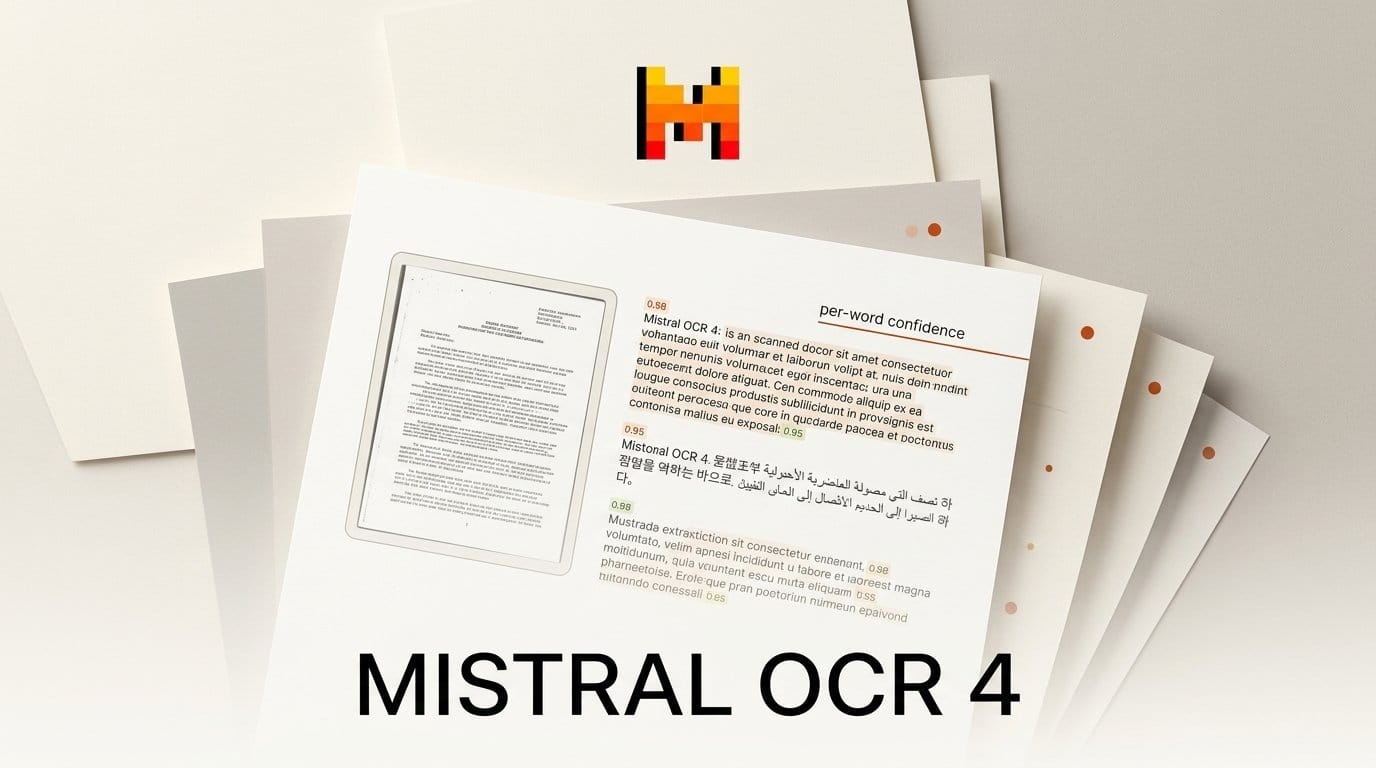
Announced on June 23, 2026, OCR 4 converts documents into typed, structured output. It tags titles, tables, equations, and signatures as distinct block types, attaches bounding-box coordinates to each element, and returns a confidence score for every page and word. It supports 170 languages across 10 language groups and ships as a single self-hosted container for teams that cannot send sensitive documents to an external API.
Why It Matters
Most OCR tools hand back a wall of text and leave you to guess where a table ended or whether a number was read correctly. OCR 4's per-word confidence scores and typed blocks make it practical to build reliable document pipelines, where low-confidence fields get flagged for review instead of silently corrupting your data downstream. It is a clear step up from Mistral OCR 3, which introduced the structured Document AI playground earlier this year, and it targets the exact failure points (handwriting, dense tables, multi-column scans) where older tools fall apart.
Key Details
Mistral reports a top score of 85.20 on OlmOCRBench and 93.07 on OmniDocBench, and says OCR 4 leads all eight language groups in its internal multilingual evaluation. The model plugs into the Mistral Search Toolkit for retrieval-augmented search over parsed documents. Pricing runs $4 per 1,000 pages on the standard API, $2 per 1,000 on the batch API, and $5 per 1,000 through the no-code Document AI product. It is available now through Mistral Studio, Amazon SageMaker, and Microsoft Foundry, with Snowflake Parse Document support listed as coming soon.
What to Do Next
If you process invoices, contracts, research papers, or scanned archives, test OCR 4 against your messiest documents first, the handwriting, dense tables, and multi-column layouts where accuracy usually breaks. Start with the batch API at $2 per 1,000 pages to keep costs down on a large backlog, and wire the per-word confidence scores into a human-review queue so flagged fields get a second look. Full integration details and code samples are in the Mistral documentation.