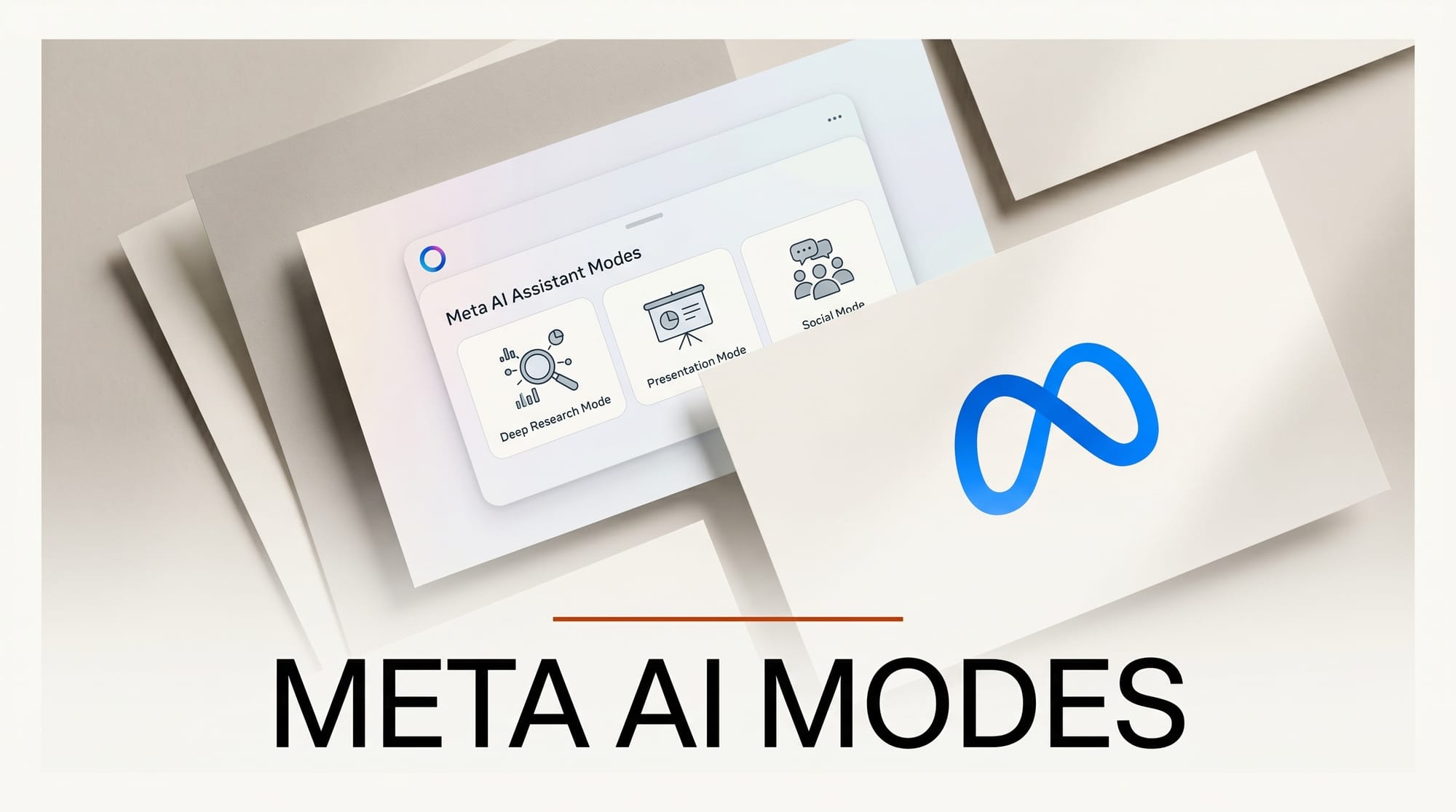
Meta is quietly testing three new operational modes for its AI assistant on the web: Deep Research, Presentation, and Social. The features were spotted in development on June 12, 2026, and they push Meta's assistant beyond chat into the same agentic, artifact-generating territory already staked out by OpenAI, Google, and Anthropic. One of the three, the slide-deck generator, already produces usable output.
What Happened
According to a report from TestingCatalog, Meta AI's web interface is gaining a mode switcher with three additions. Deep Research searches the open web and aggregates multiple sources into structured summaries, separate from the existing parallel-reasoning "Contemplating" mode. Presentation generates slide decks as shareable artifacts you can view inline or open through a link. Social uses background agents to pull posts from Instagram, Threads, and Facebook at once. The modes sit at different stages: Presentation is already operational with solid output, while Deep Research and Social remain in progress during testing.
Why It Matters
Presentation is the mode creators can act on today. It drops Meta into a crowded slide-generation race against Gamma and Claude artifacts, but with one structural advantage: built-in distribution to billions of existing Meta users. The Social mode is more novel. No other major assistant can natively read your Instagram, Threads, and Facebook feeds, which could turn Meta AI into a content-research tool for creators who live on those platforms. It extends the assistant's broader push we covered when Meta AI added voice mode and Threads mentions.
Key Details
Presentation competes directly with Gamma, Manus, and Claude in the artifact space; in testing it produced shareable decks rated "solid." Manus and similar agent platforms made one-prompt artifact generation a headline feature, and Meta is matching it. Deep Research is not yet fully operational and currently returns incomplete results. Social, the least mature of the three, still surfaces unfamiliar profiles instead of a user's real network, which suggests the social-graph integration is not wired up yet. None of the three modes has an official launch date, and Meta has not confirmed them publicly. This is a discovery from observed testing, not an announcement.
What to Do Next
If you have access to Meta AI on the web, open the mode switcher and try Presentation now. Give it a clear topic, a target audience, and a slide count, then export the deck and refine it in your usual tool. Treat Deep Research and Social as previews, not production features, until Meta confirms them. For a fast workflow test, ask Presentation for a five-slide pitch on a project you are shipping this week, then compare its structure and copy against what you would have written yourself. If it saves you the first draft, it earns a spot in your rotation.