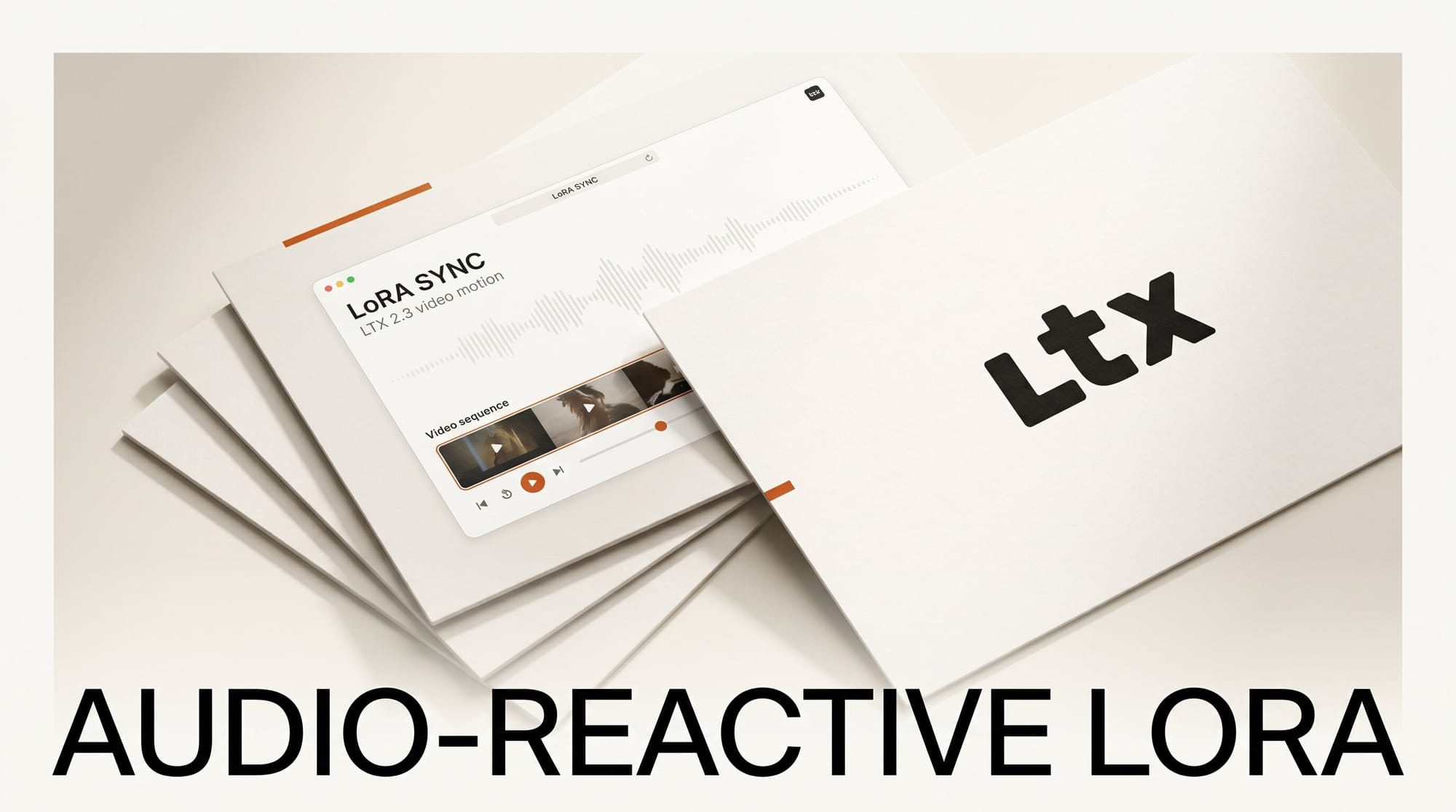
A new open-source Audio-Reactive LoRA for the LTX 2.3 video model lets creators sync on-screen motion to a soundtrack, turning a still image and an audio track into a music-driven clip. Shared by developer 100percentrobot, the adapter is released under the Apache 2.0 license and runs on top of the existing LTX 2.3 pipeline in ComfyUI.
What Happened
100percentrobot published the Audio-Reactive LoRA on Hugging Face as an add-on for Lightricks' LTX-2 model family. Instead of producing generic motion, the LoRA modulates how a generated video moves so that beats, rhythm, and other musical elements drive the visual changes. The creator describes the current build as "early stages and really just a proof of concept," with a Version 2 already planned. It pairs with a ComfyUI workflow that takes one source image and one audio file as inputs and outputs a clip whose movement tracks the music.
Why It Matters
Audio-reactive visuals have traditionally required after-the-fact editing in motion tools or dedicated VJ software. Generating them at inference time means the motion is baked into the diffusion process rather than keyframed by hand, which shortens the path from a finished track to a shareable video for musicians, motion designers, and social creators. It also extends the fast-growing LTX 2.3 ecosystem, which already spans dozens of community LoRAs, encoders, and workflows. It joins a wave of LTX 2.3 tooling we have covered, from the LTX Director timeline editor to Scenema's open-source voice cloning.
Key Details
- Base model: Lightricks LTX 2.3
- License: Apache 2.0, commercial use allowed
- Trigger words: "continuous audio-reactive video" and "audio-reactive"
- LoRA weight: 1.0 to 2.0, with 1.4 or higher recommended for stronger motion
- Clip length: creator recommends 10 to 20 second videos
- Inputs: one source image plus one audio track
The recommended prompt structure breaks a clip into four phases, describing how the scene morphs from one state to the next with each visual transition tied to a specific musical element.
What to Do Next
Install LTX 2.3 in ComfyUI using the official ComfyUI LTX 2.3 tutorial, then load the adapter with the Diffusers call pipe.load_lora_weights("100percentrobot/LTX-2.3-Audio-Reactive-LORA") or drop it into your ComfyUI models folder. Start with a single high-contrast image and a short music loop, set the LoRA weight to 1.4, and write your prompt in four phases so the model has clear transition points to hit. Because this is an early proof of concept, expect to iterate on the weight value and prompt phrasing before you lock in clean, beat-synced motion.